
Been perusing late 17th and early 18th century texts, as one is wont to do, when I came across this pronoun rant.
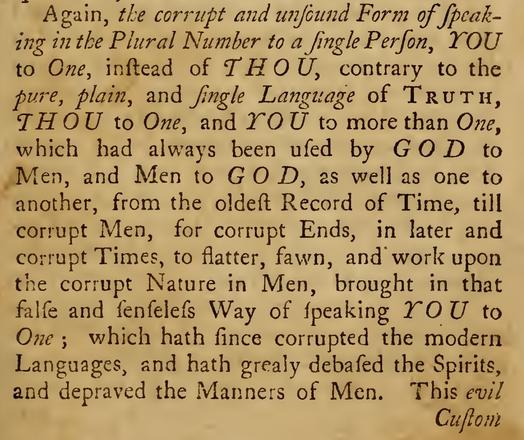
I've seen a similar quote before, but was surprised to actually come across it while reading.

#Quaker #Books

For those who wish to see what happens next, the text is available online:

https://archive.org/details/historyoflifeoft00ellw/page/24/mode/2up

The history of the life of Thomas Ellwood : Or, an account of his birth, education, &c. with divers observations on his life and manners when a youth: and how he came to be convinced of the truth; with his many sufferings and services for the same ; Also, several other remarkable passages and occurrences : Ellwood, Thomas, 1639-1713 : Free Download, Borrow, and Streaming : Internet Archive

448 p. ; 21 cm

Internet Archive

And, yes, early #Quakers were weird.

We're still weird, just in different ways.

@jetton Few people seem to get that, unlike modern pronoun rants, this was a rant *for* equality against the still newish practice of using ‘you’ to flatter social ‘superiors’. If ‘thou’ was good enough for God, it was good enough for me and thee.

Still, a fun rant to look back on.

@evan @jetton “Newish” is stretching it a bit. See https://en.wikipedia.org/wiki/T%E2%80%93V_distinction . You might also come across a quaint northern English phrase for putting people in their social places: “Tha’ll not tha all them that tha’s thee!”
T–V distinction - Wikipedia

@boredtownboy @jetton Yes, it was a load-bearing ‘ish’ for the sake of brevity. A lot of prominent early Quakers, including George Fox came from the North of England and from families in trade. When they started travelling in ministry I’m guessing that they encountered places and sections of society where the more widespread use of ‘you’ sounded novel to them and grated on their ears all the more. And they had the KJV Bible to back them. Just a guess, though.
@evan @boredtownboy @jetton Were they not using the Geneva Bible? I’m more familiar with Puritans than Quakers.
@shannonkay @boredtownboy @jetton Good question and I’m certainly no expert (but interested to hear from those who are). From a quick look, the Quaker Bible index says ‘The Authorized (King James) Version was the most recent; several 16th-century translations – Geneva, Bishops’, and Tyndale – were still current, and Friends quoted all of them.’ https://qbi.earlham.edu/intro.htm
Quaker Bible Index: Introduction

@evan @shannonkay @boredtownboy

I'm also no expert, but of the early Friends' journals I've read, The King James Version was the most commonly quoted.