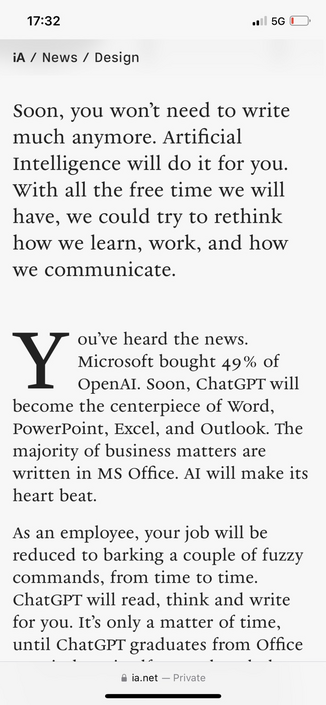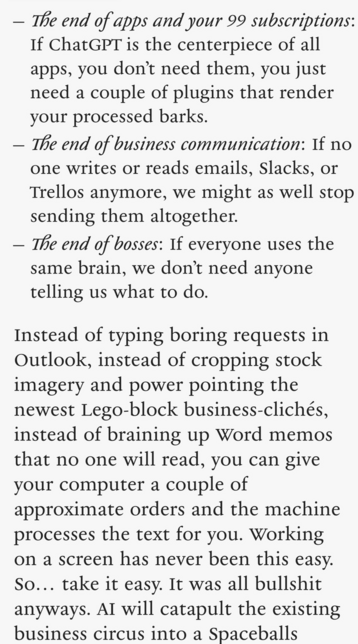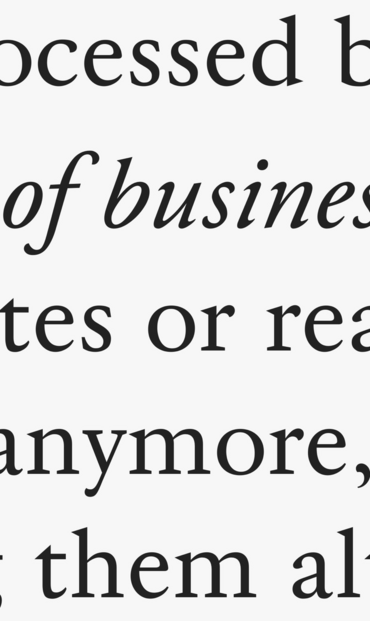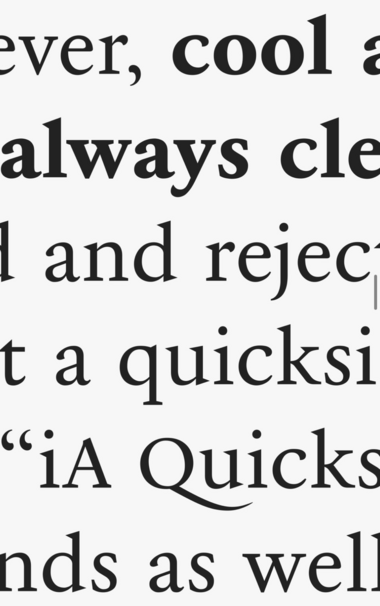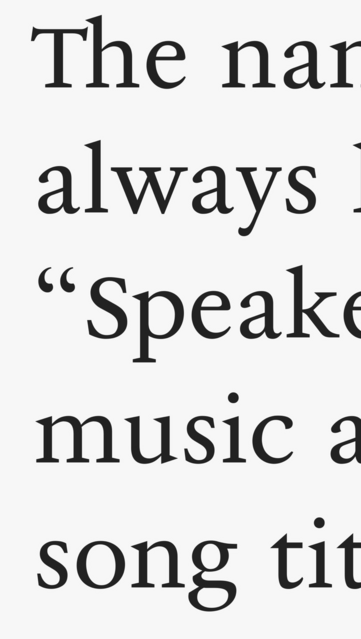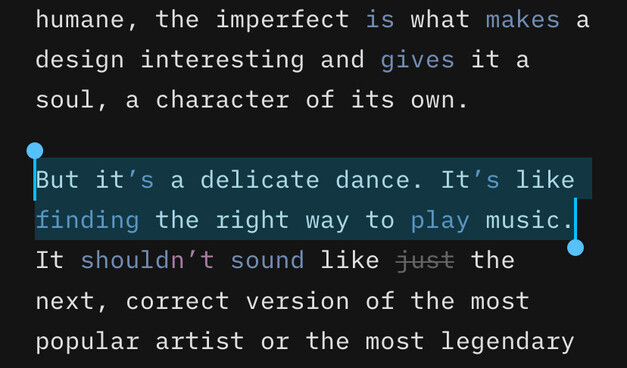
New site is online. New structure, new typeface, new teasers, new videos, new support section, new buy, new everything. Still a little raw on the edges, here and there.
Tell me if you find broken bits and pieces. HTTPS://iA.net
iA - Home

We build fast and beautiful information systems that focus on their core purpose.

iA
I've looked at these for a couple of months now from very very close. Fonts are code and the nature of code is that it's never perfect.
It had to be done, as the Garamond I wanted just didn't exist. Started feeling a bit weird after three months working on variable cap height regular, bold, 2 italics, and bold italics like a madman, so I brought it to a close. Two weeks ago, I read how Jony Ive spent the last 4 years on his Baskerville with a group of type specialists, and I went: "Ha!" https://www.fastcompany.com/90888571/jony-ive-spent-the-last-4-years-perfecting-his-typeface-heres-why-hell-never-be-done
We always deal with interpretations of music, and we always deal with interpretations of typefaces (printed, processed on different screens). Pure form, whether it's a triangle or a Garamond a only exists in our mind. A lot of the early Garamonds were photocopying the shape of the metal, ignoring both the nature of print and the the nature of the screen. That's one reason why early digital typefaces were lacking soul. Studying Garamond's original prints, f.i., is like reading sheet music.
@reichenstein Started writing a note after reading your first post. I couldn’t agree more, obviously… 😁
@reichenstein Early digital versions of “classics” were mostly based on master drawings for photo composition. These drawings were decades earlier usually based on prints of the largest sizes in metal. So they were already copies of copies. Adding insult to injury, early digital fonts were often digitised very hastily too in order to quickly fill the market gap.
@paulvanderlaan I see, I thought they simply transposed the shape in metal which would explain why most of them are so thin. I thought, yeah, "Metal is always thinner than the inked in letter and surrounding white light makes the letter look even thinner than the inked one". But being copies of copies and the hurry in which they were produced explains it even better. Thank you for the explanation!
@reichenstein The large sizes in metal type that were used for the transition to photo composition were usually high in contrast with thin details. That’s the main reason why early digital fonts have become so skinny.
@paulvanderlaan I see. That's exactly what they look like.
@reichenstein @paulvanderlaan And some copied the relatively crude unit-isation from photo/metal as well.
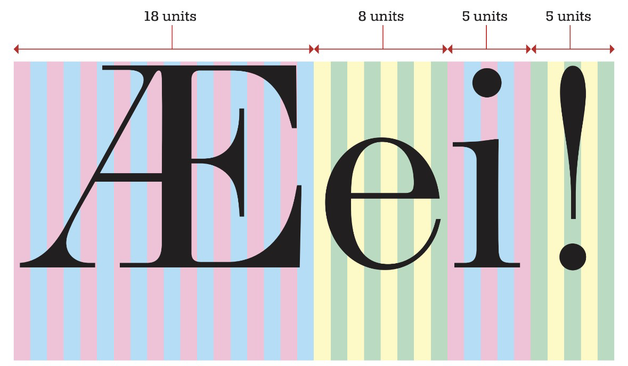
@klim @reichenstein I’ve heard similar stories how the 18 unit system can be found back in some digital Monotype fonts but never found any examples.
@reichenstein @paulvanderlaan @klim Some time ago, @jenskutilek wrote some sort of app that analyzes fonts and reports how many widths they have. If I recall correctly, he could tell which fonts were still based on the 54-units system used by Linotype‘s phototypesetters
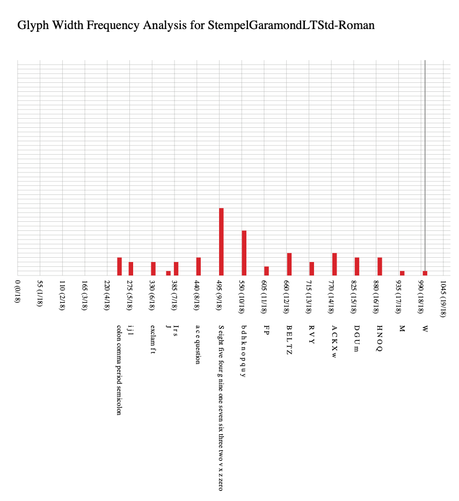
@typeoff @reichenstein @paulvanderlaan @klim That's right. Some are even on the older 18 unit spacing grid. Once a font has been published, the spacing was unlikely to be changed, except for the "Next", "Nova", etc. reworked versions. This is an example of Stempel Garamond LT, where only the J and punctuation seem to have been adjusted. (I wanted to check a newer version of the font, but apparently MyFonts don't even sell Stempel Garamond anymore ...)
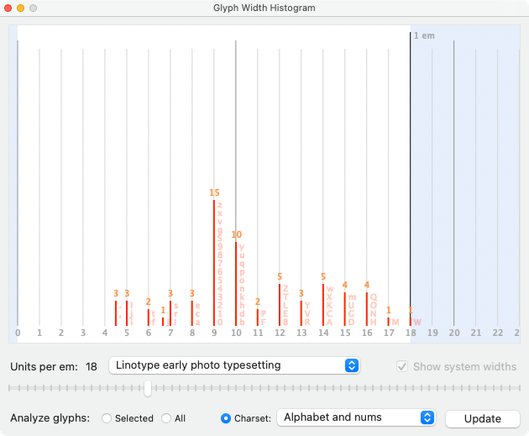
@typeoff @reichenstein @paulvanderlaan @klim Ah, I forgot, later I made an interactive RoboFont window from the script, where you could switch between different unitization systems.
RoboFont/Histogram.py at master · jenskutilek/RoboFont

RoboFont extensions and scripts. Contribute to jenskutilek/RoboFont development by creating an account on GitHub.

GitHub
@klim @reichenstein @paulvanderlaan Also some years ago, @BijouType mentioned which Monotype fonts still have the 18-unit system traceable in their digital versions, but I can’t find the email now 😭
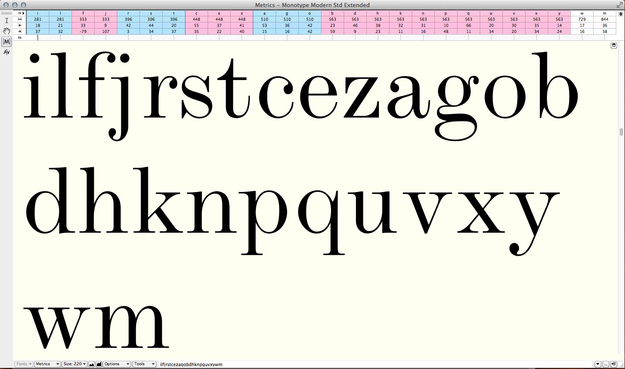
@typeoff @klim @reichenstein @paulvanderlaan Monotype Modern and Monotype Grotesque are basically untouched, in regards to spacing
@typeoff @klim @reichenstein @paulvanderlaan There are probably others, if you poke around the other digitized versions of Monotype families first manufactured before the 1960s — especially the ones that never became too popular as digital families. Paul’s account of how digitizations were done is exactly how Robin Nicholas explained it to me, with one corollary: some of the less popular families had better conversions, because they were a lower priority and were less rushed.
@BijouType @typeoff @klim @paulvanderlaan Amazing to be connected to type professionals like you all. It's not easy to find such precise information about how exactly digital type came to be (Dan: "can't find that email, but..."). It's also a bit scary, obviously. 😌
@reichenstein @paulvanderlaan @typeoff @BijouType @klim If you want really weird holiday Lektüre, I recommend the books by Peter Karow, for instance Digitale Schriften https://en.wikipedia.org/wiki/Peter_Karow 🥳
Peter Karow - Wikipedia

@kupfers @paulvanderlaan @typeoff @BijouType @klim Thank you! I'm all for really weird holiday Lektüren of that kind.
@reichenstein @klim @paulvanderlaan @typeoff @BijouType System Helvetica also still had the phototype unit system spacing (perhaps updated since 2012 or when @nicksherman and I made the NHG site for Font Bureau) https://designmodo.com/wp-content/uploads/2013/01/Neue-Haas-Grotesk.jpg (his illustration but website now offline)
@kupfers @reichenstein @typeoff @BijouType @paulvanderlaan @nicksherman Were Sabon’s Roman/Italic duplexed onto widths?
@klim @kupfers @reichenstein @typeoff @BijouType @paulvanderlaan @nicksherman yes – working across Mono / Lino / cold metal was Sabon’s original design prompt
@klim @kupfers @reichenstein @typeoff @BijouType @paulvanderlaan @nicksherman possibly bold too iirc. One of the great achievements.
@nicksherman @kupfers @kai @paulvanderlaan @typeoff @BijouType @reichenstein There ya go Oliver — that’s probably why Sabon italic is wider than most garalde italics ✌️
@klim @nicksherman @kupfers @kai @paulvanderlaan @typeoff @BijouType That I knew. Aesthetically the text image ("Schriftbild") may be a bit irritating, I nevertheless like how readable the wider spaced Sabon italics are, compared to the traditional—intentionally space saving—designs. Italics are not used to save space anymore, so I guess we can give them more room, now, independent of printing technology requirements. 😊
Neue Haas Grotesk — Features

The digital version of Helvetica that everyone knows and uses today is quite different from the typeface’s pre-digital design from 1957. Originally released as Neue Haas Grotesk, many of the features that made it a Modernist favorite have been lost in translation over the years from one typesetting technology to the next.

@reichenstein @BijouType @paulvanderlaan @typeoff Which is kinda amazing. Comparing digital (bad) to metal (good) Plantin is instructive, they’re like two different typefaces. But that doesn’t seem to have stopped people from using digi Plantin — the name carries weight regardless.
@BijouType @typeoff @klim @reichenstein @paulvanderlaan Indeed Neue Kabel revived by Marc Schütz or Classic Grotesque by Rod McDonald seem way less hasty than for instance Helvetica Now, the 2019 release – worst possible time ever as MT was then withdrawn from NASDAQ
@reichenstein It’s not like reading sheet music Oliver. Sheet music was written with the express purpose of being interpreted.
@kai 🤣 You mean Garamond did not create his fonts primarily to be studied by Webdesigners trying to find out what his idea was so they could adapt them to small screens? And Achilles didn't fight like a lion because lions don't fight to get Helena back, but for survival? It's the nature of an analogy that there are difference between two things that are compared. You can wag your index at the most obvious anology by refocusing on the difference instead of the similarity, Kai.
@reichenstein Looks great. Will it be publicly available like Mono/Duo/Quattro?
@denkfix No, the plan is to have them exclusively in our apps. That was part of the motivation to put so much energy into them and make them from scratch.
@reichenstein That is perfectly understandable. Just curious: How is this going to work with Export to Word – standard-Garamond after export?
@reichenstein some obvious lovely touches – the th ligature, the Q – but the thing that really made me go ‘oh yes, nice!’ Is the bottom of the ‘j’. How it all hangs together is very nice.
@markboulton Thank you. The j wasn't obvious. Took a lot of iterations.
@reichenstein Suggestions to consider (or, of course, ignore): Should the triangular ascender and x-height serifs be blunted to fit the baseline serifs better? Should the italic spacing be a touch tighter? Is that lovely italic Th ligature a candidate for "kill your darlings" treatment?
@celiason these are quite precisely some of the main questions of consistency I fought with, there are alternatives to each question saved in Glyphs, and the answer, so far, is no. The Th needs better spacing and the h in particular needs that daring tilt. The italic a though will see an overdue change very soon.
@celiason Triangular ascender: While it's hardly even recognizeable at reading sizes, it does give the face more character and breaks the monotony of identical serifs. Italic spacing: I don't like the usual claustrophobic italics, love the weird yet very readable Sabon spacing (it had its own technical reasons, but I nevertheless like it better). That lovely italic Th ligature: I noticed the abundance in crazy italic ligatures in the original prints and took the freedom to do more.
@celiason Also, triangular ascender: I only discovered later that it fits like a puzzle piece with the exaggerated ink traps on the iA Sans. The real reason though why it survived is that it always felt better when I brought it back. I know exactly why you said what you said. :-)
@reichenstein Of course, the other side of my "should the triangular serifs be blunter" might be "should the baseline serifs be sharper," but it sounds like you're happier with the difference.
@celiason The idea is baseline blunt but then the drop shaped terminals in a f, j, r, c sharp like the whipped cream terminals in the italics. There are similar designs out there, but then they often make the spur of a and t, and the spurs of c e sharp as well, which I find easily results in an unbalanced shape of these letters. The whipped cream italics are also not perfectly sharp for that reason. The curves just ended up looking wrong. Head serifs could take the sharpness though.
@celiason The goal was to have our own Garamond with the option of smaller than usual capitals. I mainly wanted to use it for our upcoming literary templates in iA Writer and iA Presenter. Had no intention to make it modern or special in any way, I was completely at piece with making it standard and boring, but then it just looked stronger with some tension. All along the process I told myself: "You can still make a more boring head serif axis in the variable font." I might.
@reichenstein “future variable axes” may be the new “stylistic alternates” for us indecisive type designers! :-)
@celiason I have two completely different serifs, one that fits the text with the cool original tilted capitals, one for block quotes and words in all italic caps (the tilted ones look bad there). I ended up not needing any of that. Even the axis for capital sizes on the regular has been completely unused, so far. Why an axis to make things boring? So you can say: "I know it's a bit weird but I liked it like that." I end up doing axis because I was worried to be judged.
@reichenstein I quite like the idea and execution of small-as-possible caps. When next to ascenders (“Th”) they’re a touch jarring maybe. But elsewhere they’re satisfying to me. Importantly, “iA” looks pretty balanced!
@reichenstein these caps remind me a bit of “three-quarter figures” which I always love.
@celiason I wasn't planning on using them in body text. I thought they might be great in figure caption sized text. But then, again, I just liked them more, eventhough the spacing is very hard to do (it's still a bit off here and there).
@reichenstein totally gorgeous. Looking at the other comments, I feel like I don’t bring much help.
@reichenstein any chance of Presenter for Windows?
@alx Depends on the demand after the launch. We are getting a lot of request for a Windows version currently, but we do not make any promises.
@reichenstein I really hope you will! I tried it on Mac and I’m so impressed, but as I work on different platforms I really long for having it available for both!
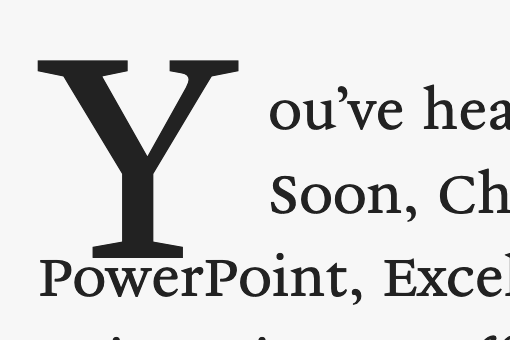
@reichenstein really love the design; the first letter rendering on #Firefox is slightly off though (removing the negative margins solves it a bit; but can see why you'd optimise for Safari (and perhaps Chrome?))
@murb Haven't even looked at Firefox yet. Thanks for the reminder.
@reichenstein typeface for the news articles is great! Looking forward to try it with the writer and presenter and to download to font for other apps in the future
@Tikay Well, in iA Writer and iA Presenter, yes. But, most likely, the fonts won't be available outside our apps. That's part of the reason why we made them.

@reichenstein I discovered that my Mastodon app ( @megalodon ) shits the bed when you use ALLCAPS for the protocol part of the link.

Your website typography has always been amazing. Remember that blog post where you held up a book next to the screen? Good times.

@reichenstein Are you ever going to add *jump-to* outlining as found in Ulysses and Drafts to Apple versions?
@gebloom Outline is on our roadmap, very high on the list, don't ask us for ETAs though.
@reichenstein I don’t know how I stumbled upon your work but the article’s well written and the font is thought out. I guess I’m following this project now