Some of you may have seen Elon Musk's endorsement of Robert F. Kennedy Jr.'s crazy antivax conspiracy theories today.

Over at post.news, I just posted a long-form piece about this, and about how science education needs to adapt to online disinformation.

Please a look. If you like it, boost it there or here or — if you dare — over on the birdsite.

https://post.news/article/2J7VEapSIpNWsrC0EawD8CopYqo

Science education in an age of twitter disinformation / Post.

Alternatively, if you prefer to read it here, I'm posting here as well by request. I have mixed feelings about cross-posting like this, but people have asked — and I sure understand the rationale for not wanting to use post.news. I've written about it myself.

So, anyway, here you go.

Science education in an age of twitter disinformation

tl;dr — Science education needs to adapt to a world of misinformation on social media and beyond. Today, prominent antivaxxer Robert F. Kennedy Jr. tweeted the ridiculous claim that as director of the NIAID, Dr. Fauci bought the silence of the entire worldwide virology community by handing out research grants. Elon Musk then affirmed and amplified his claim.

With even a rudimentary understanding of how science works as a social institution, it is obvious that Kennedy is lying yet again. But in the classroom, we don't teach how science works as a social institution. It's time to fix that.

---

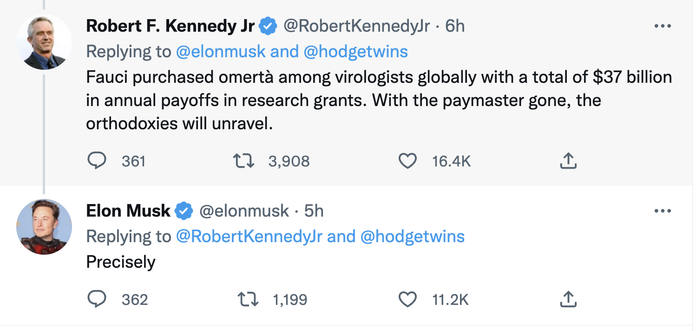
Today, Robert F. Kennedy Jr., one of the longest-standing and highest-profile activists in the antivax movement, tweeted a blatant lie. Nothing newsworthy there. The newsworthy part is that Twitter owner and CEO Elon Musk—yes, the supposed scientific visionary—affirmed and amplified Kennedy's message. The two men's posts are below.
Here, Kennedy is claiming that Fauci used grant funding to obtain worldwide omertà — silence purchased by the Mafia — with regard to vaccine harms. Set aside the immediate errors about Fauci's position and available budget (1). The notion that the head of a granting agency — even a large granting agency — could somehow purchase worldwide silence is absurd.
First of all, as NIAID director, Fauci has little if any involvement in individual funding decisions. Second, while NIAID does fund some work conducted internationally, scientists overseas are far from reliant on NIAID/NIH funding. (Even virologists in the US are not entirely reliant on NIAID/NIH funding.)
Third, the story that Kennedy is trying to spin ignores the huge incentives —both in terms of prestige and financial reward (2) — that researchers have to demonstrate that conventional wisdom is incorrect. Fourth, even in the absence of career and monetary incentives, the story supposes that not a single person out of tens of thousands would choose to follow conscience over profit.
Kennedy's story is a common conspiracist trope, in which some higher authority orchestrates a massive worldwide coverup of publicly beneficial information. With an understanding of the scale of the scientific endeavor, such tales become laughable. Think about what it takes to buy silence. If everyone in the community knows what is happening or can find out, everyone in the community has to be getting paid off, or hoping that they will be soon.
For Kennedy's story to be even plausible, the NIAID would have to be paying off literally tens if not hundreds of thousands of people — and paying them so much that not a one of them would choose to break ranks and provide the world with credible evidence of the vaccine harms that Kennedy proclaims are omnipresent.
Moreover the conspirators would have to somehow ensure that none of these tens of thousands breath a word of the conspiracy itself—this in a world where everything gets leaked even from tight closed circles: the Supreme Court, the White House, corporate boardrooms.

One could go on and on in this vein, unpacking the reasons why Kennedy's story — and Musk's affirmation — are ridiculous. That's not my aim here, however. What I want to do with this post is look at why people aren't able immediately to see through this brazen dishonesty.

---

So why not? Why does anyone believe this nonsense? There are any number of domain-general factors involved that contribute to the spread of any sort of disinformation. People fall prey to conformation bias. People consume social media for entertainment, and share social media posts as signifiers of group membership rather than because they believe they are true. The rise of tribal epistemology leads readers to set aside critical thinking in deference to the in-group nature of the source.
In addition to all of these, I think that there reasons specific to science why people struggle to see through lies like these. I believe that misinformation and disinformation about science spreads because our current system of science education is inadequate. Last year I joined a Moore Foundation working group charged with identifying the ways in which science education needs to change to adapt to our current misinformation environment.
My initial views came down strongly in favor of teaching more data reasoning, more critical thinking, and more media literacy. Indeed, all of things are necessary. But they're not sufficient to combat disinformation about science. Over a series of meetings with the working group, I came to view that I lay out below.
To dispell disinformation about science, we need to teach people why science is trustworthy. Right now, I think we're failing to do that in the K-12 classroom and even at the college level. We teach the settled facts of science: how does photosynthesis work, what is special relativity, what explains the often exquisite fit of organisms to their environments.
We teach how to execute the technical procedures used in science and technology: how do you sequence a genome, design a regression, or implement a random forest algorithm. We even teach some aspects of a so-called "scientific method"—making observations, forming hypotheses, designing experiments, testing against data, refining hypotheses, and back around again (3).
What we don't teach is how science functions as a social institution that allows tens or hundreds of thousands of individuals to work together collectively to undercover the workings of the physical universe. Everything we teach about the process of science involves that which one can do alone at night in an empty laboratory.
But the reason that we should trust science over other forms of knowledge is not because someone follows a particular set of steps in the laboratory. It's because the social institutions of science have proven highly effective at developing (at a bare minimum) empirically adequate theories to the explain the world.
To understand how they do this, people need to understand how science is structured. Who does it? Where, and paid by whom? What motivates them? What are their incentives and reward structures? What makes someone credible as a scientist? What constitutes expertise, and how is it acquired and demonstrated? What is the role of peer review in science? How does the scientific community deal with uncertainty and disagreement? What is scientific consensus? How is it formed? How can it be overturned?
While a few programs provide welcome exceptions, in general we don't teach any of this in the classroom.
A big part of the problem is the aim of science education in the US. We are still operating in a post-Sputnik model, where the aim of science education is to create a cadre of insiders who can form the next scientific workforce upon which our economic, technological, and military strength relies.
In a world of scientific misinformation that can lead to nationwide vaccine refusal, climate change denial, and any number of other problems, we need to do more than train a subset of the population for scientific careers. We need everyone in the country to be fluent in the sphere of science.
We need, in the words of Noah Feinstein, to make sure that everyone is at least a competent outsider to science: someone who has "learned to recognize the moments when science has some bearing on their needs and interests and to interact with sources of scientific expertise in ways that help them achieve their own goals." https://onlinelibrary.wiley.com/doi/10.1002/sce.20414
My argument, at its core, is that to do that, we need to teach people why science deserves their trust – and this requires teaching how science works as a social institution. I've written about this in brief in a Science American article: https://www.scientificamerican.com/article/to-fight-misinformation-we-need-to-teach-that-science-is-dynamic/
To Fight Misinformation, We Need to Teach That Science Is Dynamic

Science is a social process, and teaching students how researchers work in tandem to develop facts will make them less likely to be duped by falsehoods

Scientific American

As a working group, we also published a long-form report on the matter:

https://sciedandmisinfo.stanford.edu/

Science Education in an Age of Misinformation

Science Education in an Age of Misinformation
It's infuriating and exhausting to see lies from Robert F. Kennedy Jr. and like get traction on social media. It's outright discouraging to see them amplified by the world's second richest man who ought to know better. If we want make progress against disinformation like this, however, we need to do more than refute it at the source.
We need to teach people enough about how science works that they can see through these conspiracy stories at a glance. That is going to require major changes in how we teach at all levels. Otherwise, our friends, family, and neighbors are easy prey for those who seek to distort and deny science in pursuit of their own selfish agendas.

Endnotes:

(1) Fauci is the director of the NIAID, a division of the NIH, and thus oversees a budget roughly a sixth of what Kennedy claims.

(2) Recall that arch-antivaxxer Andrew Wakefield himself aimed to profit from demonstrating vaccine harm. When he published the notorious 1998 Lancet paper claiming vaccine harm from the MMR vaccine, he was not only consulting for a law firm suing vaccine manufacturers; he had recently filed a patent on an alternative "safer" vaccine.
(3) I personally think that the so-called scientific method that we teach in the high school and college classroom is a poor caricature of what scientists actually do. I've described it as an impoverished folk-Popperianism, but that's an aside for another time.

Postscript: With respect to Robert F. Kennedy Jr.'s conspiracy theory, @gorskon very recently posted a nice article on how NIH grants are actually selected for funding.

https://sciencebasedmedicine.org/improving-how-the-nih-decides-which-grants-to-fund-reality-vs-conspiracy/

Improving how the NIH decides which grants to fund: Reality vs. conspiracy

Last week, the NIH announced a plan to decrease the problem of reputational bias in grant funding. I couldn't help but contrast how hard the NIH tries to use the most rigorous scientific criteria to d

Science-Based Medicine
@ct_bergstrom I saw that bit on Twitter and sort of started writing a followup addressing this nonsense.
@ct_bergstrom
I cannot thank you enough for sharing your work here.
All very valid.
Maybe because I did, in fact, learn in depth about the scientific method, I have a great deal of difficulty understanding how people fall so easily for mis or dis information.
Yes.
Our first steps need to be teaching the sciences.
@ct_bergstrom More folks should read Latour and Pickering on the “doing” of science. (“Folk-Popperianism” is a great description, BTW.)
@craigm @ct_bergstrom "How We Teach Science" by John Rudolph, was a good read for this layperson. Largely covers the history ("The Scientific Method" was neither developed nor promulgated by scientists, development of national standards, etc).
@ct_bergstrom many of us have adopted the Next Generation of Science Standards. We definitely do our best to teach what scientists DO, and not some formulaic “method” of doing science. Lots of data analysis and modeling and argumentation. It’s isn’t always easy, but there is an underpaid army of us doing our best to push science literate voters out of our classrooms!
@empty_teacher Yes, NGSS are definitely better than the Vision and Change document that effectively sets standards for college life sciences teaching. Very glad to hear that you and others are focusing on this in the classroom.
@ct_bergstrom We’ve always been told NGSS were college instructor driven/developed… I wonder why they don’t include an undergraduate band of standards?
@ct_bergstrom I have a lot of anti-vaccine people in my family, and it can feel difficult to impossible to cut through the noise. I eventually found out a family member had never learned how a clinical trial was conducted and why, and it seemed to sway him a bit. I can only speak for myself, but I think it can get hard to remember what a layperson does and does not know.
@ct_bergstrom i’m not sure this will solve all the problems you want to, but I am all for teaching how science operates as a social institution. But - we can’t do this by replacing folk-Popperianism with folk-Mertonism. We must expose and inquire into more of the political economy of science, including relations with industry, publication costs, fraudulent, research, and so on. Otherwise, the picture wouldn’t be believable nor enough to explain why scientific knowledge should be trusted.
@ehud @ct_bergstrom one could make the case that we've done is all a disservice in oversimplifying Popper's work.
@ct_bergstrom I don't think my peers (age late 40s/early 50s) were never really taught that science is mutable as we learn more. And anti-science groups are weaponizing that

@olavf though middleaged people are central to the antivaxx movement, bit wishful to think that cohort had a specifically impoverished science education

if you read this study of science communications in HS texts published 1966-2005, all but one (from 1968!) are said to perpetuate the singular 'scientific method' myth

https://onlinelibrary.wiley.com/doi/epdf/10.1002/tea.20226

@undafiend it's not that the textbooks are outdated, it's that teachers often teach to the book, not teach that science is constantly in flux. Without learning that concept it's rather easy to "science is a lie" every time our understanding of things change.

C-19 deniers are a perfect example if this.

@olavf textbook quality obviously has a direct effect on education, and if you teach to a good book (like Toon 68) the outcome is better, all else equal

either way, to claim Gen Xers had notable gaps in their science ed vs. younger (and presumably older) cohorts, there needs to be some evidence of that - otherwise, it's just interpolating from current political behavior, which isn't very good science imo!

@olavf (although should follow my own guidelines and say 'textbook quality may have a direct effect' if I'm not citing anything)
@olavf @ct_bergstrom oddly This is my experience of everybody else. When I point out that many young people, under 40, talk about philosophy of science, they only seem to recognize realism, and don't recognize constructivism, as a simplified contrast. I just wonder where the heck they didn't get taught philosophy of science.
@olavf @ct_bergstrom THIS is something I realized big time during the pandemic and had to re-explain to my dad every week: it's a n o v e l virus, meaning it's brand new, no one knows anything about it, and because it's so new they are learning about the virus on the go, meaning their advice will probably change over time. It was baffling to me that he (1) didn't understand that and (2) would regularly forget what I told him and go back to being angry and doubtful of the CDC

@ct_bergstrom love the terminology impoverished folk popperianism because that's precisely what it is.

the problem is, this is not only taught in highschool, you can easily get an Msc without going beyond this understanding of science.

That leads to epistemic trespassing, further confusing onlookers as to who is really an expert. And generally to scientists who are unable to convince the public of the merit of their work.

@ct_bergstrom Also Popper's works themselves, while very useful in empirical epistemology, induction, ... are by far not the best description or even an ideal of science as a societal endeavor.

People should teach more Lakatos, Kuhn, and many more other thinkers and most of all a history of science that is more than a list of results.

@ct_bergstrom Agree with the main points, but you’re making it sound like schools aren’t teaching anything close to what science is. The scientific method is still what scientists use to prove and peer-validate everything: statistics, math and basic principles still guide the scientific community. It’s not just about the opinion of the majority of respected groups. Their opinions are based on this basic science way of thinking that’s taught on schools and universities.

@gabotuit @ct_bergstrom I think what I'm hearing from the thread is that just because you've been taught and even practice it, they critical thinking parts of the scientific method it's still a relatively concrete "tech" application of a much deeper, abstract philosophy of knowledge.

I think about the differences between car mechanics of old who were taught to hypothesize about how a car should work vs the technicians today who basically just let the computer diagnose the problem.

@ct_bergstrom I think it would be wrong to describe what you call folk-popperianism as a poor caricature of what scientists actual do. Testing hypotheses is a key part of the scientific process. But it's only a part of the process, and i think we over emphasise it to the point of exclusion of everything else. A good scientific story probably still has a hypothesis, and a test of that hypothesis in it somewhere though.
@ct_bergstrom Thanks for your thoughts on this matter I wonder about from time to time. Methinks, an impoverished folk-Adornianism could be quite an antidote. Maybe the German Positivismusstreit would be a good textcorpus to read and discuss at school, or college, more often.
It demonstrates one important aspect you neglected a bit: antagonism, not cooperation, between researchers as a ressource in their quest for truth.
@ct_bergstrom There is a devastating human side to the false claims about the MMR vaccine. It seems to me that people often make the mistake of conflating causality with the coincident timing of two events. Falsities lead people to wrongly zero in on the vaccine as the cause of health issues without realizing that a few dozen other items in their life would count as a first time exposure in the immediately preceding time period. Causality seems to be a misunderstood concept.
@ct_bergstrom "The doctor who fooled the world" detailing the story by Brian Deere is an excellent read

@ct_bergstrom
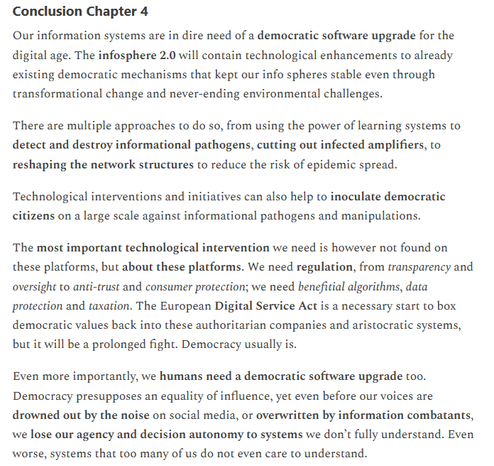
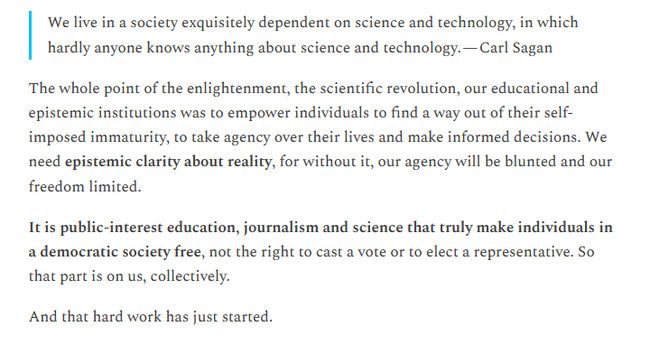
While education might certainly help in the long term, the #dynamics and mechanisms behind our current #epistemic crisis go far beyond #misunderstanding of science and education.

If we do not address the #technological, #political, #social and #economic factors driving the current attack on #science, we will usher in a darker world we thought we had left behind.

In my opinion, education is too #slow to make a dent at this point.

🔽 https://protagonistfuture.substack.com/p/asymmetric-power-in-the-information-6fb

Asymmetric power in the information age - IV

Chapter 4: Science as a candle in the dark

The Protagonist Future?

@ct_bergstrom

There's a section about the value of pre-bunking as opposed to debunking in this article about about the “Illusory Truth Effect” and why it is so important NOT to repeat lies on social media (or elsewhere), even with the intention of debunking them.
https://www.washingtonpost.com/wellness/2022/11/03/misinformation-brain-beliefs/

There's a thread with excerpts of the article here: https://newsie.social/@ZhiZhu/109530716627287778

#Propaganda #Disinformation #Misinformation #Lies #Journalism

Why do our brains believe lies?

Many of the decisions we make depend on accurate information, but our psychological biases and predispositions make us vulnerable to the spread of falsehoods.

The Washington Post
@ct_bergstrom this is a brilliant thread and I agree completely with your points. But I also think the depressing truth is that people also believe misinformation because they want to - because it's more fun and sexy than the truth. It makes for more interesting stories. And that sucks. But would people rather read the history of a building if I made up a great ghost story? You bet. Some people do this. Some people want it. Depressing af

@ct_bergstrom Yes! This is why I wrote Raising Heretics, and why I founded and run adsei.org - because we need to shift the teaching of science from facts and known processes (really an education in confirmation bias) to critical thinking and rational scepticism.

we should be teaching using problems that don’t have obvious or known solutions, and teaching kids to challenge their own results, as well as those of others.

https://adsei.org/2021/08/10/why-does-education-need-fixing/?amp=1

Why does Education need fixing?

What do Climate Change, Covid, and STEM education have in common? How can we tackle inequality, and stop social media manipulating us?

Australian Data Science Education Institute
@ct_bergstrom It's not just about education. If you appeal to people's base fears, no amount of education can change their minds. Self awareness on own triggers is the best defence, but very difficult to teach.
@ct_bergstrom I think you underestimate the *moral* suspicions that segments of the population harbor against scientific institutions. There is a history of scientific abuse and malpractice (eg Tuskegee Syphilis Study), so it's naive to expect that scientists will always be good-doers. Of course this gets weaponized for political purposes in turn, but it's a real issue. Trust has an epistemic AND a moral component. I've written on this recently 👇 https://www.bostonreview.net/articles/the-inflated-promise-of-science-education/
The Inflated Promise of Science Education - Boston Review

Building public trust requires far more than the conveyance of facts and instruction in scientific thinking.

Boston Review
@cdutilhnovaes @ct_bergstrom the relationship between science and medicine is very interesting to me. i wonder if i'd call those involved in that study scientists. i'd have to look.

@ct_bergstrom

This should also be the role of "news" reporting, as well.

But most of the time reporting of science becomes a "two sides to every issue" discussion as interests of advertisers, sponsors, investors and religious pressure groups take control of the "news media narrative".

@ct_bergstrom I'm convinced that some of these people are willful. You see doctors falling prey to it every day on TV. They aren't uneducated fools; they are either corrupt or not resilient psychologically.

@ct_bergstrom First, thank you for fighting the good fight on this.

The worlds richest man is a notorious charlatan and if he isn't a bad-faith actor than I am the second coming of Jesus.

I can't help but think that a big part of helping people develop intellectual self-defences is accounting for the fact that there are bad-faith actors who deceive with bad-faith arguments purely for their own perverse pleasure.

I think that our sense of discouragement is the air that these people breathe.

@ct_bergstrom Science comes from humanity, so as such it can be distorted and used by humans to serve nefarious objectives. Science as such is not an untouchable God, since linked to humans and money.
@ct_bergstrom
Science should be trustworthy.
It is not. It is highly political and warped by special interests. Covid has made this more obvious than it has ever been before--people that are willing to get it wrong on purpose have prospered whereas those that stayed true have found themselves out of work and silenced on social media. If you want to rebuild the general public's trust in science, you're going to have to get the liars off television and out of their gvt posts.
@dancingdogs
@noyes @ct_bergstrom @dancingdogs …. or just educate people on basic scientific principles, the truth is out there to be seen by a curious mind, just need the right tools

@ct_bergstrom Excellent!

I wrote a related article which you might find of interest.

https://medium.com/@mtobis/who-decides-what-is-true-b6d9057489cd

Who Decides What Is True? - mtobis - Medium

There’s no Supreme Court of Truth, no supreme authority that affixes an imprimatur of “scientific fact”. Yet we believe many things to be true which we could not have known about without science…

Medium

@mtobis @ct_bergstrom funny, we should acknowledge more that science is a 'discipline', a bit like in the medieval monasteries, of various kinds, under various lords, but altogether with a certain systemic robustness.

Science has some properties of the decentralised fediverse that make it antifragile. Funding from business has had corrupting influences, but never completely so.

Eight rules to combat medical misinformation - Nature Medicine

Authors of biomedical research should provide clear and accurate information to society, whilst working to combat misinformation and disinformation.

Nature
@PhysioKTBroker Not sure what you're asking. I wrote that Nature Medicine piece so presumably I agree with much of it.
@ct_bergstrom And this is exactly why I get up and go to work every day!
@ct_bergstrom
This is a very helpful concept, that everyone is at least a competent outsider. I‘ll invest some thinking how libraries and other scientific information infrastructures can support this process. The responsibility to facilitate this sort of skill-building shouldn‘t just be thrown at schools.

@ct_bergstrom

#whoLetTheDadsOut
Are you suggesting that science isn't flat?

@ct_bergstrom
So true. Here in France the problem starts in highschool (lycée): all the compulsory ‘core’ subjects are in the humanities: French, Philosophy, History… save for one called ‘Scientific Learning’ that provides an overview of ALL scientific disciplines (at the bargain price of 2h per week! -compare this to the 4h/w French, 4h/w Philosophy, and 3h/w History).
Physics, Maths or Biology are optionals, and obviously only chosen by kids with a science career in mind.