Some of you may have seen Elon Musk's endorsement of Robert F. Kennedy Jr.'s crazy antivax conspiracy theories today.
Over at post.news, I just posted a long-form piece about this, and about how science education needs to adapt to online disinformation.
Please a look. If you like it, boost it there or here or — if you dare — over on the birdsite.
https://post.news/article/2J7VEapSIpNWsrC0EawD8CopYqo

Science education in an age of twitter disinformation / Post.
Alternatively, if you prefer to read it here, I'm posting here as well by request. I have mixed feelings about cross-posting like this, but people have asked — and I sure understand the rationale for not wanting to use post.news. I've written about it myself.
So, anyway, here you go.
Science education in an age of twitter disinformation
tl;dr — Science education needs to adapt to a world of misinformation on social media and beyond. Today, prominent antivaxxer Robert F. Kennedy Jr. tweeted the ridiculous claim that as director of the NIAID, Dr. Fauci bought the silence of the entire worldwide virology community by handing out research grants. Elon Musk then affirmed and amplified his claim.
With even a rudimentary understanding of how science works as a social institution, it is obvious that Kennedy is lying yet again. But in the classroom, we don't teach how science works as a social institution. It's time to fix that.
---
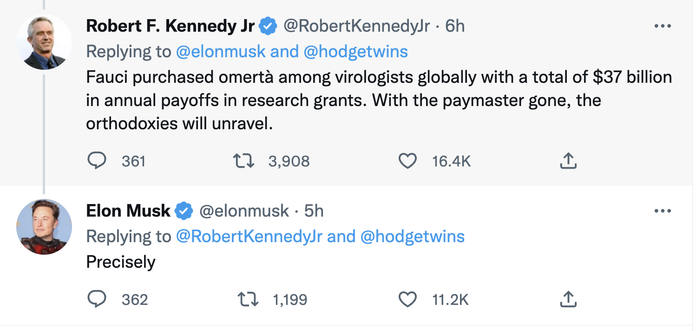
Today, Robert F. Kennedy Jr., one of the longest-standing and highest-profile activists in the antivax movement, tweeted a blatant lie. Nothing newsworthy there. The newsworthy part is that Twitter owner and CEO Elon Musk—yes, the supposed scientific visionary—affirmed and amplified Kennedy's message. The two men's posts are below.
Here, Kennedy is claiming that Fauci used grant funding to obtain worldwide omertà — silence purchased by the Mafia — with regard to vaccine harms. Set aside the immediate errors about Fauci's position and available budget (1). The notion that the head of a granting agency — even a large granting agency — could somehow purchase worldwide silence is absurd.
First of all, as NIAID director, Fauci has little if any involvement in individual funding decisions. Second, while NIAID does fund some work conducted internationally, scientists overseas are far from reliant on NIAID/NIH funding. (Even virologists in the US are not entirely reliant on NIAID/NIH funding.)
Third, the story that Kennedy is trying to spin ignores the huge incentives —both in terms of prestige and financial reward (2) — that researchers have to demonstrate that conventional wisdom is incorrect. Fourth, even in the absence of career and monetary incentives, the story supposes that not a single person out of tens of thousands would choose to follow conscience over profit.
Kennedy's story is a common conspiracist trope, in which some higher authority orchestrates a massive worldwide coverup of publicly beneficial information. With an understanding of the scale of the scientific endeavor, such tales become laughable. Think about what it takes to buy silence. If everyone in the community knows what is happening or can find out, everyone in the community has to be getting paid off, or hoping that they will be soon.
For Kennedy's story to be even plausible, the NIAID would have to be paying off literally tens if not hundreds of thousands of people — and paying them so much that not a one of them would choose to break ranks and provide the world with credible evidence of the vaccine harms that Kennedy proclaims are omnipresent.
Moreover the conspirators would have to somehow ensure that none of these tens of thousands breath a word of the conspiracy itself—this in a world where everything gets leaked even from tight closed circles: the Supreme Court, the White House, corporate boardrooms.
One could go on and on in this vein, unpacking the reasons why Kennedy's story — and Musk's affirmation — are ridiculous. That's not my aim here, however. What I want to do with this post is look at why people aren't able immediately to see through this brazen dishonesty.
---
So why not? Why does anyone believe this nonsense? There are any number of domain-general factors involved that contribute to the spread of any sort of disinformation. People fall prey to conformation bias. People consume social media for entertainment, and share social media posts as signifiers of group membership rather than because they believe they are true. The rise of tribal epistemology leads readers to set aside critical thinking in deference to the in-group nature of the source.
In addition to all of these, I think that there reasons specific to science why people struggle to see through lies like these. I believe that misinformation and disinformation about science spreads because our current system of science education is inadequate. Last year I joined a Moore Foundation working group charged with identifying the ways in which science education needs to change to adapt to our current misinformation environment.
My initial views came down strongly in favor of teaching more data reasoning, more critical thinking, and more media literacy. Indeed, all of things are necessary. But they're not sufficient to combat disinformation about science. Over a series of meetings with the working group, I came to view that I lay out below.
To dispell disinformation about science, we need to teach people why science is trustworthy. Right now, I think we're failing to do that in the K-12 classroom and even at the college level. We teach the settled facts of science: how does photosynthesis work, what is special relativity, what explains the often exquisite fit of organisms to their environments.
We teach how to execute the technical procedures used in science and technology: how do you sequence a genome, design a regression, or implement a random forest algorithm. We even teach some aspects of a so-called "scientific method"—making observations, forming hypotheses, designing experiments, testing against data, refining hypotheses, and back around again (3).
What we don't teach is how science functions as a social institution that allows tens or hundreds of thousands of individuals to work together collectively to undercover the workings of the physical universe. Everything we teach about the process of science involves that which one can do alone at night in an empty laboratory.
But the reason that we should trust science over other forms of knowledge is not because someone follows a particular set of steps in the laboratory. It's because the social institutions of science have proven highly effective at developing (at a bare minimum) empirically adequate theories to the explain the world.
To understand how they do this, people need to understand how science is structured. Who does it? Where, and paid by whom? What motivates them? What are their incentives and reward structures? What makes someone credible as a scientist? What constitutes expertise, and how is it acquired and demonstrated? What is the role of peer review in science? How does the scientific community deal with uncertainty and disagreement? What is scientific consensus? How is it formed? How can it be overturned?
While a few programs provide welcome exceptions, in general we don't teach any of this in the classroom.
A big part of the problem is the aim of science education in the US. We are still operating in a post-Sputnik model, where the aim of science education is to create a cadre of insiders who can form the next scientific workforce upon which our economic, technological, and military strength relies.
In a world of scientific misinformation that can lead to nationwide vaccine refusal, climate change denial, and any number of other problems, we need to do more than train a subset of the population for scientific careers. We need everyone in the country to be fluent in the sphere of science.
We need, in the words of Noah Feinstein, to make sure that everyone is at least a competent outsider to science: someone who has "learned to recognize the moments when science has some bearing on their needs and interests and to interact with sources of scientific expertise in ways that help them achieve their own goals."
https://onlinelibrary.wiley.com/doi/10.1002/sce.20414My argument, at its core, is that to do that, we need to teach people why science deserves their trust – and this requires teaching how science works as a social institution. I've written about this in brief in a Science American article:
https://www.scientificamerican.com/article/to-fight-misinformation-we-need-to-teach-that-science-is-dynamic/
To Fight Misinformation, We Need to Teach That Science Is Dynamic
Science is a social process, and teaching students how researchers work in tandem to develop facts will make them less likely to be duped by falsehoods
As a working group, we also published a long-form report on the matter:
https://sciedandmisinfo.stanford.edu/

Science Education in an Age of Misinformation
It's infuriating and exhausting to see lies from Robert F. Kennedy Jr. and like get traction on social media. It's outright discouraging to see them amplified by the world's second richest man who ought to know better. If we want make progress against disinformation like this, however, we need to do more than refute it at the source.
 Carl T. Bergstrom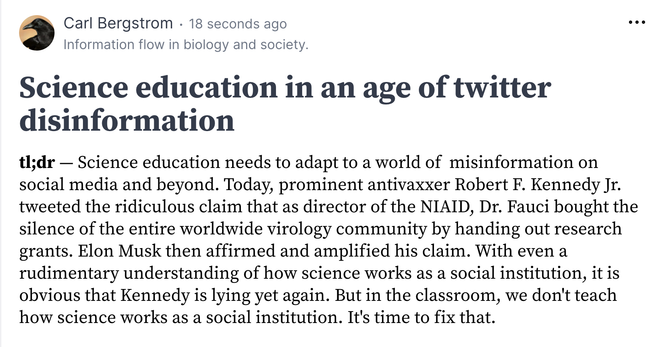
 Unidos contra la Covid-19