 ECE 2026 - Tours (France)
 CellBioNews
The silent spreader: Reassessing the role of #mice in #leptospirosis risk.
https://phys.org/news/2024-07-silent-spreader-reassessing-role-mice.html
Thanks to the organisers: S Pincebourde, H Colinet, Q Willot, C Robinet, M Laparie, C Bertelsmeier, S Thany, and E Taillebois
#ECE2026 #Entomology #Ecology #EvolutionaryBiology #Sustainability #Biodiversity #Biomimetism #Genomics #MolecularBiology #Science #Insects #Bugs #Virus #Biology #Parasites #Plantvirus #Arbovirus #Zoonotics #InsectScience
The silent spreader: Reassessing the role of #mice in #leptospirosis risk.
https://phys.org/news/2024-07-silent-spreader-reassessing-role-mice.html
Intensive #farming could raise risk of new #pandemics, researchers warn.
#zoonotics #pathogen #transmission
https://phys.org/news/2024-07-intensive-farming-pandemics.html
#Genetic analyses reveal new #viruses on the horizon.
https://phys.org/news/2024-05-genetic-analyses-reveal-viruses-horizon.html

Suddenly they appear, and like the SARS-CoV-2 coronavirus, can trigger major epidemics: Viruses that nobody had on their radar. They are not really new, but they have changed genetically. In particular, the exchange of genetic material between different virus species can lead to the sudden emergence of threatening pathogens with significantly altered characteristics.
Why #climate_change is making #parasitic #diseases harder to predict.
https://theconversation.com/why-climate-change-is-making-parasitic-diseases-harder-to-predict-229575
Scandinavia's first farmers slaughtered the hunter-gatherer population, #DNA analysis suggests.
#anthropology #zoonotics #genomics
https://phys.org/news/2024-02-scandinavia-farmers-slaughtered-hunter-population.html

Following the arrival of the first farmers in Scandinavia 5,900 years ago, the hunter-gatherer population was wiped out within a few generations, according to a new study from Lund University in Sweden, among others. The results, which are contrary to prevailing opinion, are based on DNA analysis of skeletons and teeth found in what is now Denmark.
Animal-To-Human Diseases Could Kill 12 Times More People By 2050
#emerging #diseases #zoonotics #pandemics #health https://grrlscientist.medium.com/animal-to-human-diseases-could-kill-12-times-more-people-by-2050-5a02cbb7e8a6

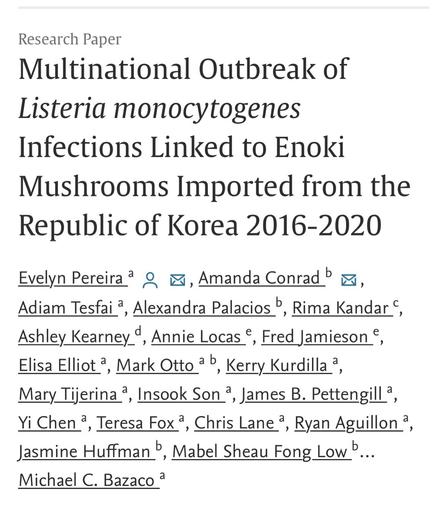
Excited to share a new article we just published on a multinational, multi-year outbreak of listeriosis linked to imported Enoki mushrooms:
The .pdf is still a pre proof, but hopefully finalized soon.
#Zoonotics #FoodSafety #IDmastodon
https://www.sciencedirect.com/science/article/pii/S0362028X2306773X?via%3Dihub
White-tailed #deer #blood shown to kill #bacteria that causes #Lyme disease.
https://phys.org/news/2023-03-white-tailed-deer-blood-shown-bacteria.html

As tick season kicks in across the country, the executive director of the University of Massachusetts Amherst-based New England Center of Excellence in Vector-Borne Diseases (NEWVEC) and his team have completed research that offers a promising lead in the fight against Lyme disease.
Researcher aims to assess ripple effects of #rodent #disease
https://phys.org/news/2023-03-aims-ripple-effects-rodent-disease.html


 GrrlScientist ⧖ Ⓥ SciComm 🇺🇦
 Michael Bazaco☣️🦠