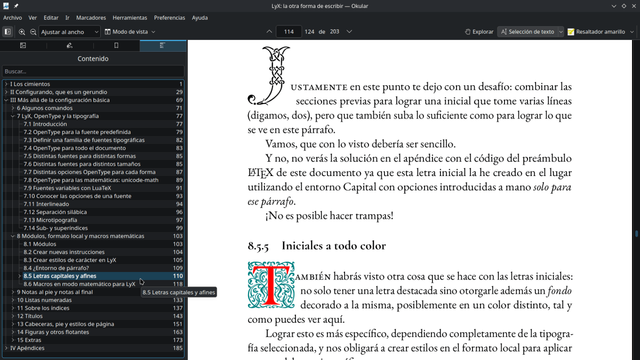
Disponible la edición 2026 de LyX, la otra forma de escribir | El Pingüino Tolkiano
https://elpinguinotolkiano.wordpress.com/2026/05/04/disponible-la-edicion-2026-de-lyx-la-otra-forma-de-escribir/
#LyX, #Tipografía, #UnicodeMath, #XeTeX, #LuaTeX
Any #xelatex experts out there? I am having a VERY weird experience with fontspec.
I write
\setsansfont{NameOfFont}
And everything works as it should. Except when "NameOfFont" is the font I actually want, when everything *except* \textbf works correctly. Then it just renders normal weight text instead.
Nothing in the log file suggests any weirdness.
If I explicitly spell out the path and the filenames for all the weights then it works correctly; but I want other people to use this so that's not really a viable option.
The most confounding thing is that it *was* working, and I do not know what changed. My best guess is that some cache somewhere needs to be blown away... but Xelatex doesn't use a font cache.... I think?
Any ideas?
p.s. using a Mac.
And finally, babel 25.14 simplifies how to declare languages. Something like \usepackage[marathi]{babel} is enough, without provide=*. Remember lazy loading is often better for handling secondary languages.
https://latex3.github.io/babel/news/whats-new-in-babel-25.14.html
Later I used #LibreOffice and #Zotero, because it was easier to handle at some parts. And I use LibO unto this day - it‘s an important tool for my daily work and I couldn‘t do it especially without #Calc.
But for texts I tend to use #Markdown and use #LibreOffice for output. Maybe i could as well use pandoc to generate some #XeTeX files and see what I get out of it?
In any case: If ever had to write anything regarding humanities again, I would pick it up again.
@saxnot There are several reasons. One of them is #xetex lacks a true #bidi model. But more importantly, #luatex provides tools for #PDF not available in #pdftex or #xetex. A couple of links: https://www.texdev.net/2024/11/05/engine-news-from-the-latex-project • https://latex3.github.io/babel/guides/migrating-xetex-luatex.html
The latest release of LaTeX went to CTAN on Friday, and moves us forward in truly automatic tagging for PDFs, particularly for mathematics. As part of the work, we have been looking at the capabilities of different engines. Here, I want to summarise what users should take from that for existing and for new documents.
Now that #luatex is the recommended engine for LaTeX, you can find in the #babel site minimal localized documents for about 300 languages and 45 scripts. There are also basic guides on how to migrate from #pdftex and #xetex.