“Unhappy is the land that needs a hero”*…

To the extent that evolutionary biologist and sociobiologist Robert Trivers has been in the news over the last decade, it has been for his entanglement with and highly-questionable defense of Jeffrey Epstein. But as Lionel Page reminds us, two decades before that– well before he could have known the execrable “financier”– Trivers made hugely important contributions to his field…

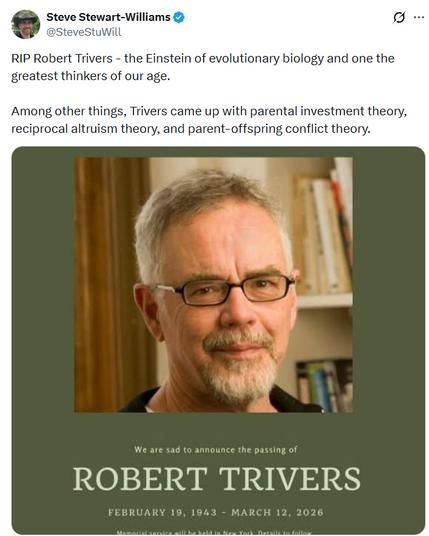
Steve Stewart-Williams announced… that Robert Trivers passed away.

Trivers was one of the most—perhaps the most—influential evolutionary biologists of the 20th century. His work should be much more widely known in social and behavioural sciences, in particular in economics, as Trivers’ intellectual approach is very much in line with a game theoretic understanding of social interactions.

It is hard to overstate the importance of his work. Einstein famously published four groundbreaking papers in 1905, a year often referred to as his “Annus mirabilis”, during which he revolutionised physics. Trivers might be said to have had a “Quinquennium Mirabile” for the five years between 1971 and 1976, during which he produced a series of ideas that revolutionised evolutionary biology…

[Page unpacks four of those contributions: Reciprocal Alturism, Parental Investment, Parental Offspring Conflict, and Self-Deception, each fascinating…]

… Trivers has been one of the most influential evolutionary biologists, and his papers are still worth reading today. His insights, published more than 50 years ago, are fascinating. They often align very well with economic theories of behaviour, and it is therefore regrettable that his ideas are not more well-known in economics, and in particular in behavioural economics.

A key feature of Trivers’ take across these contributions was to see that beneath the world of social interactions we observe, there are deep structures in terms of incentives that shape the game we play. Understanding these games and their structures helps us make sense of the seemingly endless complexity of human psychology and social dynamics. In several key contributions, Trivers helped lift the veil on the underlying logic of human behaviour…

From cooperation to conflict: the evolutionary grammar of social interactions: “The fascinating insights of Robert Trivers” from @lionelpage.bsky.social.

For more on Trivers and the controversies in his life (Epstein, but also the Black Panthers and a Rutgers set-to), all of which followed the burst of productivity described above, see here.

And for some thoughts on how one might reconcile appreciation for a scientist’s work with abhorence of his later sins, see “Ghosts of Science Past Still Haunt Us. We Can Put Them to Rest.

* Bertolt Brecht (through the mouth of Galileo, in The Life of Galileo)

###

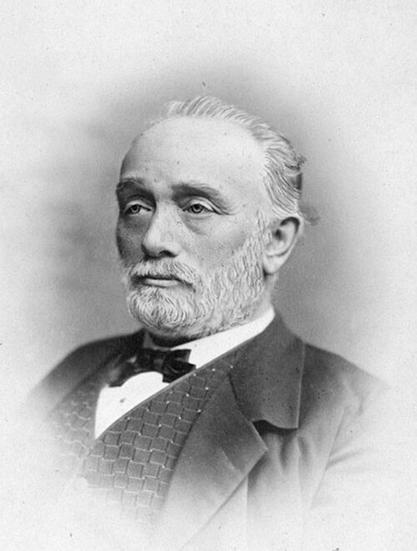
As we linger over legacies, we might send material birthday greetings to a man who helped lay the groundwork for the field to which Trivers contributed, Ludwig Büchner; he was born on this date in 1824. A philosopher, physiologist, and physician, he became one of the leading exponents of 19th-century scientific materialism. Büchner was an early champion of Darwin’s theory of evolution, endorsing it within a decade of its first issuance, then did much to spread it by citing and building on it in his own books.

As far as we know, Büchner’s life was free of the scandal and conflict that plagued Trivers. He taught at the University of Tübingen and published dozens of books and papers. Later in his life he founded he “German Freethinkers League” (“Deutsche Freidenkerbund”) and served as a member of the second chamber of the Landstände of the Grand Duchy of Hesse as a representative of the German Free-minded Party from 1884 to 1890. He was the younger brother of Georg Büchner, a famous revolutionary playwright, and Luise Büchner, a women’s rights advocate; and he was the uncle of Ernst Büchner, inventor of the Büchner flask.

source

#culture #Darwin #evolution #evolutionaryBiology #history #humanBehavior #LudwigBüchner #LudwigBuchner #Materialism #ParentalInvestment #ParentalOffspringConflict #Psychology #ReciprocalAlturism #RobertTrivers #Science #scientificMaterialism #SelfDeception #socialDynamics #sociobiology #theoryOfEvolution

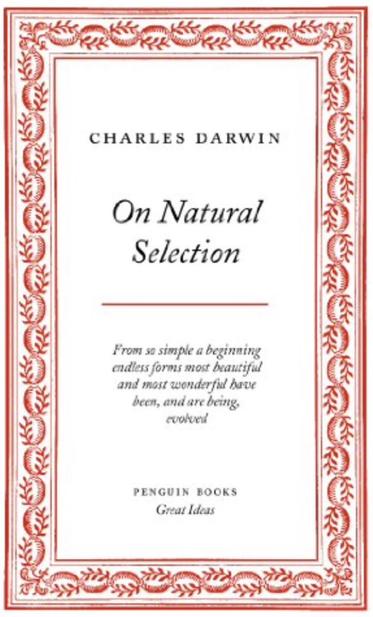
I haven’t actually finished any of the books that I’ve already started reading, but I’m going to start to read this today and hope to finish it before the day is over. Happy Darwin Day everyone!

#CurrentlyReading #Goodreads #ReadingChallenge #Bibliophile #Booklovers #Bookworm #CharlesDarwin #OnNaturalSelection #Evolution #NaturalSelection #TheoryOfEvolution #DarwinDay #PenguinBooksGreatIdeas #GreatIdeas #PenguinBooks

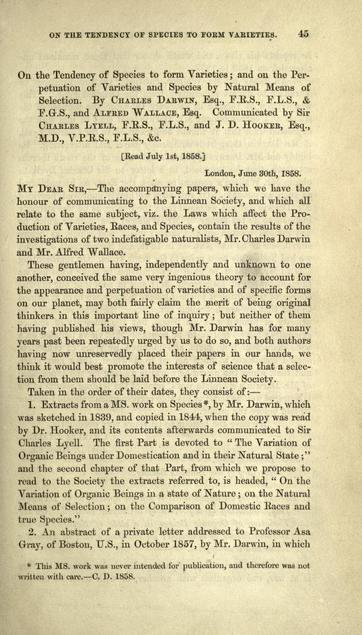
Darwin and Wallace's original papers to the Linnean Society (published 1858) are fascinating reads, showing how they each developed the concept of natural selection. The foreword by Lyell and Hooker makes clear that Darwin was very reluctant to publish!

Both mention artificial selection, but Wallace uses the tendency of domesticated animals to "return to type" in the wild - seen at the time as some sort of stabilising force against change - to bolster the idea of natural selection.

On the tendency of species to form varieties; and on the perpetuation of varieties and species by natural means of selection. Journal of the Proceedings of the Linnean Society, Zoology. 3:45-62, 1858-9
https://archive.org/details/darwin-wallace-1858-journalofproceed-00linn/mode/1up?view=theater

#NaturalSelection #OriginOfSpecies #CharlesDarwin #AlfredRusselWallace #LinneanSociety #EvolutionaryBiology #TheoryOfEvolution

On the tendency of species to form varieties. : Darwin, Charles, 1809-1882 : Free Download, Borrow, and Streaming : Internet Archive

On the tendency of species to form varieties; and on the perpetuation of varieties and species by natural means of selection. Published in Journal of the...

Internet Archive

#OTD in 1858.

Charles Darwin first publishes his theory of evolution through natural selection in The Journal of the Proceedings of the Linnean Society of London, alongside Alfred Russel Wallace's same theory.

Darwin published his theory of evolution with compelling evidence in his 1859 book On the Origin of Species.

https://en.wikipedia.org/wiki/Charles_Darwin

Books by Charles Darwin at PG:
https://www.gutenberg.org/ebooks/author/485

#science #theoryofevolution #naturalhistory

Charles Darwin - Wikipedia

A.N. Whitehead was influenced by Hegel’s evolutionary idealism, just as many 19th century thinkers whose thoughts embodied aspects of the theory of evolution... #philosophy #historyofphilosophy #alfrednorthwhitehead #processphilosophy #Idealism #hegel #theoryofevolution #metaphysics #philosophyofscience https://philosophyindefinitely.wordpress.com/2020/06/15/whiteheads-process-philosophy/
Whitehead’s process philosophy…

Lecture #61 – Whitehead’s process philosophy Alfred North Whitehead was most influential in the second half of the 20th century with his process philosophy. Whitehead started as a …

philosophy indefinitely
Photo by Marcelo Moreira on Pexels.com

I usually write these half-baked ideas into social media in a somewhat obscure way where no one really gets it. But at least I get the idea out of my mind into the wild. I did this with this idea too, I wrote it into my Mastodon account, now auto-deleted, but apparently, the idea stuck with me. I found myself thinking about it this morning so I decided to do the unusual and elaborate on it.

So here is the idea I am ruminating on:

I sense a tension between my evolutionism and my conviction that the best way to understand science is through social constructionism as it happens in the Science and Technology Studies (STS).

Evolutionism has very deep roots in my personal and intellectual history, and I have started to use the basic tenets of STS to understand science and society relations, especially what I call the creation-evolution controversy more than ten years ago. Throughout these years I hardly suspected there was a tension between them. For me, STS is the naturalist way to think about science and that is very in line with my evolutionism.

However, very recently I have decided to go deeper into the field of philosophy and I suspect that that is what triggered this realization. Let me elaborate, I consider myself a student of the philosophy of science, not a good one though, I have always been tempted to think in these matters STS-wise, and my general problem with procrastination and other related problems, kept me away from becoming an accomplished student of the philosophy of science. However, recently as a student enrolled in a philosophy department, I have decided to invest more in and improve my philosophical background and abilities. I did this because I realized that without getting deeper into philosophy it is not possible to become an accomplished philosopher of science, especially epistemology. At least that was how it started. Now I want to be a well-read person in every branch of philosophy.

So I gave a pause on writing my M.A. thesis and enrolled in some epistemology classes where I also read Barry Allen’s Knowledge and Civilization, currently, I am supposed to write an essay on it instead of writing this post.

Here is where things get complicated, I realized that when I think of epistemology and get deeper into the subject I can’t help but think about it in evolutionary terms. So I find myself defending the evolutionary epistemologists from the criticisms of Barry Allen.

Many years ago when I first heard of evolutionary epistemology I really got excited but quickly disappointed with them when I realized they are throughgoing adaptationist who tries to explain knowledge in terms of natural selection.

I am an evolutionist but thanks to one of my professors when I began to be interested in sociobiology I was warned about their wicked ways. Early on in my biology education, I was more in line with Gould and Lewontin’s understanding of evolution and I am allergic to the adaptationist program, so when I saw that evolutionary epistemologists are adaptationists I wasn’t impressed.

But now, many years later here I am defending evolutionary epistemology. Furthermore, I have decided to “take evolution seriously” before venturing deeper into the philosophy.

But how much philosophy should be engaged with science? I think there are lessons to be taken from Barry Allen’s engagement with science in his Knowledge and Civilization. Below is my two-cent take on his heavy use of science in his philosophy during a presentation I made about his book.

Cons
● The heavy use of science which can be change in a
short time can make his philosophy out-dated, quickly.

● Since most philosophers are not interested in science
this much, it can reduce their audience significantly.

Pros
● If his way of doing philosophy is adopted by more
people it can accelerate the philosophical progress.

From my course presentation – 2023

Another problem with philosophy engaging with science is the case of evolutionary epistemology. Won’t it be taking the mainstream understanding of a science, in this case, the adaptationist program of Modern Synthesis in Evolutionary Biology, the best way to engage with a science? For me apparently not! Obviously, it is the easiest way but can be hugely mistaken.

Here comes the tensions I was wondering about science and philosophy, in my case my philosophy and evolutionary biology.

First, how to balance between the ephemerality of the scientific theories and the particularity of scientific facts and supposedly more perennial and general philosophies. The solution that comes to my mind is giving up the generality and perenniality of philosophies like we did in science but who would value such a philosophy?

Second, how to choose between competing theories as in the case of evolutionary biology, the solution would be to immerse oneself in science.

Third, is the balancing between the social and constructed character of science with philosophy’s own social and constructed nature? Weirdly I am more uncomfortable with the idea of socially constructed philosophy than science. Probably I should ditch that too, and think of philosophies as theories too.

Fourth, and the most serious problem for me is where to stop naturalism/evolutionism in theorizing (both scientifically and philosophically) about humans. I believe that Homo sapiens is the product of evolution and our nature is continuous with the rest of nature so when to stop applying evolution to human affairs which are obviously social.

These are the musings of a very confused and not well-read philosophy student.

Lastly, I must refer to the blog post and a tweet from Helen de Cruz which encouraged me to write this post on my already existent doubts.

One of my wishes for 2024 is for philosophers to stop being evolutionary psychology caricatures.

— Helen De Cruz (@Helenreflects) January 1, 2024

While thinking all about this in the back of my head I encountered this tweet this is a real scare for me. I don’t want to end up as a caricature of an evolutionary psychologist and this tweet strikes me deeply.

And here is her blog post about the subject How I almost became an evolutionary psychology proponent

I would be more than happy to hear about your thoughts on these matters.

https://jresearches.wordpress.com/2024/01/04/an-impulsive-post-on-philosophy-and-science/

#AcademicLife #ethics #evolution #graduateStudet #history #philosophy #PhilosophyOfScience #science #theoryOfEvolution

Did Monkeys Really Sail the Oceans on Floating Rafts of Vegetation? | New Scientist | from 2021 📖 🕯️

“The mystery of how some species colonised new continents is as old as the theory of evolution itself. Now, with fresh clues surfacing, ‘the rafting hypothesis’ might finally sink or swim.”
#reading #RaftingHypothesis #TheoryOfEvolution #TheNewWorld #continents #monkeys #oceans #science #theories
https://www.newscientist.com/article/mg25233653-500-did-monkeys-really-sail-the-oceans-on-floating-rafts-of-vegetation/

Did monkeys really sail the oceans on floating rafts of vegetation?

The mystery of how some species colonised new continents is as old as the theory of evolution itself. Now, with fresh clues surfacing, the rafting hypothesis might finally sink or swim

New Scientist
sci_bastian

mad scientist | tour guide on the EvolutionEisenbahn I love telling stories. Ask me about science. about me: German farm boy at heart, nerd, Zelda fan, PhD in neurobiology, first generation college graduate, LGBTQ scientist

YouTube

The article 👆🏽 reminded me of this old article 👇🏽 in The Economist about the battle between the "creeps" and the "jerks" in #EvolutionaryBiology:

"Repeat After Me" [2004], The Economist (https://www.economist.com/science-and-technology/2004/12/16/repeat-after-me).

#Evolution #NaturalSelection #Biology #TheoryOfEvolution #Darwin

Repeat after me

Evidence that evolutionary change is not always a smooth process

The Economist
Do we need a new theory of evolution?

The long read: A new wave of scientists argues that mainstream evolutionary theory needs an urgent overhaul. Their opponents have dismissed them as misguided careerists – and the conflict may determine the future of biology

The Guardian