T CrB - overview of the accretion history, Roche-lobe filling, orbital solution, and radiative modeling: https://arxiv.org/abs/2507.23323 -> "Expectations for an imminent new outburst of the recurrent symbiotic nova #TCrB are mounting, initiated by the discovery in 2015 of a new enhanced mass-transfer phase (SAP), which is reminiscent of the one preceding the last recorded outburst in 1946. [...] SAP has been caused by an inside-out collapse of the disk, during which the mean accretion rate onto the WD has been ~28x larger than in quiescence. SAP ended in April 2023, but from May 2024 mass-flow has intensively resumed at disk inner radii while the collapse wave reached the outer portions of the disk; the consequent revamp in mass accretion could fill the gap inherited by the fainter 2015-2023 SAP and eventually lead the WD accreted shell to ignition."
T CrB: overview of the accretion history, Roche-lobe filling, orbital solution, and radiative modeling

(abridged) We aim to derive a robust estimate of the most important parameters describing the physical nature of T CrB, trace the accretion history onto its white dwarf, and account for the unexpected delay in the occurrence of the new outburst: the SAP prior to 1946 was brighter, and it was followed by the nova eruption within 6 months from its conclusion. This time the 2015-2023 SAP has been fainter and two years past its conclusion no new eruption has yet taken place. During 2005-2025, a period covering SAP and the preceding quiescence, we collected a massive amount of photometric and spectroscopic observations that we have analyzed together with Swift UVOT data. Guided by the results of the orbital solution and in particular by the radiative modeling to which we subjected the whole set of available data, we found for T CrB a binary period of 227.5528 days, an inclination of 61 deg, and masses of 1.35 Msun and 0.93 Msun for the white dwarf and the M3III companion, respectively, making mass transfer dynamically stable. The red giant fills completely its Roche lobe, and at Vrot sin(i)=4.75 +-0.26 km/s it is rotating much slower that the 16 km/s co-rotation value. The ~20 deg azimuth of the hot spot, implied by the hump shaping the optical light curve in quiescence, fixes the outer radius of the disk to 58 Rsun, the same as the canonical value expected from disk theory. In quiescence the disk is cold and mostly neutral. SAP has been caused by an inside-out collapse of the disk, during which the mean accretion rate onto the WD has been ~28x larger than in quiescence. SAP ended in April 2023, but from May 2024 mass-flow has intensively resumed at disk inner radii while the collapse wave reached the outer portions of the disk; the consequent revamp in mass accretion could fill the gap inherited by the fainter 2015-2023 SAP and eventually lead the WD accreted shell to ignition.

arXiv.org

#TCorBor magnitude 10.1

Source AAVSO, Observer: IDG on 2025-06-28

#blazeStar #TCrB

#TCorBor magnitude 10.1

Source AAVSO, Observer: IDG on 2025-06-27

#blazeStar #TCrB

#TCorBor magnitude 10.0

Source AAVSO, Observer: HBB on 2025-06-26

#blazeStar #TCrB

SciTech Chronicles. . . . .May 5th, 2025

https://bit.ly/stc050525

#neurodegenerative #tau #misfolded #fibrils #nova #TCrB #Red #White #modular #Unitree #"B2 quadruped" #"extreme environment" #"water Cannon" #imaging #D-PSCAN #NTS #VNS #mtDNA #mutant #Disease #heteroplasmy

SciTech Chronicles. . . . . . . . .May 5th, 2025

This summer I hear the drumming Vol II No 29 242 links Curated Mission Control RSS Feed Wordpress SubStack Comments Buy Me A Coffee Synth...

Regarding T CrB, the star behaves in the same manner as in recent months. So we have no real clue when its outburst will happen.
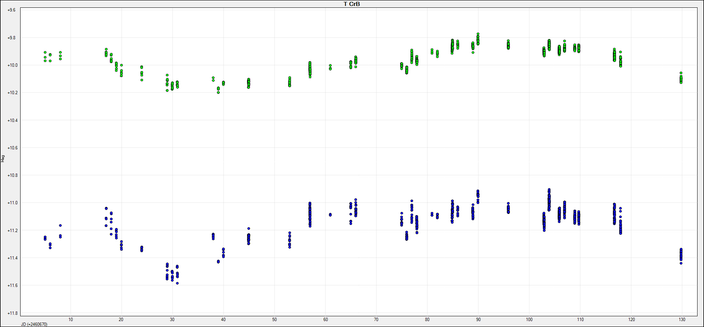
These are my most recent photometric observations of this recurrent nova star (Fig. 1).

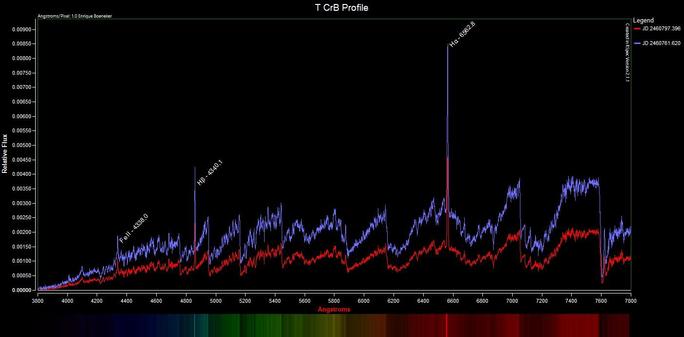
I am complementing my observations with a comparison of the spectra with data from AAVSO’s observer PROI (Fig. 2).

The blue spectrum corresponds to when T CrB was close to its peak brightness at the end of March. The red spectrum was captured three days ago, when this star seemed less bright.

#Astrodon #Astronomy #TCrB #Science

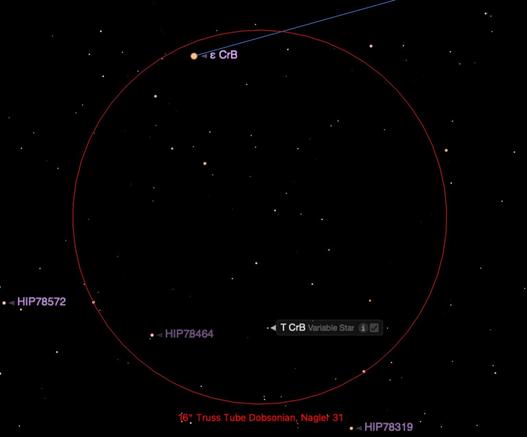
Finally tracked down the overdue nova T Coronae Borealis by star hopping. It was gratifyingly unimpressive 😃

#tcoronaeborealis #tcrb #astronomy

Heute, 27.3., ist der eine auf Basis der #Umlaufbahnen vom #Doppelgestirn berechnete Termin!
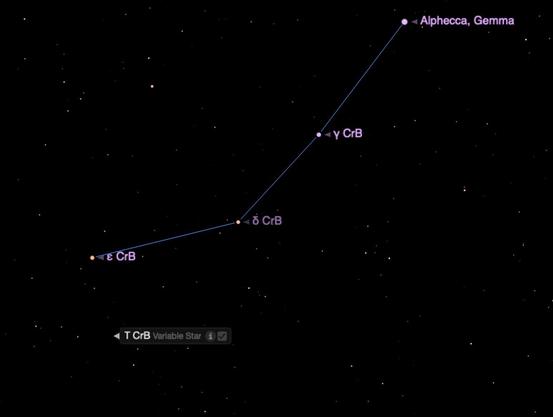
Seit Monaten erwarten #Astronomie Fans das mit bloßem Auge sichtbare Aufleuchten einer #Nova ✨im #Sternbild Corona Borealis
Wo ihr hingehauen müsst, um den "neuen Stern" zu sehen - gesetzt den Fall, der Weisse Zwerg wird zur #Nova und das Wetter passt - zeigt euch mein
- Video: https://youtu.be/NF4NWw2EuWM
- Info: https://www.fr.de/wissen/warten-auf-die-nova-am-himmel-forscher-berechnet-termin-fuer-die-sternexplosion-zr-93640098.html

#TCrB #Sterngucker #Kosmos #Wissenschaft #Sternexplosion #science

Wo finde ich die Nova in Corona borealis?

YouTube
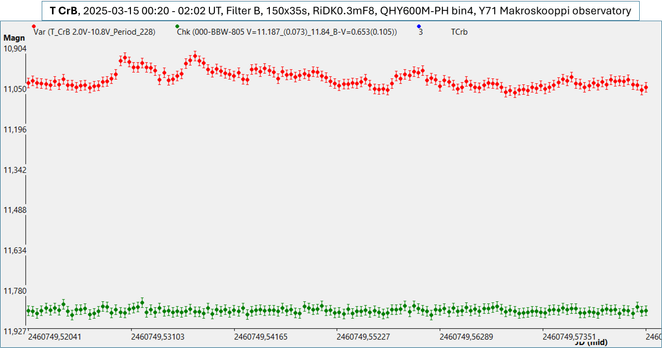
Recurrent nova #TCrB is still collecting material to it's surface, critical level not yet achieved to start eruption. Here a graph during 2025-03-15_0020-0200UT with 40sec time resolution using B filter, taken at Y71 Makroskooppi observatory. Some brightness flickering of it's accretion disk is visible.
@coreyspowell One last thing: the incoming #TCrB nova might be a type Ia event. It sits 2500 light years from here and will present as a new "guest star" or might even cast a second shadow during the day if the Chandrasekar limit is hit. I guess you especially will enjoy those few days of sky gazing.