Enrique Boeneker has moved

321 Followers
107 Following
763 Posts
Since Astrodon.Social is shutting down, I have moved my account to @CosmoSidewalk. See you there! And, please, don¡t get lost!

Hello World!

I am an Education and Outreach Scientist at the Space Telescope Science Institute supporting JWST. I post about my work, astronomy news, and accessibility.

Since Astrodon.social is shutting down, I am migrating this account from @kellylepo.

Discover the Physics of Auroras

Magnetospheres and Geomagnetic Storms

Many planets, including Earth, are surrounded by a large magnetic shield called a magnetosphere. On Earth, this shield stems from the churning molten metal core inside the planet and extends far out into space.

Our magnetosphere protects us from harmful charged particles in the space environment. As these particles collide with the magnetosphere, they can transfer energy to the magnetosphere itself. However, if certain regions become overloaded, a geomagnetic storm can erupt, just as rain clouds swell with water droplets preceding a thunderstorm.

During a geomagnetic storm, much of the accumulated energy in the magnetosphere flows down along Earth's magnetic field lines, precipitating into the atmosphere like a summer downpour on the prairie. This type of particle precipitation injects millions of amps into the atmosphere, leading to impressive auroral displays in places far from Earth’s poles.

https://science.nasa.gov/sun/auroras/#deeper-science

Credits:
NASA/Goddard Space Flight Center/Scientific Visualization Studio/AJ Christensen

** --> Uploading animated files in ".gif" format is a bit of a trick, because the originals are usually too big. The free software imagemagick does a great job here when it comes to resizing your file! You can try it yourself with the following command:

$convert(or "magick" depending on your version) in.gif -coalesce -resize (desired size eg:"256")x -deconstruct out-deconstruct.gif

#space #earth #aurora #astrophotography #photography #NASA #science #physics #nature #education #4sAur

How do we know that globular star clusters are the oldest structures of our universe? The answer is surprisingly fascinating.

Picture number 1 is my latest capture of the largest known globular cluster in the Northern Hemisphere: M13, which I believe contains approximately half a million stars.

Picture number 2 features pictures of 0.9 m Kitt Peak's Observatory telescope, together with images taken by the Hubble Space Telescope of another glob cluster: M4.

Well, it turns out that the HST could resolve, after many hours of exposures, the white dwarfs within the latter cluster. Not only that, but it could also analyze them using a technique known as spectroscopy, and determine in this way that these stars are approximately 12 to 13 billion years old.

This is not only useful for determining the cluster's age, but also for pinpointing the age of the entire universe. So, these tiny "insignificant" star remnants did us a big favor.

#Astrodon #Astronomy #astrophysics #astrophotography #stars #cluster #outdoors #nightsky

About 1 trillion stars, located 21 million l-y away from us, and featuring a diameter 2.5 times larger than the Milky Way: this is M101, the Pinwheel Galaxy, and I can capture it, with total impunity, with a 103 mm off the shelf telescope. If this is not mind boggling, then what is?

#Astrodon #astronomy #astrophotography #nightsky #space #galaxy #outdoors

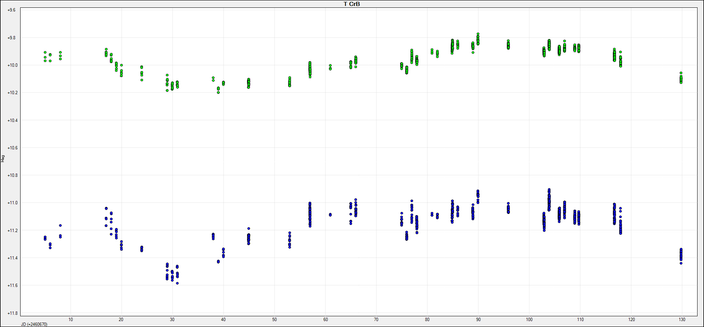
Regarding T CrB, the star behaves in the same manner as in recent months. So we have no real clue when its outburst will happen.
These are my most recent photometric observations of this recurrent nova star (Fig. 1).

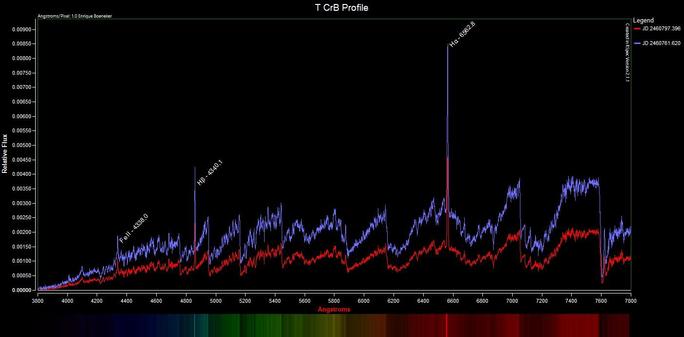
I am complementing my observations with a comparison of the spectra with data from AAVSO’s observer PROI (Fig. 2).

The blue spectrum corresponds to when T CrB was close to its peak brightness at the end of March. The red spectrum was captured three days ago, when this star seemed less bright.

#Astrodon #Astronomy #TCrB #Science

Faint broadband targets are almost a no-no for imagers like me living in a huge city. TBH I never thought I could pull this out: I introduce to y’all part of rho Ophiucci’s nebula!

This is a little bit more than 8 hours of total integration of 60 s exposures through LRGB filters taken with my small 90 mm refractor telescope.

#Astrodon #astronomy #astrophotography #nightsky #space #nebula #outdoors

Hey y’all!
Due to the bad weather, I have been revisiting my past pictures, like this one of IC 342. I am slowly improving my processing skills. Had to share this with you.

#Astrodon #astronomy #astrophotography #space #galaxies #outerspace #outdoors #nightsky #stars

#PPOD: This view from NASA's Cassini spacecraft shows a wave structure in Saturn's rings known as the Janus 2:1 spiral density wave. As a result of the same process that creates spiral galaxies, spiral density waves in Saturn's rings are much more tightly wound. In this case, every second wave crest is the same spiral arm that has encircled the entire planet multiple times. Credit: NASA/JPL-Caltech/Space Science Institute/CICLOPS

#space #science #scicomm

I found out from Wikipedia that this distant object is called Sarah's Galaxy. I find this name more appropriate than the ordinary and vulgar one that people call it. Sarah's Galaxy refers to Sarah Williams, who wrote this poem that is all me now:

"Though my soul may set in darkness, it will rise in perfect light;
I have loved the stars too truly to be fearful of the night."
The Old Astronomer

#astronomy #astrophotography #Astrodon #space #nightsky #astrophoto #Galaxy #galaxies #stars #outdoors #poetry

What if I tell you about a galaxy that has not one but two supermassive black holes? What if I tell you that these SMBH orbit very close to each other, at a distance of about 0.07 l-y? And, would you believe me if I tell you that these two, at the center of this galaxy, emanate a relativistic jet producing an active galactic nucleus? This all happens at the center of this well-known galaxy: M81.

#astronomy #astrophysics #astrophotography #space #nightsky #outdoors #galaxy #AGN #Astrodon