What is the Sunk Cost Fallacy?

You book a concert ticket for $150. The night of the show, you feel exhausted, the weather is awful, and you genuinely do not want to go. But you go anyway because you already paid for the ticket.

That is the sunk cost fallacy in action.

It is one of the most common and costly thinking errors in personal finance, and understanding it can save you significant amounts of money over the course of your life.

Defining the Sunk Cost Fallacy

A sunk cost is any money, time, or effort you have already spent that cannot be recovered. The sunk cost fallacy is the tendency to continue investing in something simply because of what you have already put in, rather than evaluating whether continuing makes sense going forward.

The word “sunk” is apt. Like a ship on the ocean floor, that money is not coming back regardless of what you do next. The rational approach is to make every future decision based only on future costs and future benefits. The fallacy occurs when past spending distorts that judgment.

Economists and behavioral psychologists have studied this pattern for decades. The researchers Daniel Kahneman and Amos Tversky, whose work is explored in Kahneman’s book Thinking, Fast and Slow, found that people feel the pain of losses more intensely than the pleasure of equivalent gains. This asymmetry, which they called loss aversion, is one reason sunk costs are so psychologically difficult to ignore.

Why It Matters for Your Money

The sunk cost fallacy shows up across nearly every area of personal finance.

Investing is where it gets particularly expensive. Someone buys a stock at $80. It falls to $40. Rather than evaluating the stock on its current merits and future prospects, the investor holds on because they want to “get back to even.” The original $80 is gone either way. The only question that matters now is whether this $40 is better deployed here or somewhere else.

The same logic applies to actively managed mutual funds with high fees and mediocre performance records. People stay in them because they have been contributing for years. But past contributions are not a reason to continue. The relevant question is whether this fund, evaluated from today forward, is the best place for new and existing money.

Real estate is another common trap. A homeowner who has put $30,000 into a renovation may continue pouring money into a project that has already gone wrong, simply because walking away feels like admitting defeat. But the $30,000 is gone. The decision to continue should rest entirely on whether the remaining work will produce a reasonable return, not on how much has already been spent.

Cars, subscriptions, gym memberships, business ventures, and even bad relationships all follow the same pattern. The money or time spent in the past is simply not relevant to whether you should continue.

Best selling money books on Amazon

The Psychology Behind the Mistake

Several well-documented cognitive biases drive sunk cost thinking.

Loss aversion, as described above, makes quitting feel like a loss even when it is the right financial move. There is also a concept called commitment and consistency bias, the deeply human tendency to want to remain aligned with past decisions to avoid the discomfort of acknowledging a mistake.

Charlie Munger, the late business partner of Warren Buffett and one of the clearest thinkers in investing history, advocated strongly for the mental habit of inversion. Instead of asking “how can I make this work?”, invert the question: “Would I choose to start this today, knowing what I know now, if I had not already invested anything?” If the answer is no, you have your answer.

Morgan Housel explores related ideas in The Psychology of Money, noting that financial decisions are rarely purely mathematical. They are tangled up with ego, identity, and the story we tell ourselves about who we are and whether our past choices were sound.

How to Recognize It in Your Own Life

The clearest signal that you are falling for the sunk cost fallacy is when you justify a financial decision primarily by referencing what you have already spent. Watch for phrases like:

“I’ve already put so much into this.”

“I can’t quit now after everything I’ve invested.”

“I just need to get my money back first.”

None of these are forward-looking reasons to continue. They are backward-looking rationalizations.

A useful exercise is to run what some financial thinkers call a “fresh start” test. Imagine you are encountering this decision for the first time today, with no history. You have a certain amount of money. Would you choose to put it into this stock, this business, this subscription? If the answer is no, the sunk cost fallacy may be driving your current behavior.

What to Do Instead

Recognize that cutting losses is not failure. It is rational. The goal of personal finance is not to be consistent with your past self. The goal is to maximize your future outcomes.

This is one of the reasons index fund investing is so effective as a long-term strategy. When you invest in a broad S&P 500 index fund, you are not attached to individual companies. If a company becomes uncompetitive, it shrinks in the index or drops out entirely. You are always holding a forward-looking portfolio, not one anchored to past decisions.

When evaluating any ongoing financial commitment, try to build a habit of zero-based thinking. Start from zero. Ask only: given everything I know right now, does this make sense going forward? That is the question that matters. Everything before today is history.

Final Word on Opportunity Cost

There is one more dimension worth understanding alongside sunk costs: opportunity cost. Every dollar you continue to pour into a losing investment or depreciating commitment is a dollar that cannot compound elsewhere.

The sunk cost fallacy does not just cost you what you have already spent. It costs you the returns you could have earned by moving that capital somewhere more productive. Over long time horizons, those foregone returns can dwarf the original loss.

Learning to let go of sunk costs is not just about avoiding bad decisions. It is about freeing up resources, mental and financial, for better ones.

#BehavioralFinance #IndexInvesting #Investing #Psychology #SunkCostFallacy


"Im #Verkehr können wir jeden Tag entscheiden, welches Verkehrsmittel wir nehmen.", sagt Klimaforscher Niklas Höhne vom New Climate Institute.

https://www.tagesschau.de/wissen/klima/klimaschutz-expertenrat-gebaeude-verkehr-100.html

Nur #Carsharing Nutzende haben die #Freiheit diese Entscheidung wirklich jeden Tag aufs Neue zu treffen. Autobesitzende haben schon so viel Geld in ein Verkehrsmittel investiert, dass die Nutzung von 👣🚲🚋🚄 meist ökonomisch nicht mehr attraktiv ist.

#sunkcostfallacy #Klimaschutz #expertenrat #Klimaziel

Warum Klimaschutz bei Verkehr und Gebäuden stockt

Laut Expertenrat wird Deutschland sein Klimaziel für 2030 verfehlen. Vor allem zwei Bereiche sind dabei weiter ein Problem: Verkehr und Gebäude. Warum das so ist - und weshalb Klimaschutz dort besonders umstritten bleibt.

tagesschau.de

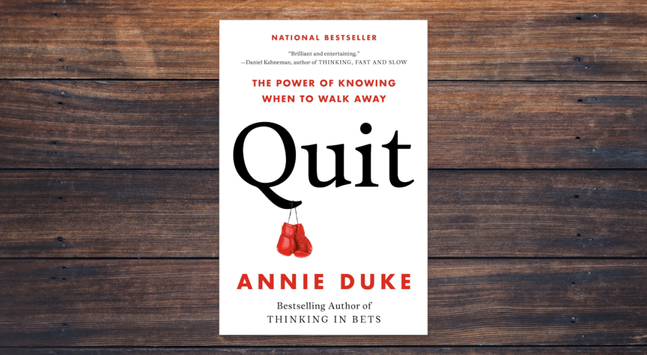
Book Review: Quit by Annie Duke

Most of us were raised on the same lesson: winners never quit, and quitters never win. It sounds like wisdom, but according to Annie Duke, it might be one of the most financially and personally damaging beliefs we carry. In Quit: The Power of Knowing When to Walk Away, Duke argues that knowing when to stop is not a character flaw. It is a skill, and learning it could change your life.

Brief Book Summary

Published in 2022, Quit makes a case that quitting, done well and at the right time, is one of the most rational decisions a person can make. Duke walks readers through the psychological forces that keep people locked into failing courses of action, from bad investments to dead-end careers, and explains why our brains are wired to resist giving up even when logic says we should.

The book draws on behavioral economics, cognitive psychology, and real-world case studies to explain the costs of persisting too long. Duke introduces concepts like “the grit trap,” the danger of sunken costs, and identity-based commitment, all of which cause people to keep going when stopping would have been the smarter move. She also offers practical tools for making better quitting decisions, including the use of “quitting coaches” and pre-committed decision criteria.

Buy Quit on Amazon

Who Is Annie Duke?

Annie Duke is a former professional poker player who competed at the World Series of Poker for nearly two decades, winning a World Series of Poker bracelet in 2004 and the Tournament of Champions in 2004. After retiring from poker, she became a consultant, speaker, and author focused on decision-making under uncertainty.

Her first book, Thinking in Bets, introduced many readers to the idea that good decisions do not always lead to good outcomes, and that separating decision quality from outcome quality is a critical mental skill. Quit builds on that framework by applying it specifically to the decision to walk away.

Duke holds a bachelor’s degree from Columbia University and completed graduate coursework in cognitive psychology at the University of Pennsylvania before leaving to pursue poker professionally. That academic background in how humans think and decide runs throughout her writing.

Lessons Readers Can Take Away

Sunk costs are a trap

One of the most valuable lessons in the book is a deeper understanding of the sunk cost fallacy. Money already spent, time already invested, and effort already committed are gone regardless of what you do next. Making future decisions based on past losses is irrational, yet nearly everyone does it. For personal finance readers, this lesson applies directly to holding onto a bad investment, continuing to fund a failing side business, or staying loyal to a financial product that no longer serves you.

Grit has limits

Duke is careful not to dismiss perseverance entirely, but she draws an important distinction between grit in service of a worthy goal versus grit as stubbornness. Persistence only pays off when the underlying path is sound. Sticking with a bad plan longer does not make it a good plan.

Identity makes quitting harder

When we tie who we are to what we are doing, walking away feels like a personal failure rather than a rational adjustment. Duke explores how this plays out in careers, relationships, and financial commitments. For anyone who has ever said “I’ve come too far to stop now,” this chapter is worth the price of the book alone.

Pre-commitment and decision criteria help

Duke recommends deciding in advance under what conditions you will quit, before emotions take over. In investing, this resembles a pre-set stop-loss rule or a rebalancing threshold. Setting the criteria when you are calm and objective is far more reliable than making the call in the heat of the moment.

Getting outside perspective matters

Duke suggests using a trusted outside party, someone not emotionally invested in your outcome, to help evaluate when it is time to walk away. For financial decisions, this is an argument for working with a financial advisor or a trusted, knowledgeable friend who can offer honest feedback rather than reinforcement.

Buy Quit on Amazon

Criticisms of the Book

No book is without weaknesses, and Quit has a few worth noting.

Some readers and critics have pointed out that Duke’s examples lean heavily on high-stakes, dramatic scenarios, from elite athletes to military operations, which can make the framework feel harder to apply to ordinary, everyday decisions. Not every reader is managing a multi-million dollar fund or competing at a world-class level.

Others have argued that the book is somewhat repetitive, making the same core arguments across multiple chapters without adding significant new depth in each one. The central thesis is compelling, but readers looking for dense, technical analysis may find the pacing slow.

There is also a fair criticism that the book does not spend enough time addressing the real-world constraints that make quitting genuinely hard for many people. Walking away from a bad job is easier when you have an emergency fund. Exiting a bad investment is easier when you have other capital. Duke acknowledges this to some degree, but critics have noted that the book occasionally underweights financial and social barriers that make rational quitting harder in practice.

Should You Buy This Book?

Yes, with a caveat about your expectations.

If you are looking for a book that will make you a more thoughtful decision-maker, especially around when to stay committed to something and when to cut your losses, Quit delivers. The core ideas are sound, well-researched, and practically useful. For anyone managing a personal investment portfolio, building a side business, or navigating a career change, the mental models Duke provides are worth internalizing.

If you are looking for a detailed how-to guide with step-by-step instructions, the book may leave you wanting more. It is better described as a framework-builder than a tactical manual.

Readers who enjoyed Thinking in Bets will likely find Quit a natural and worthwhile companion. Readers new to behavioral economics and decision-making will also find it accessible and engaging. It is not the most advanced book in this space, but it does not need to be.

Final Thoughts

The idea that quitting is always weakness is a belief worth examining. Quit: The Power of Knowing When to Walk Away gives readers the language and the logic to challenge that assumption and make better decisions as a result.

In personal finance, some of the most costly mistakes are not bad purchases or bad investments. They are the failure to recognize when something has stopped working and the reluctance to act on that recognition. Duke’s book is a useful antidote to that pattern.

It is not a perfect book, but the core argument is one that more people need to hear. If the idea of losing money on a stock you refuse to sell because you have already lost too much sounds familiar, start here.

Buy Quit on Amazon

#AnnieDuke #BookReviews #Books #DecisionMaking #Nonfiction #Psychology #Quit #SunkCostFallacy #ThinkingInBets
Competitive disadvantage
The best time to switch was yesterday. The second best time is today.
Make the switch: https://massaxis.com
#SwitchingCosts #SunkCostFallacy #MoveForward #BusinessDecisions #CutYourLosses #BetterChoices #ProgressNotPerfection #CourageToChange #SmartMoves #NoRegrets
MassAxis

MassAxis is a web application for managing your business.

Spiritual Bypassing isn't the real problem. The real problem? People want it that way.

30 years of meditation is boring. A 30-day "transformation" feels good. So we pay gurus to sell us identity – not insight.

Meanwhile, attention spans dropped to 8 seconds. Goldfish: 9 seconds. We lose.

The Bullshit Mountain is where you feel enlightened without doing the work. The valley below? Slow, real learning. No likes. No shortcuts.

Just a book. A mat. Years.

Step off the mountain. Walk through the dark valley. Learn slowly. Smile.

Not because it's easy. But because you finally started.

Full German madness here: https://mahamind7.blogspot.com/2026/04/spiritual-bypassing-und-was-das.html

#BullshitMountain #SpiritualBypassing #AttentionEconomy #SlowLearning #NoGurus #DigitalDetox #LifelongLearning #EsotericCritique #DunningKruger #SunkCostFallacy

Spiritual Bypassing – und was das eigentliche Problem ist

Blog über Spiritualität, Persönlichkeitsentwicklung, Esoterik, Philosophie, Lebenserfahrung, Tarot, Meditation, Breathwork, Liebe. Alles kostenlos.

I spent the whole day working on my long abused and neglected Jeep Scrambler, but I did take a break for a root canal.
(I have neither abused nor neglected it, but in the past 43 years it has suffered much).
Yay Team #SunkCostFallacy

Sammeln und Komplettieren – Podcast E128

Achievement-Hunting, Komplettieren, Platinieren: Ist so ein Sammelwahn eigentlich normal oder schon pathologisch? Wir haben uns auf Social Media umgehört, wie verbreitet Komplettionismus unter Spielerinnen und Spielern eigentlich ist – und warum manche Menschen ihre Spiele gern vervollständigen.

Bild: Yakuza: Like A Dragon, Ryu Ga Gotoku Studio/SEGA

Zu Gast

Host

  • Benjamin Strobel

TLDR

Transkript für Folge 128 herunterladen

00:00:30 Intro und Begrüßung Teresa
00:06:23 Ist Completionism eine Zwangsstörung?
00:19:28 Wenn das Spiel zur Arbeit wird
00:32:13 Unabgeschlossene Aufgaben: Zeigarnik- und Ovsiankina-Effekt
00:43:50 Leidenschaft, Mastery und sozialer Vergleich
00:59:57 FOMO, Wertschätzung und Reziprozität
01:03:41 Das Ende aufsparen und Sunk Cost Fallacy
01:09:49 Zwanghafte Persönlichkeit
01:23:21 ADHS
01:31:38 Autismus
01:36:05 Dank & Abmoderation

Psychologie und Konzepte

Literatur und Links

In eigener Sache

Wenn euch die Folge gefallen hat, hinterlasst uns doch eine gute Bewertung bei Apple und Spotify oder abonniert uns bei Amazon MusicAudible oder Deezer. All das hilft uns dabei, auf den Plattformen sichtbarerer zu werden.

Wenn ihr uns finanziell unterstützen möchtet, könnt ihr das auf Steady tun – jeder Beitrag hilft uns, Behind the Screens weiter wachsen zu lassen.

Wir freuen uns über Feedback. Schreibt uns doch einen Kommentar unter diesen Post oder meldet euch via BlueSky oder LinkedIn. Noch besser: Diskutiert mit uns auf Discord!

#ADHS #Autismus #Completionism #FearOfMissingOut #OvsiankinaEffekt #Reziprozität #Selbstbestimmungstheorie #SozialerVergleich #Sucht #SunkCostFallacy #ZeigarnikEffekt #ZwanghaftePersönlichkeitsstörung #Zwangsstörung

The Albanese government is leaning heavily into the sunk cost fallacy, as disclosed in this article.

The old world order is crumbling, tying Australia’s future to the declining American empire is becoming increasingly more perilous.

America has shown it has no regard for allies. Australia is at greater risk of damage from the USA than China.

(Why would China want to imperil the supply of raw materials Australia sells them at bargain basement prices? While our US ‘ally’ has clearly stated its goal of decreasing imports and has exerted its antipathy towards Australia on numerous occasions-The Dismissal, Medicare, PBS, etc)

From the article.

Reuss-Smit believes the Australian government is reluctant to step out of line with the US, partly due to fears it could impact the AUKUS agreement.

"Laws don't crumble when someone violates them, they crumble when somebody won't stand up for them."

Australia needs to stand up!

https://www.sbs.com.au/news/article/what-iran-war-reveals-about-us-power/dp0hs1ujg?dlb=%5B2026/03/14%5D%20del_newswkend_bau&did=DM52705&cid=sbsnews:edm:acnewswe:relation:news:na:na

#auspol #aukus #ruleoflaw #sunkcostfallacy #uspol #china #USA

How war in the Middle East is 're-ordering power' and what it means for Australia's alliances

The war in the Middle East has signalled changes to the international order, with some saying the system is in "severe crisis".

SBS News
But is the initial Magic Eraser necessary, you ask? Fortunately, I ordered another #ThinkPad #X270 to figure this out 😇
#sunkcostfallacy
#Sunkcostfallacy ~ some relationships are not worth working on. No matter how much has been invested previously. Turn around and walk away. In all likelihood, it will eventually contribute to your peace of mind.