 Daniel Pomarède
Donald G. York, co-founder of Sloan Digital Sky Survey and ‘visionary’ astronomer, 1944-2025
#Astronomy #Astronomer #DonaldGYork #SDSS #telescope #science #news #astrodon
Donald G. York, co-founder of Sloan Digital Sky Survey and ‘visionary’ astronomer, 1944-2025
#Astronomy #Astronomer #DonaldGYork #SDSS #telescope #science #news #astrodon
Slides from my #SDSS talk today on designing an Intermediate #rstats course:
kbodwin.github.io/Talks-and-Presentations/SDSS_2025/Intermediate_R.html
(Skip to the end if you want to get on a mailing list for sharing the materials we're making!)
Thank you to all who attended an early Friday talk and asked great questions! 🤩
in the #arXiv
DESIVAST: A Catalog of Low-Redshift Voids using Data from the DESI DR1 Bright Galaxy Survey
by Hernan Rincon and co-authors
https://arxiv.org/abs/2411.00148
#Cosmology #Astronomy #Astrophysics #Astrodon #DESI #survey #DESIsurvey #galaxies #catalog #void #voids #cosmicvoids #voidfinder #SDSS #science #STEM #research
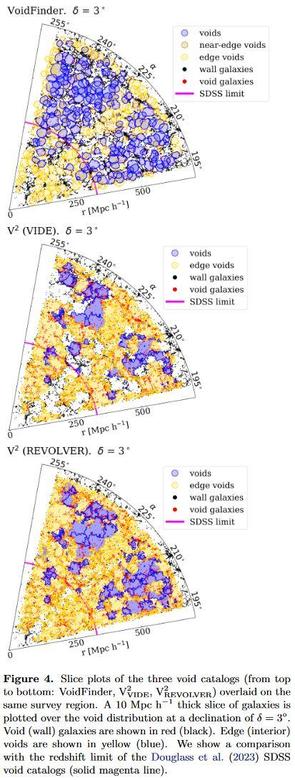
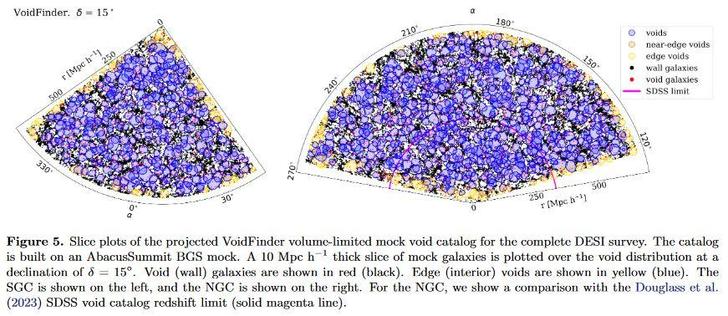
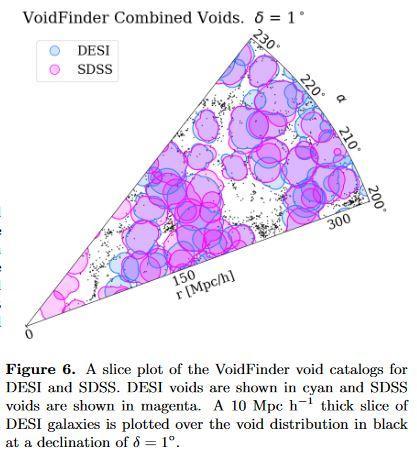

We present three separate void catalogs created using a volume-limited sample of the DESI Year 1 Bright Galaxy Survey. We use the algorithms VoidFinder and V2 to construct void catalogs out to a redshift of z=0.24. We obtain 1,461 interior voids with VoidFinder, 420 with V2 using REVOLVER pruning, and 295 with V2 using VIDE pruning. Comparing our catalog with an overlapping SDSS void catalog, we find generally consistent void properties but significant differences in the void volume overlap, which we attribute to differences in the galaxy selection and survey masks. These catalogs are suitable for studying the variation in galaxy properties with cosmic environment and for cosmological studies.
"
MPIA: Ein massereiches Schwarzes Loch erwacht – “live”
Astronomen sehen das Erwachen eines massereichen Schwarzen Lochs in Echtzeit. Eine Pressemitteilung des Max-Planck-Instituts für Astronomie (MPIA).
"
https://www.raumfahrer.net/mpia-ein-massereiches-schwarzes-loch-erwacht-live/
19.6.2024
#Astronomie #2MASS #AGN #ALeRCE #eROSITA #ESO #GALEX #Gezeitenstörung #MPIA #SchwarzesLoch #SDSS #VLT #WISE #Xshooter #ZTF

Astronomen sehen das Erwachen eines massereichen Schwarzen Lochs in Echtzeit. Eine Pressemitteilung des Max-Planck-Instituts für Astronomie (MPIA). Quelle: Max-Planck-Institut für Astronomie 19. Juni 2024. 19. Juni 2024 – Ende 2019 begann die zuvor unauffällige Galaxie SDSS1335+0728 plötzlich heller zu leuchten als je zuvor. Um den Ursachen auf den Grund zu gehen, haben Astronomen Daten von […]
in the #arXiv
What makes a cosmic filament? The dynamical origin and identity of filaments I. fundamentals in 2D
by Job Feldbrugge and Rien van de Weygaert
https://arxiv.org/abs/2405.20475
📷 Multiscale filament network and filament branching (cf Fig. 3)
#Cosmology #CosmicWeb #Universe #Cosmography #DarkMatter #filament #filaments #galaxy #galaxies #astronomy #astrophysics #astrodon #SDSS #DESI #Euclid #science #STEM
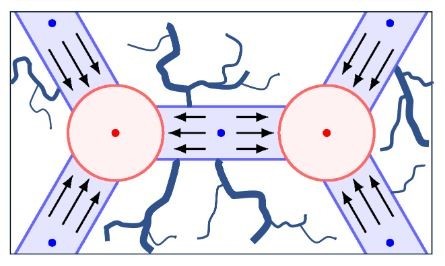

Cosmic filaments are the main transport channels of matter in the Megaparsec universe, and represent the most prominent structural feature in the matter and galaxy distribution. Here we describe and define the physical and dynamical nature of cosmic filaments. It is based on the realization that the complex spatial pattern and connectivity of the cosmic web are already visible in the primordial random Gaussian density field, in the spatial pattern of the primordial tidal and deformation eigenvalue field. The filaments and other structural features in the cosmic web emerging from this are multistream features and structural singularities in phase-space. The caustic skeleton formalism allows a fully analytical classification, identification, and treatment of the nonlinear cosmic web. The caustic conditions yield the mathematical specification of weblike structures in terms of the primordial deformation tensor eigenvalue and eigenvector fields, in which filaments are identified -- in 2D -- with the so-called cusp caustics. These are centered around points that are maximally stretched as a result of the tidal force field. The resulting mathematical conditions represent a complete characterization of filaments in terms of their formation history, dynamics, and orientation. We illustrate the workings of the formalism on the basis of a set of constrained $N$-body simulations of protofilament realizations. These realizations are analyzed in terms of spatial structure, density profiles, and multistream structure and compared to simpler density or potential field saddle point specifications. The presented formalism, and its 3D generalization, will facilitate the mining of the rich cosmological information contained in the observed weblike galaxy distribution, and be of key significance for the analysis of cosmological surveys such as SDSS, DESI, and Euclid.
"MPIA: Forscher identifizieren zwei der frühesten Bausteine der Milchstraße
.. Bei den „Shakti“ und „Shiva“ genannten Gebilden dürfte es sich um Überreste zweier Galaxien handeln, die vor 12 bis 13 Milliarden Jahren mit einer frühen Version der Milchstraße verschmolzen und so zum frühen Wachstum .. beitrugen. Eine Pressemitteilung des .. MPIA."
21.3.2024
#Astronomie #Gaia #Galaxien #Himmelsdurchmusterung #Metallizität #Milchstraße #MPIA #SDSS #Shakti #Shiva #Weltraum
in the #arXiv
Hawai`i Supernova Flows: A Peculiar Velocity Survey Using Over a Thousand Supernovae in the Near-Infrared
by Aaron Do and co-authors
https://arxiv.org/abs/2403.05620
#cosmography #cosmology #cosmicflows #ZTF #transient #atlas #asassn #SDSS #6dF #redshift #UKIRT #Subaru #telescope #telescopes #survey #surveys #infrared #nearinfrared #LSS #astronomy #astrophysics #astrodon #supernovae #galaxies #universe #localuniverse #catalogues #space #science #research #STEM #Hawaii #UHIfA
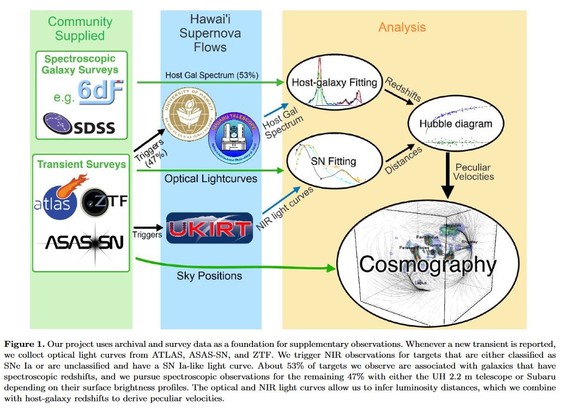
We introduce the Hawai'i Supernova Flows project and present summary statistics of the first 1,217 astronomical transients observed, 668 of which are spectroscopically classified Type Ia Supernovae (SNe Ia). Our project is designed to obtain systematics-limited distances to SNe Ia while consuming minimal dedicated observational resources. To date, we have performed almost 5,000 near-infrared (NIR) observations of astronomical transients and have obtained spectra for over 200 host galaxies lacking published spectroscopic redshifts. In this survey paper we describe the methodology used to select targets, collect/reduce data, calculate distances, and perform quality cuts. We compare our methods to those used in similar studies, finding general agreement or mild improvement. Our summary statistics include various parametrizations of dispersion in the Hubble diagrams produced using fits to several commonly used SN Ia models. We find the lowest dispersions using the \texttt{SNooPy} package's EBV\_model2, with a root mean square (RMS) deviation of 0.165 mag and a normalized median absolute deviation (NMAD) of 0.123 mag. The full utility of the Hawai'i Supernova Flows data set far exceeds the analyses presented in this paper. Our photometry will provide a valuable test bed for models of SN Ia incorporating NIR data. Differential cosmological studies comparing optical samples and combined optical and NIR samples will have increased leverage for constraining chromatic effects like dust extinction. We invite the community to explore our data by making the light curves, fits, and host galaxy redshifts publicly accessible.
By using public data from the #SDSS, #researchers have analyzed the #kinematics of #satellitepairs around #massivegalaxy groups. Findings suggest that the #universe may be younger than predicted by the #LCDM model with #Planck #cosmologicalparameters.

In standard cosmological models, the formation of cosmological structures begins with the emergence of small structures, which subsequently undergo hierarchical merging, leading to the formation of larger systems. As the universe ages, massive galaxy groups and clusters, being the largest systems, tend to increase in mass and reach a more dynamically relaxed state.
Great paper by Mirjam Guesgen for @Motherboard @VICENews on the discovery of the Big Ring
On the proximity of this structure with the Giant Arc:
“Identifying two extraordinary ultra-large structures in such close configuration raises the possibility that together they form an even more extraordinary cosmological system.” @morninglopez (co-author of the discovery)
https://www.vice.com/en/article/m7bwea/scientists-discover-big-ring-ultra-large-structure-in-space
#bigring #giantarc #galaxies #quasars #sdss #cosmology #astronomy #astrophysics #astrodon #space #science
I'm excited to present at the Spatial Data Science Symposium coming up this week! I've written up the content of the presentation for anyone interested in learning more https://shriv.github.io/sdss-2023/
#sdss2023 #sdss #r #python #geospatial #datascience #nz #wellington #walkability

 Kelly Bodwin
 RTN
RTN Corrado
 Shrividya Ravi