Sacroiliac joint MRI for diagnosis of ax-SpA: algorithm to improve the specificity of the current ASAS MRI criteria - European Radiology
Objective To compare sacroiliac joint (SIJ) lesions on MRI in women with versus without axial spondyloarthritis (ax-SpA) and establish an algorithm to determine whether such lesions are due to ax-SpA. Methods This retrospective comparative study assessed bone marrow edema (BME), sclerosis, erosions, osteophytes, and ankylosis at the SIJ in two groups of women, one with and another without ax-SpA. Sensitivity and specificity were calculated for combinations/characteristics of lesions, using rheumatologists’ assessment with assessment of spondyloarthritis international society (ASAS) criteria as the gold standard for diagnosis of ax-SpA. Results Compared to women without ax-SpA, women with ax-SpA had more BME (61% vs 17%, p < 0.001), sclerosis (40% vs 22%, p < 0.001), erosions (35% vs 5%, p < 0.001), and ankylosis (2% vs 0%, p = 0.007), but less osteophytes (5% vs 33%, p < 0.001). The ASAS MRI criteria yielded 59% sensitivity and 88% specificity, while a new algorithm achieved 56% sensitivity and 95% specificity using the following criteria: no osteophytes at the SIJ and either (i) BME at the SIJ with at least one dimension ≥ 8 mm or (ii) at least one erosion at the SIJ. Conclusions We recommend the following pragmatic algorithm for MRI diagnosis of ax-SpA in women: no osteophytes at the SIJ and either (i) BME at the SIJ with at least one dimension ≥ 8 mm or (ii) at least one erosion at the SIJ. The false positive rate when using the new algorithm (3.3%) is less than half than when using the ASAS MRI criteria (7.7%); thus, its application in clinical practice could reduce overdiagnosis and prevent overtreatment of ax-SpA. Clinical relevance statement The developed algorithm has a false-positive rate that is less than half than when using the ASAS MRI criteria (3.3% vs 7.7%), thus its application in clinical practice could reduce overdiagnosis and prevent overtreatment of axial spondyloarthritis. Key Points • Compared to women without axial spondyloarthritis (ax-SpA), women with ax-SpA had a significantly higher prevalence of bone marrow edema (BME), sclerosis, erosions, and ankylosis, but a significantly lower prevalence of osteophytes. • A new algorithm for positive ax-SpA based on sacroiliac joint MRI was developed: no osteophytes at the sacroiliac joint (SIJ) and either (i) BME at the SIJ with at least one dimension ≥ 8 mm or (ii) at least one erosion at the SIJ. • We recommend this new algorithm for diagnosis of ax-SpA in women, as it has a significantly better specificity than the assessment of spondyloarthritis international society (ASAS) MRI criteria and less than half the false positive rate; thus, its application in clinical practice could reduce overdiagnosis and prevent overtreatment of ax-SpA.
 Scientific Frontline

 All Scientifical
 The vOICe vision BCI 🧠🇪🇺
 Anil
Anil
 Research in English
 getmisch
 European Radiology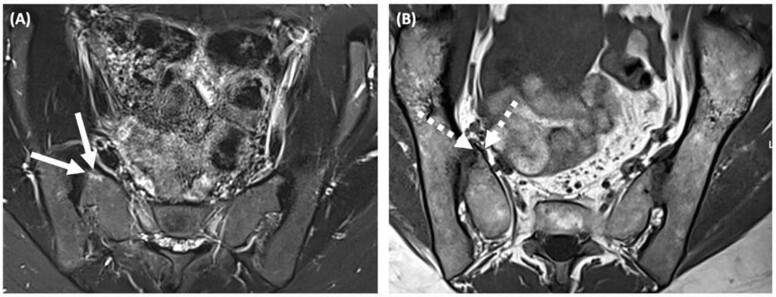

 New Submissions to TMLR