French Buyers of US Cheese Company Fail to Revive Florida Suit

French nationals who bought a US-based cheese distribution company can’t sue the sellers in Florida courts just because the buyers hired a lawyer based…
#dining #cooking #diet #food #Frenchcheese #Cheese #civilfraud #corporateofficers #dismissal #francais #france #French #frenchcheese #negotiatedacquisitions #personaljurisdiction
https://www.diningandcooking.com/2168297/french-buyers-of-us-cheese-company-fail-to-revive-florida-suit/

French Buyers of US Cheese Company Fail to Revive Florida Suit - Dining and Cooking

French nationals who bought a US-based cheese distribution company can’t sue the sellers in Florida courts just because the buyers hired a lawyer based in

Dining and Cooking

Case of the Day: Fuld v. PLO

The case of the day is Fuld v. Palestine Liberation Organization (S. Ct. 2025). I last wrote about the case when the Second Circuit denied a petition for a rehearing en banc, and friend of Letters Blogatory Maggie Gardner had an excellent post about the case at about the same time at the Transnational Litigation Blog. The claims in the case were brought by American victims of Palestinian terror attacks in Israel and an American victim of a stabbing attack in the West Bank. Both claims were brought under the Antiterrorism Act. The first set of victims won a judgment against the PLO and the Palestinian Authority for more than $600 million after a jury trial. The family of the second victim never made it to trial, as the District Court, after an appellate decision in the first case, ultimately held that it lacked personal jurisdiction in both cases.1

The issue in the case was the constitutionality of the Promoting Security and Justice for Victims of Terrorism Act. That statute (18 U.S.C. § 2334(e)) is long and complicated. Suffice it to say that it creates jurisdiction in Antiterrorism Act claims brought by Americans if the PLO and the PA are continuing to engage in the “pay to slay” policy, under which they pay pensions to terrorists imprisoned for killing Americans or to the families of suicide bombers, and it creates jurisdiction if the PLO and the PA have premises or conduct activities in the US after a specified time (excluding their missions to the UN). If the statute is constitutional, then the court had personal jurisdiction in the two cases; but the PLO and the PA did not (the lower courts found) have sufficient contacts with the United States to satisfy ordinary personal jurisdiction test under the Due Process Clause. But the case was in federal court and arose under federal law. The question was whether the Fifth Amendment, which contains the Due Process Clause applicable in the case, has the same minimum contacts requirement as the Fourteenth Amendment, which contains the Due Process Clause that limits the jurisdiction of the state courts.

Ordinarily, the Federal Rules of Civil Procedure make it clear that the personal jurisdiction of the federal courts is coextensive with the personal jurisdiction of the courts of the state where the federal court sits.2 More specifically, FRCP 4(k)(1)(A) provides that service of a summons on a defendant is sufficient to vest the court with personal jurisdiction if the defendant “is subject to the jurisdiction of a court of general jurisdiction in the state where the district court is located.” But FRCP 4(k)(2) provides a residual federal jurisdiction if the claim arises under federal law, the defendant is not subject to personal jurisdiction in the courts of any state, and the exercise of jurisdiction is constitutional. And FRCP 4(k)(1)(B) provides for federal jurisdiction “when authorized,” as here, “by a federal statute.” So this is one of the rare cases where the courts have to consider whether the Fifth Amendment and the Fourteenth Amendment impose the same limitations on jurisdiction.

The Court, in a unanimous decision (two of the justices, Justices Thomas and Gorsuch, concurred in the judgment but did not join the Chief Justice’s opinion for the Court) reversed, holding that the statute was constitutional because the Fifth Amendment did not require the minimum contacts required under the Fourteenth Amendment, and because whatever the limitations on personal jurisdiction under the Fifth Amendment—if there are any—the statute did not exceed them.

My fear in advance of the decision was that the court would look to the original meaning of the words of the Due Process Clause at the time of ratification of the Bill of Rights, after the Revolution, and at the time of ratification of the Fourteenth Amendment, after the Civil War, and decide that the same words (or very nearly the same words) mean different things. That would have been a Bad Thing. Instead, the court did what I think, as a general rule, courts should do. It asked, “What is the Fifth Amendment for?” and “What is the Fourteenth Amendment for?” and let the answer to those questions guide the decision. The gist of the analysis is that the Fourteenth Amendment aims to regulate the jurisdiction of the states vis-à-vis each other (as well as to ensure fairness to defendants). But the Fifth Amendment has no analogous function, because the national government has no horizontal competitors. (Vertical competition with the states is regulated by Article III’s limitations on the federal courts’ subject-matter jurisdiction, and those limits weren’t in play here). I am okay with the analysis, though I do think that it would have been forward-looking at least to consider whether the Due Process Clause has a role in regulating the jurisdiction of American courts vis-à-vis foreign courts. Perhaps nothing would come of that, but there is an implicit international system of allocating jurisdiction among national courts, a point the court referenced when discussing the interests of foreign litigants in not being haled into an American court–see below. I also wonder whether the functional explanation the court gave is really strong enough to overcome what seems to me to be a very strong presumption: when two related statutes (or constitutional provisions) use the same words, we should require a very strong reason before holding that they don’t mean the same thing.

The court left for another day the limits of the Fifth Amendment, refusing the adopt the petitioners’ argument that the Fifth Amendment imposes no territorial limitations. It reasoned that whatever the limits are, the statute, which was narrowly drawn to provide a forum for cases with a clear nexus with the national interest and the private interests of American victims of terrorism, while not subjecting foreign defendants to US jurisdiction in a wide range of cases.

  • You might think this is odd, since the FSIA (28 U.S.C. § 1330(b)) provides that “personal jurisdiction over a foreign state shall exist as to every claim for relief over which the district courts have jurisdiction” under one of the exceptions to foreign sovereign immunity in the statute, provided the foreign state has been served with process. And Palestine is a state, right? Well, the United States does not recognize it as a state, and the court did not inquire any further into the point. Nor, it seems, was the PA eager to press the point. The question of Palestinian statehood comes up in lots of legal contexts (e.g., the ICC’s jurisdiction over alleged Israeli war crimes), and it certainly suits the PA to be a state in that context but not in this context. ↩︎
  • In this discussion I use the word “state” in the US sense, that is, “state of the United States.” ↩︎
  • #Palestine #personalJurisdiction

    Case of the day: Devas v. Antrix

    Credit: Joe Ravi (CC BY-SA)

    The case of the day is Devas Multimedia Pvt. Ltd. v. Antrix Corp. Ltd. (S. Ct. 2025), my “case to watch” from March 7, 2025. Antrix was an Indian state-owned enterprise that promoted and marketed the Indian space program. It signed a satellite leasing contract with Devas, an Indian company, und which Antrix would build a satellite and put it in geostationary orbit, and Devas would lease network capacity on the satellite to provide multimedia broadcasting service throughout India. After years of work leading up to the launch, but before the launch itself, the Indian government decided it needed the S-band spectrum, the part of the satellite’s spectrum that Devas planned to lease, for its own purposes. So it caused Antrix to terminate the contract, citing the government’s new policy and the force majeure clause. Devas brought an arbitration, asserting that the force majeure was “self-induced” and that Antrix was liable for breach. The arbitrators awarded more than $500 million in damages. Devas confirmed the award in courts in France and the UK and sought confirmation in the Western District of Washington. Antrix moved to dismiss on the grounds that the court lacked jurisdiction. That argument seems like a loser on its face, because the FSIA has an exception to the ordinary rule of foreign sovereign immunity in cases seeking confirmation of an arbitral award if the award is “governed by a treaty or other international agreement in force for the United States calling for the recognition and enforcement of arbitral awards.” And the district court did confirm the award and entered a $1.3 billion judgment.

    Then the case took a turn. An Indian court held that Devas had fraudulently induced Antrix to enter into the contract. The Indian government then seized Devas in order to wind down its business. Several shareholders, and an American subsidiary of the company, then sought to intervene in the US case so that they could seek to enforce the judgment, and the court allowed the intervention. An Indian court also set aside the award in light of the finding of fraud.

    On appeal, the Ninth Circuit reversed, holding that the district court lacked personal jurisdiction. Come again? Ordinarily everyone understands that when an FSIA exception to foreign sovereign immunity applies, the court necessarily has personal jurisdiction. The statute says that the court has personal jurisdiction “as to every claim for relief over which the district courts have jurisdiction” because no exception to immunity applies “where service has been made under [28 U.S.C. §] 1608.” But the Ninth Circuit held that Devas also had to show sufficient minimum contacts between the sovereign defendant and the United States. Hence today’s case.

    Today’s unanimous decision, by Justice Alito, dispatched the Ninth Circuit’s statutory analysis. The text of the statute is pretty darn clear, and in fact, the requirement of connection with the United States is built into many of the FSIA’s exceptions.1 The Court also found the legislative history supported the conclusion. I am always happy to see the Court cite legislative history, and in particular the House Report on the FSIA, though I note that here it cited the legislative history “to the extent it is relevant,” which I assume was the price of keeping the decision unanimous.

    But Devas didn’t even try to defend the Ninth Circuit’s statutory analysis. Instead, it argued that the minimum contacts requirement followed from the Due Process Clause, which is to say that a foreign sovereign is a “person” entitled to due process for constitutional purposes. Unfortunately but probably predictably, the Court avoided decision on that issue, because the Ninth Circuit hadn’t addressed it. Thus it remanded the case for further proceedings.

  • The commercial activity exception, for example, requires commercial activity “carried on in the United States,” or a commercial act abroad “that causes a direct effect in the United States.” The expropriation exception requires that the expropriated property, or property exchanged for it, be “present in the United States in connection with a commercial activity carried on in the United States.” And so on. ↩︎
  • #FSIA #India #personalJurisdiction

    File:Panorama of United States Supreme Court Building at Dusk.jpg - Wikimedia Commons

    Case to watch: Devas v. Antrix

    Credit: Joe Ravi (CC BY-SA)

    Friend of Letters Blogatory Ingrid Brunk has a good post at the Transnational Litigation Blog about the oral argument in Devas v. Antrix, the case that asks whether it’s necessary, when seeking to confirm an arbitral award against a foreign state, to prove some connection between the foreign state and the United States. That could be so either because the foreign state is a “person” entitled to due process, or because the arbitration exception to FSIA immunity has some requirement of a connection.

    There is a lot that’s of interest in the case, and several heavy hitters have filed amicus briefs. Does the “minimum contacts” test of International Shoe and its progeny apply at all in cases governed by the Fifth Amendment rather than the Fourteenth Amendment? Does the FSIA’s arbitration exception have, or imply, some sort of minimum contact or nexus requirement? My own big-picture view, which has little to do with the way the case has was argued,1I haven’t read the amicus briefs, so perhaps one of the amici is thinking along similar lines. is that it doesn’t make any sense to require minimum contacts in any case seeking recognition and enforcement of a foreign money judgment or an arbitral award for damages. The main reason judgment creditors or award creditors seek recognition and enforcement in the United States is to try to satisfy the judgment or award by looking to assets in the United States.2That’s not the only reason, and there are classes of cases for which it’s not even the main reason. We ought to dust off the unpopular notice of quasi in rem jurisdiction and say that when you’re seeking to enforce a judgment or award by looking to property in the United States, the courts have jurisdiction to the extent of the property. Otherwise the United States becomes a haven for judgment and award debtors to stash their property.

    I find quasi in rem jurisdiction fascinating, and the aversion to it hard to understand. Some older posts on the issue that you might find interesting are one on AHAB v. Standard Chartered Bank (D.C. 2014), one on Harvardsky Prumyslovy Holding, A.S. v. Kozeny (N.Y. App. Div. 2018), and one on Desiano v. Envision Foods (Mass. Super. Ct. 2017).

    • 1 I haven’t read the amicus briefs, so perhaps one of the amici is thinking along similar lines.
    • 2 That’s not the only reason, and there are classes of cases for which it’s not even the main reason.

    #arbitration #FSIA #NewYorkConvention #personalJurisdiction #quasiInRem

    File:Panorama of United States Supreme Court Building at Dusk.jpg - Wikipedia

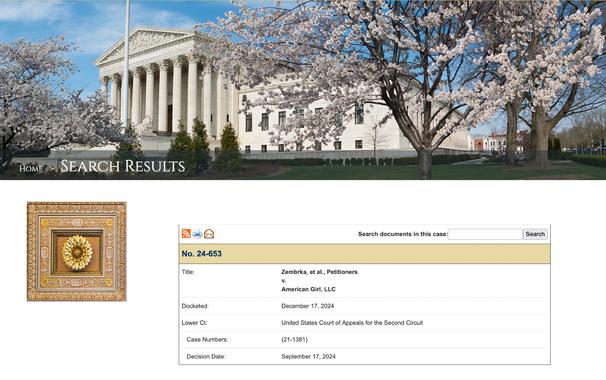
    Interesting cert petition: Zembrka v. American Girl: www.supremecourt.gov/search.aspx?... This isn't a #ScheduleA case (at least, not as I'm currently defining it) BUT the issue here is highly relevant for Schedule A cases--and for many others. #CivProMatters #PersonalJurisdiction
    Search - Supreme Court of the United States

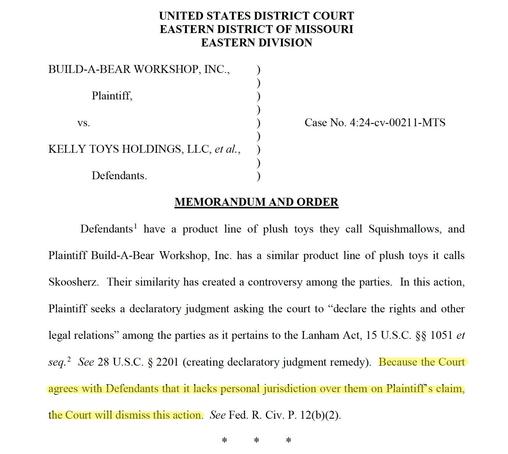
    Build-A-Bear v. Kelly Toys - Order dismissing case | PDF | Personal Jurisdiction | Trade Dress

    Build-A-Bear v. Kelly Toys - Order dismissing case

    Scribd

    The case of the day is Fuld v. PLO (2d Cir. 2024). It’s a denial of a petition for an en banc rehearing in an important personal jurisdiction case, and since the Second Circuit is so stingy with en banc rehearings, the decision isn’t a surprise. There are, though, two interesting opinions, one a concurrence from Judge Bianco, who was on the panel, and the other a dissent by Judge Menashi. Maggie Gardner has a terrific post at the Transnational Litigation Blog that gives the background and details the two opinions, so I am not going to write at length. Here are a few thoughts about the case:

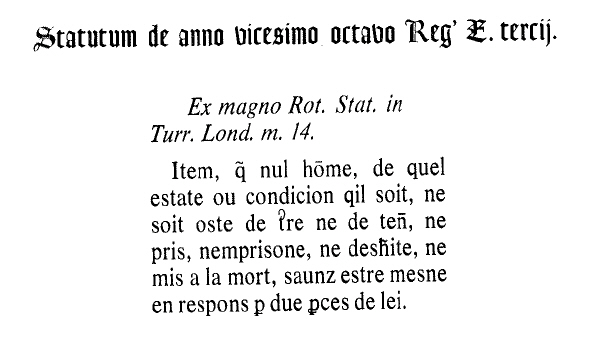
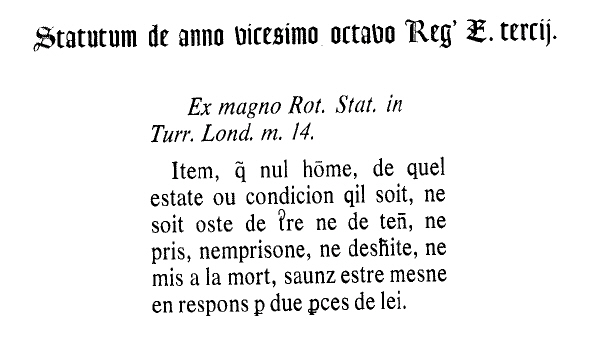
  • The dissent argues that the Fifth Amendment does not limit the reach of the federal courts’ personal jurisdiction in the same way that the Fourteenth Amendment limits the reach of the state courts’ personal jurisdiction. It’s true that the Supreme Court has left that question open, and it may be true, if you believe that what matters is the original meaning of the text, that what “due process of law” meant in 1791 is not the same as what it meant in 1868, just as it meant something different in 1215 or 1354. I am not going to go astray by criticizing the curious premise that what matters is the original meaning of the words of the Constitution or its amendments at the time of ratification. Instead, I want to focus on the practical implications of decoupling the Fifth Amendment from the Fourteenth Amendment. FRCP 4(k)(1) provides that a federal court can exercise jurisdiction if the defendant “is subject to the jurisdiction of a court of general jurisdiction in the state where the district court is located.” The idea of the rule is to keep the jurisdiction of the federal courts in sync with the jurisdiction of courts of the states where they sit.1 I can only imagine the mischief if the jurisdictional analysis in a diversity case were not identical in state and federal court. Suppose I have a claim against a foreign defendant and my claim is within the state’s long-arm statute, but the defendant lacks minimum contacts with the forum state under the Fourteenth Amendment. Can I bring the claim in federal court in the first instance (assuming the amount-in-controversy requirement is met)? Does Rule 4(k)(1) just mean that the the requirements of the long-arm statute have to be met, or does it mean that the federal court can only exercise jurisdiction only if the state court could exercise jurisdiction only if the state court could exercise jurisdiction under the Fourteenth Amendment, even though the Fourteenth Amendment does not apply to the federal courts?
  • There is something really artificial about the case. Consider that the only reason all of these issue are arising here rather than in some other case is that the court is not treating Palestine as a state. If Palestine were a state, then it would have no due process rights and the question would be whether the case comes within one of the statutory exceptions for foreign sovereign immunity. Perhaps you will say that this is not such a big deal, since what matters is whether the Executive recognizes Palestine as a state. But in earlier cases, Palestine had to argue that it should not be recognized as a state in order to avoid potentially large liabilities in terrorism cases. And as friend of Letters Blogatory David Stewart has written in the FJC’s guide to the FSIA: “Formal diplomatic or political recognition of the foreign state or government by the United States is not a statutory prerequisite. However, in some circumstances, the fact that the U.S. Government has given formal recognition to a named defendant as a ‘foreign state’ has been found relevant.” Just pause to consider how important it is to Palestine to be considered a state so that the ICC can exercise jurisdiction over alleged war crimes in the territory of Palestine, and how important it is to Palestine not to be considered a state so that it is can avoid the possibility of big liabilities in the United States to victims of alleged acts of Palestinian terrorism or their survivors.
  • Image credit: UK National Archives (Open Gov’t License)

    https://lettersblogatory.com/2024/05/19/case-of-the-day-fuld-v-plo/

    #Palestine #personalJurisdiction

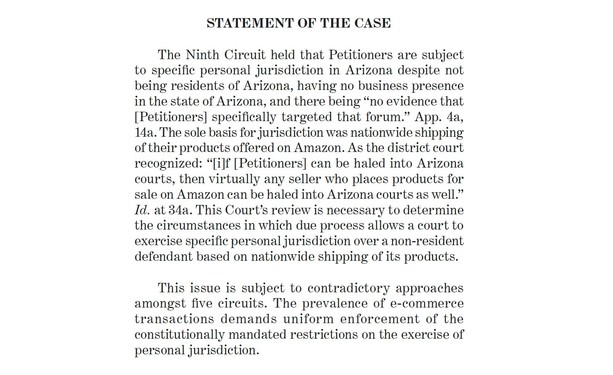
    In other SCOTUS news, Herbal Brands has (not surprisingly) filed no response to Photoplaza's petition for cert (this is the Amazon personal jurisdiction case):

    https://www.supremecourt.gov/Search.aspx?FileName=/docket/docketfiles/html/public\23-504.html

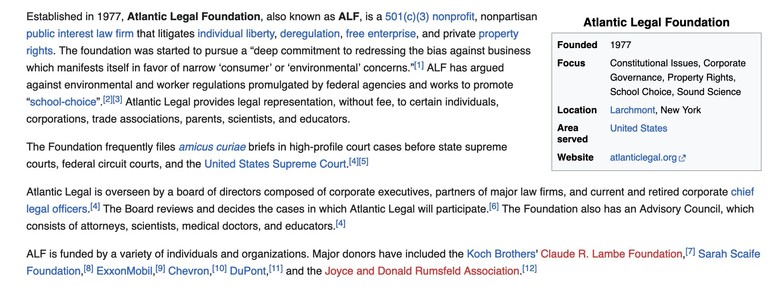
    The Atlantic Legal Foundation has, however, filed an amicus brief in support of Photoplaza.

    #Trademarks #SCOTUS #PersonalJurisdiction #CivProMatters

    Search - Supreme Court of the United States

    Interesting new cert petition:

    Amazon marketplace sellers ask SCOTUS to decide "[w]hether a seller whose products ship nationwide is subject to personal jurisdiction in every forum into which even one of its products is shipped."

    https://www.scribd.com/document/684964809/Photoplaza-v-Herbal-Brands-Cert-petition

    This isn't a #ScheduleA case but this issue raised here is extremely relevant to the viability of the Schedule A model.

    #PersonalJurisdiction #CivProMatters

    Back to the motion to dismiss: https://storage.courtlistener.com/recap/gov.uscourts.flsd.649449/gov.uscourts.flsd.649449.133.0.pdf

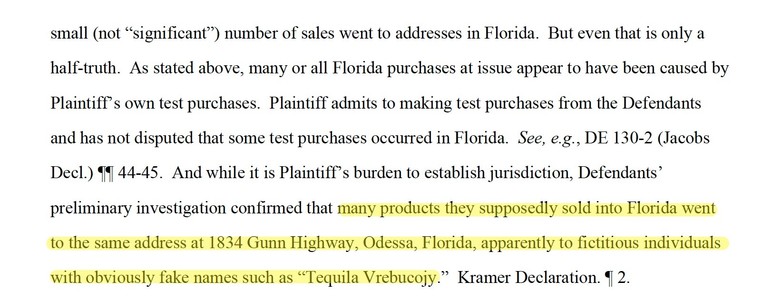
    This little gem is too good not to share.

    "[M]any products they supposedly sold into Florida went to the same address at 1834 Gunn Highway, Odessa, Florida, apparently to fictitious individuals with obviously fake names such as "Tequila Vrebucojy.'"

    #ScheduleA #BettysBest #TequilaVrebucojy #PersonalJurisdiction #CivProMatters