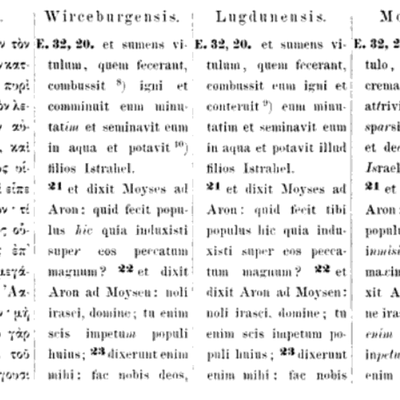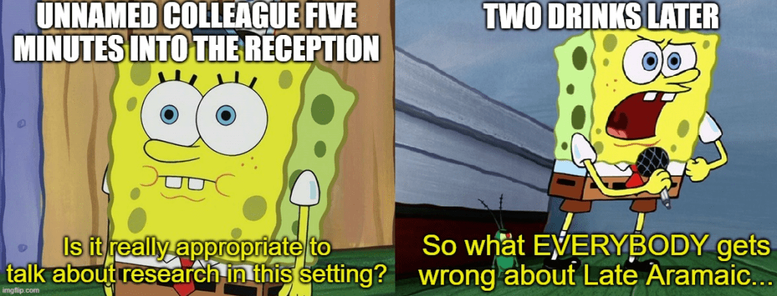
Also, any recommendations for research at the intersection of source criticism & textual criticism?
#HebrewBible #Pentateuch
2/2

I'm trying to figure out why scholars rejecting Mosaic authorship adopted the (Graf-Wellhausen) Documentary Hypothesis. Part of the answer is Astruc's earlier work on Moses's sources. But I've found only a terse reference to a "Supplementary hypothesis" & "Fragmentary hypothesis" as alternatives.

Can anyone recommend discussions of the (19th-C) Supplementary &/or Fragmentary hypotheses of Pentateuchal composition & why they were ultimately spurned by critical scholars?
#HebrewBible #Pentateuch

Samaritanism

Samaritanism is an Abrahamic monotheistic, ethnic religion. It comprises the collective spiritual, cultural, & legal traditions of the Samaritan people.

Often preferring to be called Israelite Samaritans, who originated from the Hebrews & Israelites. They began to emerge as a relatively distinct group after the Kingdom of Israel was conquered by the Neo-Assyrian Empire during the Iron Age. The Neo-Assyrian Empire was the 4th, & penultimate, stage of ancient Assyrian history.

Central to their continuity as an Indigenous Heritage in the Holy Land is keeping the Patriarchal & Mosaic covenant as specified in the Samaritan Torah. Samaritans believe this is the original & unchanged version of the Pentateuch (which is the first 5 books of the Hebrew & Christian bible) since Moses & the Israelites at Mount Sinai.

The Abisha Scroll is traditionally held by the community to be the oldest existing scroll written by Abisha, son of Aaron the priest, around 3,000 years ago based on living tradition. However, Jewish & Christian theologians have made attempts to dispute this claim which proved unsatisfactory.

Judaism claims Samaritanism developed right alongside their own religion. Samaritanism asserts itself as the true preserved form of the monotheistic faith that the Israelites kept under Moses. Samaritan belief also holds that the Israelites’ original holy site was Mount Gerizim, near Nablus, the State of Palestine (West Bank).

They also believe that Jerusalem only attained importance under Israelite dissenters who had followed Eli (In the Book of Samuel, Eli was a priest & judge of the Israelites in the city of Shiloh) to the city of Shiloh.

The Israelites who remained at Mount Gerizim would become the Samaritans in the Kingdom of Judah. Mount Gerizim is revered by Samaritans as the location where the Binding of Isaac occurred. In comparison to the Jewish belief that it occurred at Jerusalem’s Temple Mount.

Today there are only about 900 registered communal members. This puts Samaritanism as 1 of the smallest ethnoreligious groups globally in the Abrahamic faiths. Samaritans believe that this is a prophecy fulfilled from the scriptures: “You’ll be left few in number.”

Though they hope for a future time when a prophet like Moses known as the “Taheb” (Restorer) will perform 3 signs, namely the jar of manna, the staff of Moses, & Cherubim, or the Golden Candlestick.

This time period they believe is when an era of Divine Favor would return, & the hidden tabernacle of Moses would miraculously be revealed for the Israelite people & Mount Gerizim is restored to its former glory.

Samaritans trace their history, as a separate entity, to a period soon after the Israelites’ arrival into the “Promised Land.” Samaritan historiography traces the schism to High Priest Eli leaving Mount Gerizim, where stood the 1st Israelite altar in Canaan, & building a competing altar in nearby Shiloh.

The dissenting group of Israelites who followed Eli to Shiloh would be the ones who, in later years, would head south to settle in Jerusalem (the Jews). Whereas the Israelites who stayed on Mount Gerizim, in Samaria, would become known as the Samaritans.

Genetic studies in 2004 suggest that Samaritans’ lineages trace back to a common ancestor with Jews in the paternally-inherited Jewish high priesthood (Cohanim) temporally near to the period of the Assyrian conquest of the Kingdom of Israel. They’re probably descendants of the historical Israelite population. The Cohanim refers to the Jewish priestly class, male descendants of Aaron the priest.

The Hasmonean king, John Hyrcanus, destroyed the Mount Gerizim Temple & brought Samaria under his control around 120 BCE. This led to a long-lasting sense of mutual hostility between the Jews & Samaritans.

From this point, the Samaritans likely sought to consciously distance themselves from their Judean brethren. Both peoples came to see the Samaritan faith as a religion distinct from Judaism. By the time of Jesus, Samaritans & Jews deeply disparaged one another, as shown by Jesus’ Parable of the Good Samaritan.

The main beliefs of Samaritanism are:

  • There’s 1 God, Yahweh, the same God recognized by the Jewish prophets.
  • The Torah is the only true holy book & was given by God to Moses. The Torah was created before the creation of the world & whoever believes in it is assured a part in the world to come. The Torah’s status in Samaritanism as the only holy book causes them to reject the Oral Torah, the Talmud, & all the prophets & scriptures, except for a version of the Book of Joshua (which they don’t hold as Scripture), whose book in the Samaritan community is significantly different from the Book of Joshua in the Jewish “Bible.” Moses is considered to be the last of the line of prophets.
  • Mount Gerizim, not Jerusalem, is the 1 true sanctuary chosen by God. The Samaritans don’t recognize the sanctity of Jerusalem & don’t recognize the Temple Mount, claiming instead that Mount Gerizim was the place where the Binding of Isaac took place.
  • The Apocalypse, called “the day of vengeance,” will be the end of days. When an entity called the Taheb (basically the Jewish Messiah equal) that comes from the tribe of Joseph will come, be a prophet like Moses for 40 years & bring about the return of all the Israelites, following which the dead will be resurrected. The Tahib will then discover the tent of Moses’ Tabernacle on Mount Gerizim, & will be buried next to Joseph when he dies.

The Samaritans have retained the institution of a high priesthood & the practice of slaughtering & eating lambs on Passover Eve. They celebrated Pesach, Shavuot, & Sukkot. But they use a different method from that used in mainstream Judaism in order to determine the dates annually.

For example, Yom Teru’ah (the biblical name for Rosh Hashanah), at the beginning of Tishrei (This is the 1st month of the civil year & the 7th month of the ecclesiastical year in the Hebrew calendar.), isn’t considered a New Year as it is in Rabbinic Judaism.

Their Sabbath is observed weekly by the Samaritan community every week from Friday to Saturday, beginning & ending at sundown. For 24 hours, the families gather together to celebrate the rest day: all electricity with the exception of minimal lighting (kept on the entire day) in the house is disconnected, no work is done, & neither cooking nor driving is allowed.

The time is devoted to worship which consists of 7 prayer services, reading the weekly Torah portion, spending quality time with family, taking meals, rest & sleep, & visiting other members of the community.

Passover is particularly important in the Samaritan community, climaxing with the sacrifice of up to 40 sheep.

The Counting of the Omar remains relatively unchanged. The Counting of the Omar is a ritual in Judaism that consists of a verbal counting of each of the 49 days between the holidays of Passover & Shavuot. However, the week before Shavuot is a unique festival celebrating the continued commitment Samaritanism has maintained since the time of Moses.

During Sukkot, the Sukkah (the temporary hut built for use during Sukkot) is built INSIDE of houses, instead of OUTSIDE like mainstream Judaism. This Samaritan tradition is traced back to the persecution of the Samaritans during the Byzantine Empire.

The roof of the Samaritan Sukkah is decorated with citrus fruits & branches of palm, myrtle, & willow trees. This is in accordance with the Samaritan interpretation of the 4 species designated in the Torah for the holiday. The 4 species are 4 plants (the etrog, lulav, hadass, & aravah) mentioned in the Torah as being relevant to the Jewish holiday of Sukkot.

Make a one-time donation

Your contribution is appreciated.

Donate

Make a monthly donation

Your contribution is appreciated.

Donate monthly

Make a yearly donation

Your contribution is appreciated.

Donate yearly

#120BCE #4Species #Aaron #Abisha #AbishaScroll #AbrahamicFaiths #AncientAssyria #Apoclypse #Aravah #BindingOfIsaac #BookOfJoshua #BookOfSamuel #ByzantineEmpire #Canaan #Cherubim #Christians #CitrusFruits #Cohanim #CountingOfTheOmar #Eli #Etrog #GoldenCandlestick #Hadass #Hasmonean #HebrewCalendar #Hebrews #HighPriestEli #HighPriesthood #IndigenousPeoples #IronAge #IsraeliteSamaritans #Israelites #Jerusalem #Jesus #Jewish #JewishProphets #Jews #Joseph #Judah #KingJohnHyrcanus #KingdomOfIsrael #Lulav #Manna #Messiah #MosaicCovenant #Moses #MountGerizim #MountSinai #Myrtle #Nablus #NeoAssyrianEmpire #OralTorah #Palestine #ParableOfTheGoodSamaritan #Passover #PatriarchalCovenant #Pentateuch #Priest #PromisedLand #RabbinicJudaism #RoshHashanah #Sabbath #SamaritanTorah #Samaritanism #Shavuot #Shiloh #StaffOfMoses #Sukkah #Sukkot #Tabernacle #Taheb #Talmud #TempleMount #Tishrei #Torah #WestBank #Willow #Yahweh #YomTeruAh

SBL International: some talks I attended

(Live tweeting conferences is out; post hoc blogging about them is the new thing.)

Last week saw the 2024 Society of Biblical Literature International Meeting held at the Vrije Universiteit Amsterdam, advertised with pictures like this:

despite being held about an hour’s walk from where that picture was taken, at a place that looks like this:

It’s nicer on the inside.

As an International Meeting, this was considerably smaller than the SBL’s Annual Meetings in the US, with only(!) some 550 attendees. Unlike the gargantuan Annual Meeting I attended in 2018, I actually found this quite manageable and even enjoyable. And like the Annual Meeting, there were lots and lots of talks and other events. Here’s an overview of some of the ones I attended, in chronological order.

After some admirably concise and entertaining opening words by Steed Davidson (SBL Executive Director) and Bert-Jan Lietaert Peerbolte (VU Amsterdam), the conference kicked off on Sunday afternoon with a reception. Great snacks, 4/5, would be received again.

Monday talks:

  • John Will Rice analyzed passages in the books of Kings on “the sin of Jeroboam” and argued that at an earlier stage, this was Jeroboam (I)’s establishment of a “Battei Bamoth” sanctuary at an unnamed location, with non-Levitical priests, and a different festival calendar. This was later conflated with a separate tradition on Josiah destroying an altar at Bethel to make Jeroboam responsible for building that altar and putting a golden calf idol there. Rice suggests this was done to avoid the awkwardness of having Josiah destroying an altar that was now believed to have been built by the patriarch Jacob.
  • Jorik Groen gave a great talk (as his co-supervisor and one-time coauthor, I’m completely unbiased) exploring and explaining the different uses of Biblical Hebrew בּוֹא and English to come. Slides here.
  • Drawing on previous work by Yochanan Breuer and new research, Yosef Ofer presented some cases where the cantillation of the Masoretic Text reflects a mix of competing traditions. The main case study was on Isaiah 45:1, where cantillators disagreed about whether God is calling the Persian king Cyrus his Messiah or not:
  • A session on the Semantics of Ancient Hebrew Database talked about the semantics of עֶבֶד ‘slave’ or ‘servant’ (Cornelius Haposan Sinaga), חוֹתָם ‘seal’ (Marjo Korpel), and the hapax legomenon חַשְׁמַנִּים, possibly ‘amethysts’ (a posthumous suggestion by Meindert Dijkstra presented by Paul Sanders).
  • Ivri Bunis and myself presented something we’ve been meaning to work on for a while now, connecting his observations on medial deixis pronouns with prefixed hallā- with some stuff I’ve done on similar-sounding presentatives in Hebrew and other Semitic languages. Slides here.
  • In the same session, Dong-Hyuk Kim presented a recent analysis that says English “adverbs of time and place” like here, there, then, now and so forth should actually be seen as intransitive prepositions and applied it to Biblical Hebrew (which is harder, as adverbs are less clearly marked than in English). It sounds weird, but I was fully convinced.

Tuesday talks:

  • Nili Samet asked: whose voice do we hear in the pessimistic, life-negating “Better Than” proverbs in Qohelet 7:1–9? Not Qohelet’s: it contradicts his philosophy elsewhere in the book. Not a later editor’s, either, as the passage is well integrated into the book and Qohelet comments on it. Nor that of classical wisdom, as it contradicts the world view of Proverbs, for example. Drawing on parallels in Tractate Avot and Ben Sira, Samet makes a plausible case that Qohelet is critically quoting another wisdom school from the Hellenistic period, that would end up influencing pre-Rabbinic and early Rabbinic wisdom literature.
  • Kyle Young reconsidered Alexander Sperber’s choice of a manuscript on which to base his edition of Targum Onqelos and concludes that while it’s not perfect, it’s acceptable until something better comes along.
  • In my second talk this conference, I went before the Pentateuch section to ask them why, if you believe the E source is a thing, Genesis 14 can’t be its missing beginning. For the (mostly European) scholars present, the answer is “we don’t believe in E so who cares lol” (to be fair, I’m not sure I do either). But they were very nice about it, had helpful methodological pointers, and seemed to be convinced by some possible connections I suggested between Genesis 14 and other texts. Slides here.
  • The last session I attended on Tuesday focused on Qumran Cave 11, with non-Biblical texts that were published by a Dutch team. Eibert Tigchelaar (KU Leuven 🥳) gave us some historical background on two (given time constraints, mainly one) of the leading scholars, one of whom was problematic (as in publishing 1940 pamphlets on “The Jewish Question” problematic). David Shepherd showed that the Job “Targum” from Cave 11 does not yet employ a Targumic translation technique, like earlier translations into Aramaic. And Rebekka Luther also talked about the Job Targum (pace Shepherd), arguing that its translator purposefully edited it to change (improve?) the picture of Job it presents.

Wednesday talks:

  • Charbel El-Khaissi presented his ongoing PhD research on the generalization of the definite article in Syriac, showing that this was a gradual development in some environments. I like the data-heavy approach.
  • Margaretha Folmer (Leiden University 🥳) presented three marginal linguistic features in Targumei Onqelos (Pentateuch) and Jonathan (Prophets). Besides being very interesting in their own right, that they appear in the same way in both targumim supports the view that these are written in practically the same form of Aramaic, which bears on the history of their translation and transmission.
  • Emanuel Tov, in his eighties now, is the doyen of Dead Sea Scrolls research, so it was cool to attend his talk on correctional practices at Qumran. Lots of ḋȯṫṡ and strikethroughs.
  • Against the dominant (in Europe) view that the Priestly source ends in Leviticus or even Exodus, Bruna Velcic made a strong case that the spies narrative in Numbers 13 and 14 really is Priestly too (and not just post-Priestly), based both on form and contents. No conclusion on where P does end.
  • I got to chair a session featuring four speakers from Scriptura (Elizabeth Robar, Ian Atkinson, Drew Longacre, and Joseph Habib), talking about poetry, mainly Psalm 68, a major source of headaches for everyone involved.

Thursday was a half day. I attended both of the sessions on the study of pre-modern Judaism in the Low Countries, including:

  • Jonathan Stökl (Leiden University 🥳)’s enigmatically, even ominously titled talk “Elefantine…” considered different models for the religious identity of the Judean(?) community on the southern border of Achaemenid Egypt. Should we call them Jews, Yahwists, or something else altogether?
  • Willem Smelik presented on the practice of adding cantillation marks to targum manuscripts and possible implications for liturgical and study practice.
  • Joachim Yeshaya (until recently[?], KU Leuven 🥳) told us about Abraham Ibn Ezra, one of the great commentators and poets of Sepharad, and the connection between his poetry and his commentary on the Song of Songs.

Finally, a shoutout to Matthew Saunders, who attended the conference without presenting, but who also maintains a very in-depth blog on Semitic languages.

All in all, it was great to have so many people come hang out and present their work at a half-an-hour train ride from my house. They should do that more often. I look forward to seeing a lot of the ideas presented last week in print soon and, hopefully, the people presenting them too.

#Aramaic #Bible #conference #DeadSeaScrolls #Exodus #Genesis #Hebrew #Isaiah #Kings #linguistics #news #Numbers #Pentateuch #Psalms #Qohelet #SongOfSongs #Targum

(Northwest) Semitic sg. *CVCC-, pl. *CVCaC-ū-: Broken plural or regular reflex?

This paper provides a new explanation for the insertion of *a in plural forms of *CVCC-nouns also formed with an external plural suffix, e.g. *ʕabd- : *ʕabad-ū- 'servant(s)', in various Semitic languages. This *CVCaC-ū- pattern is usually

Pesach is just around the corner, so let’s talk about the Exodus. In the second part of The Forgotten Kingdom Chapter 6, Israel Finkelstein comments on the other “charter myth” of the northern kingdom: that of the exodus from Egypt and wandering in the desert. We might add the conquest of Canaan.

Unlike the mostly geography-based arguments for dating the Jacob traditions, Finkelstein lists some results from “[r]ecent research on the Pentateuch”, some of which is more controversial than he presents:

  • “this narrative had an important status in northern Israel as early as the eighth century B.C.E.”;
  • “it contains an ‘inner’ literary history” (this is not so much a real guideline for dating the tradition as a reason to ignore some literary data if they seem to be secondary—fair enough);
  • “it was originally independent from, and earlier than, the patriarchal stories”;
  • “the two blocks—patriarchs and exodus—were connected by a Priestly author at a relatively late date”, i.e. during or after the Babylonian Exile (sixth century);
  • “in the present form the narrative represents a Priestly (or even late Priestly and/or post-Priestly) compilation”.
  • On point 1:

    From the prophecies of Hosea (2:14–15; 9:10; 11:1, 5; 12:9, 13; 13:4–5) and Amos (2:10; 3:1; 9:7), and possibly also from a Kuntillet ‘Ajrud inscription that may refer to the theme of the exodus (Na’aman 2012a), it is clear that the exodus-desert tradition was well known in the northern kingdom in its later days. But what was the source of this tradition? How far back before the eighth century could one trace it?

    Finkelstein (2013: 146)

    Not very far back, if you ask Finkelstein. He follows scholars who state that there’s nothing in the Exodus traditions that can only reflect an accurate memory from the Late Bronze Age. And since Finkelstein relies on the (supported, to be fair) assumption that scribal activity in Israel only really got going around 800 BCE, he thinks it would be unrealistic for traditions from the thirteenth century or earlier to have survived for that long orally in any significant form. So instead, he identifies the historical kernel of the Exodus in an event we’ve already discussed: “Egyptian intervention in the highlands in the tenth century B.C.E.”

    Yes, that’s the wrong Shoshenq (II).

    Without detracting from my appreciation for the book as a whole: this is weak. The only element that Shoshenq’s Palestinian campaign shares with the Exodus narrative is “Egypt bad”. Otherwise, I see zero connection between “we were foreigners/slaves in Egypt and left” and “Egyptians came and devastated our country”. Moreover, if this is the basis for the Exodus tradition, I don’t see how it can be older than the patriarchal stories (point 3 above) if the oldest patriarchal material is from the kingdom of Saul (as argued by Finkelstein) and Shoshenq’s campaign put an end to the kingdom of Saul (as also argued by Finkelstein).

    If, instead, we play the geography game again, I think one can make a better case for the pre-monarchic, early Iron I (“Judges”) period as the background for the Exodus and desert wandering traditions. Some arguments I can think of:

  • The sanctuary at Shiloh has literary connections with both the entry into Canaan under Joshua (i.e., the conclusion of the desert wanderings) and the Ark of the Covenant, maybe the most wilderness-wandering artefact out there. As I learned from Finkelstein, Shiloh was destroyed during the Iron I and never recovered. So these traditions must be older than that. (We could apply this to Gilgal too, but as far as I understand, that site hasn’t been identified.)
  • Different biblical sources talk about land in Cis- and Transjordan being conquered from the Amorites. While I don’t think there’s evidence that the historical Amorites were ever that far south, the kingdom of Amurru (in Lebanon) seems not to have survived the Late Bronze Age collapse. The farther you get from the Late Bronze Age, the more any memory of Amorites should have faded.
  • We can add a couple of linguistic arguments, one well known, the other not so much:

  • If the name Moses (mōše) is from the Egyptian root msj ‘to be born’, it shows a *s to š shift that probably took place in the late second millennium BCE.
  • The expression ʔṓhel mōʕēḏ ‘(the) Tent of Meeting’ lacks a definite article. This is unexpected for Hebrew of the Iron Age but matches what we know about Bronze-Age Canaanite, suggesting that the term was inherited from the second millennium and may refer to a structure that also originated then. Like the Ark of the Covenant, the Tent of Meeting is peak wilderness material (perhaps even more so).
  • And of course, there’s the fact that as per Finkelstein, the highlands west of the Jordan were barely inhabited in the Late Bronze Age and then see a bunch of Israelite settlements popping up in the Iron I. This is not impossible to square with a tradition that says “we were somewhere else first and then we came here”.

    So without wanting to go full 600,000 Israelites Exodus truther, I do feel like it works much better to see some Israelite immigration event during the Late Bronze Age Collapse or slightly before as the historical background of the Exodus-Wandering-Conquest traditions. Like I said, I find most of Finkelstein’s book really compelling and also fair when it comes to the biblical evidence. In the case of the Exodus, though, I can’t help but suspect that his unwillingness to consider a Bronze Age setting is due to some ideological bias.

    https://bnuyaminim.wordpress.com/2024/04/19/finkelstein-on-the-exodus/

    #arche #archeology #Bible #Egyptian #Hebrew #Joshua #linguistics #Pentateuch

    Late Iron I Jacob

    Called it. In Finkelstein’s (2013) Chapter 6, on the Jacob and Exodus traditions, he lists some arguments for dating the core of the Jacob cycle in Genesis: “A fundamental myth of the n…

    Benjamin Suchard
    #Deuteronomy is the fifth book in the #Bible and the last book in the #Torah or #Pentateuch. It represents a second giving, or rehearsing, of the #Law. It is ascribed to #Moses, who would have spoken as much just before #Israel entered Canaan.

    @w7voa

    (1/3)

    Wrong call, Mr. President!

    Even by the yardstick of the #Torah (#Pentateuch), "an eye for an eye", way more blood has been shed.

    How many more eyes need to be gouged out for it to be enough?

    The tribal trauma of the #Exodus inspired 4 of the 5 books. The memory of this lives on about 3.500 years later*, is even celebrated (#Passover**).

    The rift between #Palestinians and #Israelis will not be possible to heal within President #Biden's or...

    https://journa.host/@w7voa/111631646753383005