Exploring Deep Space with Seestar S50: A Year in Review

I first bought the Seestar S50 a little over 12 months ago. I ummed and ahhed for ages trying to justify the spend, as although its not a hugely expensive instrument, its not pocket change either.

Eventually at last years New Scientist Live I took the plunge and bought it from First Light Optics. A year later, I’m still amazed at the capability of this deep space observing telescope.

M15 Globular Cluster

Firstly it is so simple to use. It connects to your smart phone and the interface is pretty intuitive. Seestar constantly improves it with updates pushed fairly regularly. I’ve read that some users have experienced issues with certain updates. However, I’ve never experienced this first hand.

Secondly, its really portable. It all fits into a small roughly 30 cm square carry case – which is really handy.

Me being taunted by a dinosaur whilst simultaneously being very happy with my new purchase last year.

The S50 is fantastic for observing and photographing galaxies and nebulae far beyond the edge of our own Milky Way Galaxy. It’s also excellent for capturing comets, the Moon, and the Sun. I’ve even managed to get a recognisable shot of Jupiter out of it. You know, that bright ‘star’ in the winter skies that is now high in the morning skies indicating that Christmas is not that far away.

Sorry for reminding you…

I recently shared some photographs on my social media. They showed the results that this little telescope is capable of. One of the things I find fascinating is watching the telescope build up the picture as it takes the photos. It live stacks them, slowly revealing more and more details of whatever object you are focused on. I also love the tracking. It will locate things that are often very difficult to find in light polluted skies.

Live stacking the image, this is M31/Andromeda with 40 seconds of data

The next step for me will be to get an equatorial mount and try the recently released equatorial mode. This will allow longer exposures without star trails. It should also increase the quality of the images I can take.

Although the scope does a lot of the hard work in getting to an early image, you can still improve upon that with some post processing. I have been using Adobe Lightroom for that. Its pretty easy to use, there is a free version of it and it works on your phone too. Although my initial idea was just to use the scope for capturing some nice images of the universe to look at, share, and print – several of mine are on the wall in my office. I’m keen on exploring its use to do some photometry. The scope stores images in the standard FITS format. With the addition of a blue light filter and an EQ mount for longer exposures, I should be able to get images in both Blue and Visible light. Then, I can process them to create a Colour Magnitude Diagram (CMD).

M31/Andromeda – The finished image, after about 40 minutes of data collection and some post processing in Lightroom

However, for now, I’ll continue to take images of some of the stunning sights our universe has to offer. I love sharing these images and have huge admiration for the astrophotographers who have developed the skills to do this. Skills that I do not have the time or patience to acquire at the moment. Some of the images they take are orders of magnitude better than anything the Seestar can take. But, for ease of use and fun, the Seestar is unmatched. For seeing things you never thought you’d see ‘live,’ it is exceptional. For sharing snapshots on social media, there is no better instrument geared towards amateurs.

I’m a huge convert and have loved having this tool in my kitbag to use alongside my optical telescope.

#astronomy #astrophotography #firstLightOptics #galaxies #nebulae #newScientistLive #science #seestarS50 #space #stars #universe

Exploring Cutting-Edge Technology at New Scientist Live

A cosmic ray detector.

A heart scanner.

And a handheld ultrasound probe that connects to a smartphone.

These were some of the fantastic hands on technology demonstrations that you could see and try out for yourself at this years New Scientist Live. Alongside this were many other interactive exhibits and really interesting and engaging people to speak to. And, as ever, there was also an outstanding program of talks and lectures by world leading scientists and speakers.

Dark Matter

First of all, lets talk dark matter. We don’t know if it exists. However, we infer its presence from many things. One example is the orbital speed of stars within galaxies. These starts are moving faster than they should be for the matter that we see present. This implies there should be something that we can’t see that is responsible for the extra gravity holding those stars in place – dark matter.

A cosmic ray (in green) detected at NS Live by the team on the Lux-Zeplin stand

The Lux-Zeplin dark matter experiment is designed to look for dark matter. However, it is incredibly sensitive and needs to be shielded from all the cosmic rays that are constantly bombarding our planet and even moving through you and I right now. To illustrate their frequency, they set up a cosmic ray detector at the show. It was absolutely fascinating and was easily one of my favourite things to see this year.

Medical Technology

Moving along to medical technology, the Butterfly Network ultrasound probe is an amazing device. It replaces a huge amount of kit. This kit is typically the size of a couple of suitcases and is wheeled around a hospital on a trolley. This new handheld probe plugs into a tablet or smartphone and runs via an app. Much simpler!

Kirsten Christensen-Jeffries and Antonios Pouliopoulos from the team at Kings College London Quiin Lab showed me how it worked. We used it to spot objects in pots of dark liquid as an analogue of doing an actual ultrasound. This experience was informative and great fun.

Using the Butterfly ultrasound probe to detect a flower!

The potential applications for something as mobile as this are clearly huge. The technology is so portable and can be used pretty much anywhere. This includes developing countries or remote villages where this kind of technology would typically not be available.

Moving around the corner I came across the team from Medical Mavericks. They used a small laptop connected to us by 3 stick on disposable sensors. The setup was used to take our heart rate. Again, such impressive tech in a small package using everyday available hardware is sure to be useful in areas where you can’t take huge diagnostic machines. A big shout out to the team who were super enthusiastic and great to talk to as well.

Thankfully my heartrate appeared ok on the day!

Engaging Talks Schedule

One of the highlights for me every year is the talks schedule. There were so many to go to, and as ever, I missed some due to the clashes. However, this year I paid an extra £10 to allow me to see the recordings of the ones I missed – a great facility!

If I had to pick out my two favourite talks, my first would be Tim Gregory‘s session on Nuclear. Tim discussed both previous, current and potential future use of nuclear to power space missions. Tim is a very engaging speaker who is clearly passionate and excited about what he does. That rubs off on the audience and makes his talks so easy to watch and listen to.

Tim Gregory kicking off the Saturday afternoon session with his talk on nuclear power

My other pick would be the final talk of the first day on the Our Planet stage. Dr Gillian Forrester showed how the thermal imaging of facial blood flow can reveal whether humans (and other animals) are stressed or not. I found this absolutely fascinating as this is a phenomenon that is easily measured using simple infrared (IR) cameras that are available today. The research itself was compelling enough, but then Dr Forrester did a live demo with two volunteers from the audience. This really reinforced how usable this method could be for detecting stress using physiologically measurable markers.

Own your own piece of the Universe!

Finally, it wouldn’t be a trip to New Scientist Live if I didn’t visit Martin on the MSG Meteorites stand. This year my haul (as my daughters would refer to it) included a large unclassified meteorite found in North West Africa. It’s fantastic to hold and look at and wonder what secrets it might one day reveal. I also picked up a nice piece of Tektite, which is a natural glass formed from the heat and debris of a meteorite impact. Martin is extremely knowledgeable and passionate about his subject and his stall is packed with fascinating artefacts.

My haul… A lovely piece of Tektite and and a large NWA meteorite

There is so much more to write and congratulations if you’ve got this far. If you’ve never been, I highly recommend it. This was our third year and every year it’s better and better. You’re in a space with thousands of other people who are curious and interested in the world around them. You listen to and talk to world-leading experts in their fields and you experiment with cutting edge technology. What could be more fun?

#Astronomy #Atoms #ButterflyNetwork #DarkMatter #Dinosaurs #Excel #GillianForrester #KingsCollegeLondon #London #LuxZeplin #MedicalMavericks #Meteorites #NewScientist #NewScientistLive #Nuclear #Science #Space #TimGregory #Ultrasound

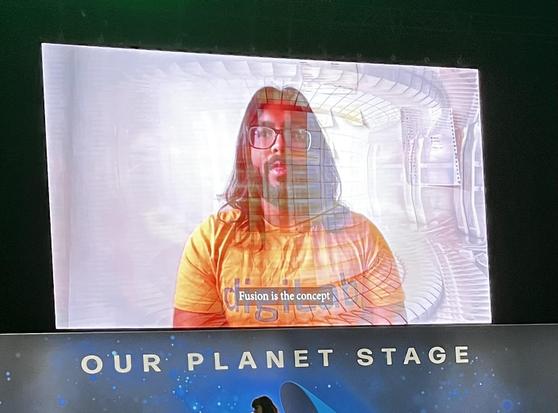
At #NewScientistLive, we’re bombarded by ads that say: the climate crisis is terrible; fusion is the answer. Yes, fusion is the answer, but it’s not happening here on Earth but 8.33 minutes away.

At #NewScientistLive, we’re bombarded by ads that say: the climate crisis is terrible; fusion is the answer.

Yes, fusion is the answer, but it’s not happening here on Earth but 8.33 minutes away.

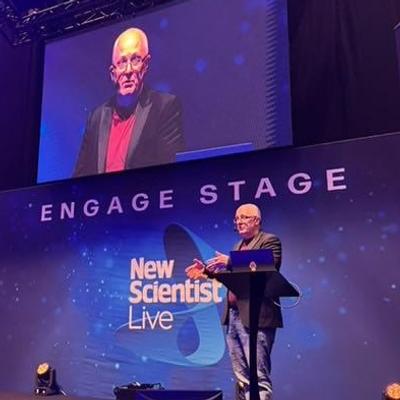
Today! At 12:45! My talk at #NewScientistLive

Are the kids alright? Mental health in young men & boys - Engage Stage

https://live.newscientist.com/nsl-london-2025-talks-programme/kids-alright-mental-health-young-men-boys

Exploring this pressing issue from various angles, from brains to social media impact

#MentalHealth #MensHealth #Adolescence

Are the kids alright? Mental health in young men & boys

New Scientist Live 2025

Just 24 hours until my talk at #NewScientistLive

Are the kids alright? Mental health in young men & boys

19/10/2025 12:45 - Engage Stage

https://live.newscientist.com/nsl-london-2025-talks-programme/kids-alright-mental-health-young-men-boys

Exploring this pressing issue from various angles, from brains to social media impact

#MentalHealth #MensHealth #Adolescence

Are the kids alright? Mental health in young men & boys

New Scientist Live 2025

Off to London soon, to speak at #NewScientistLive this Sunday

Are the kids alright? Mental health in young men & boys

19/10/2025 12:45 - Engage Stage

https://live.newscientist.com/nsl-london-2025-talks-programme/kids-alright-mental-health-young-men-boys

Are the kids alright? Mental health in young men & boys

New Scientist Live 2025
End of another #NewScientistLive show. Great talks! Books bought. Fun had. Mind blown. Tired.
Absolutely everybody came to JWST talk. Including me :) I bet the rest of the place is empty ATM. #NewScientistLive
@greenpeace have a stall on #NewScientistLive festival again. I find that strange, given their anti-science stance on some of the most important questions of today.