 Hacker News
When someone says they hate your product with a burning passion
https://www.getflack.com/p/responding-to-negative-feedback
#HackerNews #negativefeedback #producthate #customerexperience #responsivebusiness
When someone says they hate your product with a burning passion
https://www.getflack.com/p/responding-to-negative-feedback
#HackerNews #negativefeedback #producthate #customerexperience #responsivebusiness

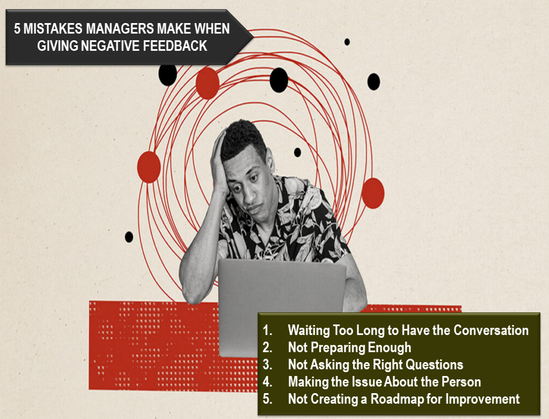

Confronting direct reports about performance issues can feel overwhelming, especially for first-time managers, who may worry that sharing critical feedback could damage their relationship with the employee. But performance conversations, especially where you need to give critical feedback, don’t have to be scary. There are a few common mistakes to avoid when giving critical feedback. One of the biggest mistakes is avoiding the conversation or waiting too long to have it. Many new managers also fail to properly prepare before their performance discussions. If there are tasks, projects, or skills at which your employee is falling short, you should also be able to give them a clear explanation of why or where they haven’t met your expectations. Some also end up making the issue about the person instead of focusing on the work itself. Being a great people manager is not about being a friend or being liked by everyone all the time — it’s about being a manager who cares about their employees and helps them get their job done.
For my fellow #feedback and #research nerds! This 1989 paper in the Academy of Management Review explores the use of feedback-seeking by poor-performing employees as a method to potentially soften the impact of negative performance evaluations.
@jstor link: bit.ly/seek-study
#FeedbackFindings #employees #humanresources #HR #communication #negativefeedback #professionaldevelopment #leadership #manager #classic
Definitely know the feeling.
Only one of the different tragedies of co-living.
With all the upsides that co-living and shared houses/appartments/flats or even bigger communities have, they also usually come with several downsides.
With every single resource that's being shared and simply split evenly across the number of people, that means there's yet another weakened #negativeFeedback element in the mental system.
Let's say you're a really frugal person and very cautious with your consumption .. and you share waste, electricity, heating, hot/cold water with two others .. all your individual efforts to conserve these resources only earn you 33 % of your actual effort. The other 66 % goes to the other two (assuming they're less diligent). And the other way round, one of the other two person's lavish behavior only costs them 33 % more and 66 % get paid by you and the other one.
Not really strong incentives to be mindful about consumption.
I live with a guy who uses so much warm water for showering and dish washing that even though I never use warm water for the dishes and currently I always shower with cold water (nicely refreshing :D ~12 °C), our combined consumption is that of a small family.
I really see this as a big problem of our time: everybody impacts the whole world with their behavior but only feels a fraction of the (mostly negative) feedback.
Talking about it could *maybe* help, but it's surely everything but fun for everyone.
Ideally all appliances should have meters on them right next to the controls, that constantly show consumption and maybe even calculate the energy consumption or the price.
'#OsBAK2/OsSERK2 expression is repressed by #OsBZR1 to modulate #brassinosteroid response and grain length in #rice'


 Allen Tien, MD, MHS mdlogix.com 94,698 田一彦
 tech news ᳇ eicker.news
 Albert Ebri
 Mathew Thomas
 Cameron Conaway
 GeekProjects News
 OfficeZenUp
 iLikeAltitude
 Journal of Experimental Botany