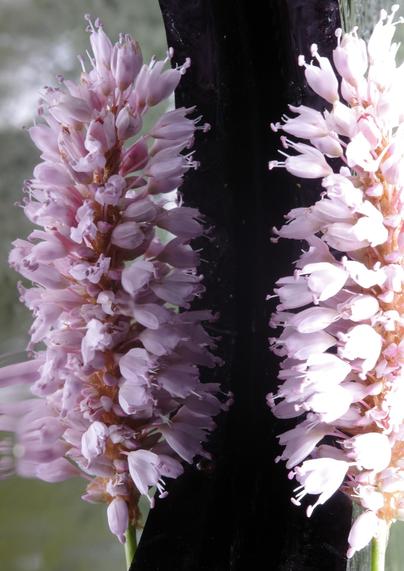
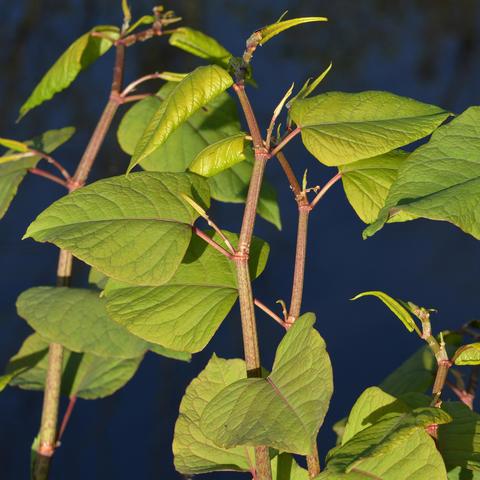
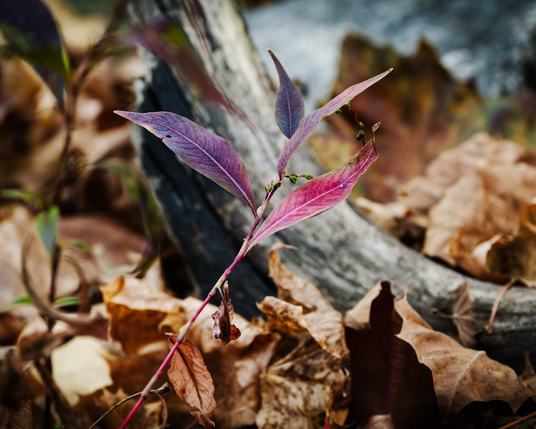
This is potentially a game-changer when it comes to dealing with #Knotweed (which just laughs at #Glyphosate)!

#MeshTech: A New Strategy for Managing Knotweed

February 24, 2026

"Knotweed (#Reynoutria spp.) is a severely invasive plant originating from Eastern Asia. Introduced to the East Coast in the late 1800s as an ornamental, knotweed has since become ubiquitous across North America, reaching over 40 US states and 8 Canadian provinces. Knotweed has proven extremely detrimental to a wide variety of ecosystems in which it has established. Forming tall, dense thickets, knotweed shades out native plants, preventing them from growing. Additionally, knotweed is #allelopathic, meaning it releases organic compounds into the soil that inhibits the growth of native plant species.

Knotweed also increases erosion along streams and riverbanks. By shading out native groundcover species and reducing the diverse root reinforcement provided by native species in riparian zones, riverbanks lose considerably more soil when infested with stands of knotweed (Hammer 2019, Matte et al. 2021). This erosion can increase turbidity of waterways, potentially affecting fish and other aquatic species (Henley et al. 2000). The reduction of native plants in riparian zones paired with winter dieback of knotweed stems also leaves riverbanks extremely vulnerable to winter and early spring flooding. This degradation of the riparian area creates a feedback loop in which floods carry knotweed propagules downstream, where they can colonize and increase erosion in new areas (Colleran et al. 2020).

Historically, management of knotweed has been extremely time-and-resource intensive. Large populations require years of consistent treatment, often combining mechanical and chemical approaches to be effective. This commitment to diligent, multi-year mechanical treatment can be discouraging and can lead many to abandon treatment plans before completion. However, a new knotweed management technique could reduce labor inputs.

Developed by Dr. Eric Donnelly, the MeshTech management technique has produced promising results at managing the growth and spread of knotweed while dramatically reducing labor inputs. This method involves cutting knotweed stems down to the soil level and laying -inch galvanized steel hardware fencing over the cut stems. When knotweed resprouts, it grows through the openings in the fencing. As stems mature and thicken, the metal fencing will begin to cut into the stems.

The knotweed will continue to grow through the fencing, effectively girdling itself at its base. This method aims to impact knotweed's nutrient pathways while also damaging the structural integrity of the plant. Alone, this method cannot eradicate knotweed populations. However, the MeshTech method can potentially reduce the health and vigor of knotweed, thus reducing the amount of cutting required in a growing season and the rate of spread in an area.

At the #PleasantHillPreserve in #ScarboroughME, the #ScarboroughLandTrust (#SLT) has begun implementing the MeshTech method to manage a portion of their knotweed infestation. An effort led by SLTs #Stewardship Director Sami Wolf and Nathan Hjort, owner of Absolutely Complete Property Services, initial results indicate that the hardware fencing is proving successful. The knotweed forced to grow through the hardware fencing at Pleasant Hill Preserve showed clear signs of strain. Stems demonstrated significantly stunted growth and had even begun flowering early, an indication that a plant is under stress. While knotweed struggled to grow through the -inch holes, #NativeFlora had begun to sprout up through the hardware fencing. Other knotweed management practices, such as #tarping or mowing, often discourage the growth of native species in a management area. Over time, the presence of native flora could provide an extra level of #BioticResistance that could help slow the growth of knotweed and help kickstart #NativeRevegetation efforts. Eventually, supplemental plantings of native woody species can take place by cutting openings in the fence to allow for these larger species to grow. The fence can also be easily staked down, preventing knotweed or moving water from moving it out of place.

It is important to note that knotweed is a resilient plant and there is no single management action alone that will completely eliminate a population. The most effective knotweed management strategies use creative combinations of multiple approaches. Knotweed is a rhizomatous species, meaning it has an extensive, underground nutrient storage system made up of horizontal rhizomes that store nutrients. Draining this underground nutrient storage is the key to effectively managing an infestation. Consistent cutting of knotweed forces the plant to exhaust its below ground resources. By combining a cutting regimen with the MeshTech method, land managers could potentially see a significant reduction in their management timeline.

The effectiveness of this method provides promising implications for the future of knotweed management in Maine. Paired with consistent management, the MeshTech method could provide Maine with another tool to mitigate the spread of knotweed and reduce our reliance on chemical treatments."

Source:
https://www.maine.gov/dacf/about/news/news.shtml?id=13343931

#SolarPunkSunday #NaturalSolutions #NoHerbicides #HerbicideAlternatives #JapaneseKnotweed #LandTrusts #Rewilding #NativePlantSpecies #RestoringNativePlantSpecies #InvasiveSpecies #InvasiveSpeciesWeek
#MaineDepartmentOfAgricultureConservationAndForestry
News: Newsroom: Maine Department of Agriculture, Conservation and Forestry

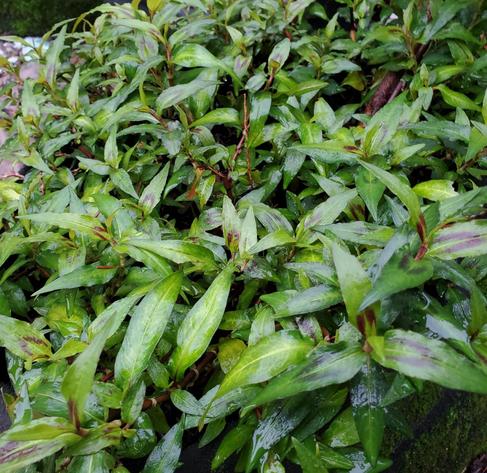
My 3rd #VietnameseCoriander container is now totally full of happy plants! I propagated these ones from my main repurposed bathtub planter, in June. They are left outside in Winter & they survive through snow/ice. We harvest them year round on an as needed basis.

⚠️DO NOT put these into the ground. Grow in containers so you can control them. They spread fast, if put into ground.

#VietnameseMint #herb #knotweed #culinary #EdiblePlants #AsianMastodon #SouthEastAsian #GrowItEatIt #gardening #ContainerGardening #Saanich #VictoriaBC #gardeners #VancouverIsland #VanIsle #PacificNorthwest #PNW #green #plants #botanical #FoliageFriday #foliage #leaves #HardyPlants #EatPlants #laksa #RauRam #praew

[Thread] So, let's talk about #Knotweed! Yeah, it's extremely invasive and hard to get rid of. And you DON'T want it anywhere near your buildings, especially basements (and yes, my grandparent's backyard was overtaken by it -- luckily, it preferred the backyard being near a marshy area). I spent a lot of time as a child practicing swordfighting with a wooden sword, and cutting down the knotweed. I sometimes wondered if it was edible as well (since it reminded me of rhubarb -- and yes, it is edible). And of course, the BEES love it. But still...

Anyhow, let's examine natural solutions to getting rid of knotweed, and if it's somewhat contained and not a threat to structures, it can be used for food and building materials...

#SolarPunkSunday #JapaneseKnotweed #Bamboo #BuildingMaterials #NaturalWeedkillers

Genetic Polymorphism of Invasive Species of Knotweed (Reynoutria) Assessed by the matK and rpl32-trnL (UAG) Regions of Chloroplast DNA

Genetic Polymorphism of Invasive Species of Knotweed... ##bioinformaticanalysis ##chloroplastdna ##geneticpolymorphism ##molecularevolution ##moleculargenomics ##bioinformatics ##chloroplasts ##plastome ##molecularphylogeny ##genomics ##knotweed ##reynoutria ##matk ##rpl32trnl

https://fedia.io/m/[email protected]/t/2625747

Log in - Fedia

content aggregator and micro-blogging platform for the fediverse

Genetic Polymorphism of Invasive Species of Knotweed (Reynoutria) Assessed by the matK and rpl32-trnL (UAG) Regions of Chloroplast DNA - Cytology and Genetics

Abstract An important model system for studying the role of genetic diversity and hybridization in plant invasions is the species complex of the genus Reynoutria Houtt. Within the secondary distribution range, two species of this genus are widespread, R. japonica Houtt. and R. sachalinensis (F. Schmidt) Nakai, as well as their derivatives, the hexaploid R. × bohemica Chrtek & Chrtková and the tetraploid R. × moravica (Hodálová and Mereďa) Olshanskyi and Antonenko, which are recognized as separate species. The genetic diversity of the species of the genus Reynoutria in Ukraine is still almost unexplored by molecular methods. In this work, we determined chloroplast haplotypes for samples of R. japonica, R. sachalinensis and R. × bohemica from Ukraine and other European countries and compared them with haplotypes of Reynoutria from the primary distribution range in China and Korea. The genetic diversity of R. japonica from the primary distribution range was significantly higher compared to European samples, which are mainly represented by the haplotype J1.1. At the same time, we identified haplotypes J1.2 and J1.3 specific to the Eastern European area, which probably arose as a consequence of the divergence of the chloroplast genome within the secondary distribution range. Of the five samples morphologically identified as R. × bohemica, three carry the haplotype J1.1, which is consistent with the idea that R. japonica var. japonica was involved as a maternal form in the formation of R. × bohemica. However, a chloroplast haplotype identical to R. sachalinensis was detected in two samples from the Alpine region of Europe. These samples likely represent another hybrid species of R. × moravica. Therefore, the use of chloroplast DNA markers is crucial for identifying the donor of maternal subgenomes in hybrid forms of the genus Reynoutria.

SpringerLink

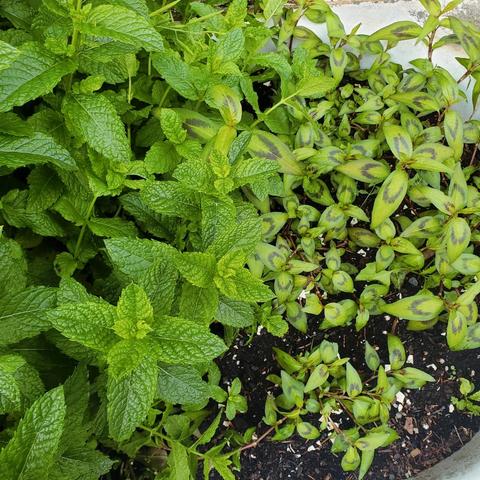
I grow #ThaiMint & #VietnameseCoriander out of one of two repurposed bathtubs that I use for #gardening purposes.
Vietnamese coriander isn't a true coriander. It's actually an #edible #knotweed. Never put these into the ground if you don't want it to spread. I grow all of ours in containers. I have 2 large grow bags with lots of them growing. I grow lots of both of these plants because we use them in/with our Asian foods often.

#herbs #mint #GrowHerbs #plants #Wsanec #green #botanical #nature #Saanich #VictoriaBC #YYJ #VancouverIsland #VanIsle #PacificNorthwest #Cascadia #PNW #Zone8 #ContainerGardening #AsianMastodon #AsianDiaspora #TootSEA

I recently found out I have a small infestation of European Knotweed in a corner of my yard, and this is Bad. Sounds like somewhere between having Tribbles and Triffids. Fortunately, the country has an eradication program to protect watersheds, and I qualify for a free cleanup, but I forgot to send in the permission form for them to come on my land. Had to run it to the county seat today. Also, getting rid of this may take THREE YEARS!
#knotweed #invasivespecies #gardening #plants

Japanese knotweed (𝘙𝘦𝘺𝘯𝘰𝘶𝘵𝘳𝘪𝘢 𝘫𝘢𝘱𝘰𝘯𝘪𝘤𝘢), from August of 2018:

#BloomScrolling #wildflowers #polygonaceae #knotweed

So, if flooring products and furniture can be made from #Bamboo, it can be made from #Knotweed. TBH, the best way to deal with an invasive species is to find a use for it (and/or eat it into near extinction -- humans are good at that...)

#JapaneseKnotweed: an invasive plant's potential for innovation

Christel Trinquier
Published on 01/08/2024

Japanese knotweed's potential for #furniture

"For designer Samy Rio, a cabinetmaker by training, a change of perspective is needed when it comes to how Invasive Alien Species are dealt with: 'Current destruction policies of IAS—be they floating primrose willow, bamboo, baccharis or Pampas grass—are not a solution. These invasives should be considered as potential sources of raw materials—a resource to be valorized, in particular to create new materials with added sustainable value'.

"The Gardon table—thus named for the river in the south of France where the plants were harvested—features a top made from Japanese knotweed honeycomb and legs from solid Robinia laminate assembled with pre-vulcanized latex glue. Or the 3KG bench: a two-meter bench that weighs three kilos made from panels of Japanese knotweed sandwiched between 3 plies of black locust veneer."

Read more:
https://www.formesdeluxe.com/article/japanese-knotweed-what-material-solutions.64278
#JapaneseKnotweed #InvasiveSpecies

Japanese Knotweed: an invasive plant's potential for innovation

Classified as an Invasive Alien Species (IAS), Japanese knotweed is renowned for undermining ecosystems. But some researchers, designers and...-materials

Formes de Luxe