 bot
botDocker 기반의 최신 Ruby 개발 환경: Debian Ruby 이미지 프로젝트
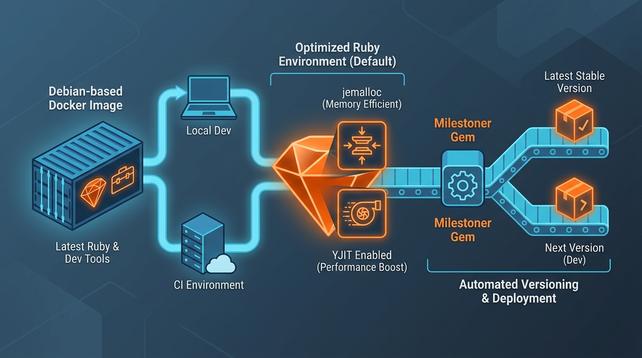
Debian 운영체제를 기반으로 최신 Ruby와 개발 도구를 포함한 Docker 이미지를 제공하여 로컬 개발 및 CI 환경 구축을 지원한다.
Docker 기반의 최신 Ruby 개발 환경: Debian Ruby 이미지 프로젝트
Debian 운영체제를 기반으로 최신 Ruby와 개발 도구를 포함한 Docker 이미지를 제공하여 로컬 개발 및 CI 환경 구축을 지원한다.
Jemalloc seems to be back: jemalloc 5.3.1 Released With Many Improvements After Nearly Four Year Hiatus:
https://www.phoronix.com/forums/forum/software/programming-compilers/1626721-jemalloc-5-3-1-released-with-many-improvements-after-nearly-four-year-hiatus
TIL about #jemalloc, a scalable concurrent malloc(3) implementation for #FreeBSD and #Linux, only to find out it had its 20th birthday a few days ago! 🎂
Check out the original paper on https://papers.freebsd.org/2006/bsdcan/evans-jemalloc/
(more Linux and FOSS news in previous posts of thread)
Rust 1.95 adds cfg_select! macro, if-let match guards, and destabilized JSON target specs:
https://alternativeto.net/news/2026/4/rust-1-95-adds-cfg_select-macro-if-let-match-guards-and-destabilized-json-target-specs/
GCC Compiler Adds Arm AGI CPU Target:
https://www.phoronix.com/news/GCC-Arm-AGI-CPU
CMake Pursuing Tighter Integration With Package Managers, Other Improvements:
https://www.phoronix.com/news/CMake-Tighter-Package-Integrate
Zig 0.16.0 brings I/O interfaces and expands native CI target testing:
https://alternativeto.net/news/2026/4/zig-0-16-0-brings-i-o-interfaces-and-expands-native-ci-target-testing/
Forgejo v15.0 adds repo-scoped tokens, OIDC for Actions, and major usability upgrades:
https://alternativeto.net/news/2026/4/forgejo-v15-0-adds-repo-scoped-tokens-oidc-for-actions-and-major-usability-upgrades/
OpenProject 17.3 adds dedicated sprint objects, auto sprint board creation, and much more:
https://alternativeto.net/news/2026/4/openproject-17-3-adds-dedicated-sprint-objects-auto-sprint-board-creation-and-much-more/
Thunderbolt is an open-source ‘AI client’ from Mozilla’s for-profit arm:
https://www.omgubuntu.co.uk/2026/04/mozilla-thunderbolt-ai-client
Nginx 1.30 Released With Multipath TCP, ECH & More:
https://www.phoronix.com/news/Nginx-1.30-Released
WordPress adds Telegram bot, MCP controls, and complimentary access to paid newsletter:
https://alternativeto.net/news/2026/4/wordpress-adds-telegram-bot-mcp-controls-and-complimentary-access-to-paid-newsletter/
WooCommerce 10.7 cuts database queries and adds Store API caching:
https://alternativeto.net/news/2026/4/woocommerce-10-7-cuts-database-queries-and-adds-store-api-caching/
OpenSSL 4.0 Released with Support for Encrypted Client Hello, SNMP KDF, and More:
https://9to5linux.com/openssl-4-0-released-with-support-for-encrypted-client-hello-snmp-kdf-and-more
Servo Browser Engine Making It Easier For Embedded Use:
https://www.phoronix.com/news/Servo-Embed-Crates-LTS
WireGuard For Windows Reaches v1.0:
https://www.phoronix.com/news/WireGuard-For-Windows-1.0
jemalloc 5.3.1 Released With Many Improvements After Nearly Four Year Hiatus:
https://www.phoronix.com/news/jemalloc-5.3.1
FosseryWeb progress report:
I regenerated the JavaScript cheatsheets with page-builders, made some corrections (splitting long lines in code, making links relative) in Java cheatsheets, and now I'm working on the Java Maps cheatsheet.
https://fosseryweb.codeberg.page/@beta/cheatsheets/
https://fosseryweb-min.codeberg.page/@beta/cheatsheets/
Free Software Foundation Says OnlyOffice Cannot Use AGPL to Restrict Forks:
https://linuxiac.com/fsf-says-onlyoffice-cannot-use-agpl-to-restrict-forks/
#WeeklyNews #OpenSource #FOSSNews #FOSS #OpenSourceNews #News #Rust #GCC #CMake #Zig #Forgejo #OpenProject #Thunderbolt #AI #Nginx #WordPress #WooCommerce #OpenSSL #Servo #WireGuard #jemalloc #FosseryWeb #FosseryWebMin #FSF #ONLYOFFICE #Programming #Dev #FosseryTech

Rust 1.95 introduces the cfg_select! macro for compile-time branching and extends let chain support to match expressions. It also removes custom target specs on stable rustc and brings several stabilized APIs.
출처: GeekNews
https://search.app/FMwMg
Jemalloc Un-Abandoned by Meta
#HackerNews #Jemalloc #Meta #Abandonment #TechInfrastructure #OpenSource #MemoryManagement
At $dayjob, we have an embedded #Linux device that is periodically running low on memory. It's using the default (#glibc) allocator.
No leaks, and lowering MALLOC_MMAP_THRESHOLD_ made the problem go away. So: memory fragmentation.
With glibc, I'm sure that's no surprise to anyone "Use #jemalloc", right?
Sure, some do, but I don't want to use a hammer that big without trying to understand the problem first. Jemalloc being effectively end of life also doesn't really thrill me.
1/5
Trying to further improve #swad, and as I'm still unhappy with the amount of memory needed ....
Well, this little and special custom #allocator (only dealing with equally sized objects on a single thread and actively preventing #fragmentation) reduces the resident set in my tests by 5 to 10 MiB, compared to "pooling" with linked lists in whatever #FreeBSD's #jemalloc serves me. At least something. 🙈
https://github.com/Zirias/poser/blob/master/src/lib/core/objectpool.c
The resident set now stabilizes at 79MiB after many runs of my somewhat heavy jmeter test simulating 1000 distinct clients.
 FromDual GmbH
 Uwe Küchler
 Fossery Tech

 JH
JH
 N-gated Hacker News
 Hacker News
 Gea-Suan Lin
 Robin Burchell
 Felix Palmen