Previously Unknown 1 km Wide Impact Crater in China and Why It's So Exciting - YouTube
https://www.youtube.com/watch?v=aqutR88gwdY

#Geology #Craters #ImpactCrater

Previously Unknown 1 km Wide Impact Crater in China and Why It's So Exciting

YouTube

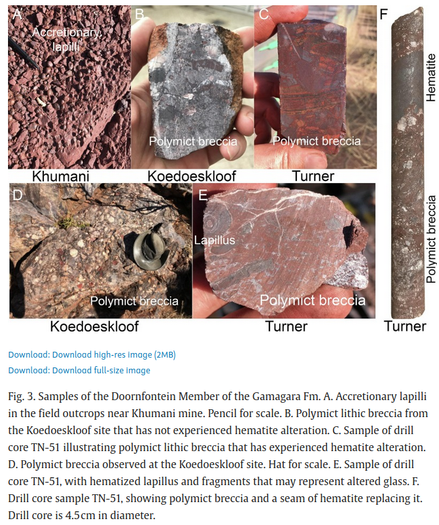
Nice wee #OpenAccess article on the discovery of possible impact ejecta from Earth's largest preserved impact structure - the Vredefort Dome, in South Africa.

https://www.sciencedirect.com/science/article/pii/S0301926825002803

#ImpactCrater #Meteorite

Southward impact excavated magma ocean at the lunar South Pole–Aitken basin: https://www.nature.com/articles/s41586-025-09582-y -> The moon's biggest #ImpactCrater made a radioactive splash: https://news.arizona.edu/news/moons-biggest-impact-crater-made-radioactive-splash
Southward impact excavated magma ocean at the lunar South Pole–Aitken basin - Nature

Observations of the shape, topography, crustal thickness and surface composition of the South Pole–Aitken impact basin on the Moon suggest a southward impact trajectory and the excavation of a discontinuous remnant magma ocean from beneath the crust.

Nature

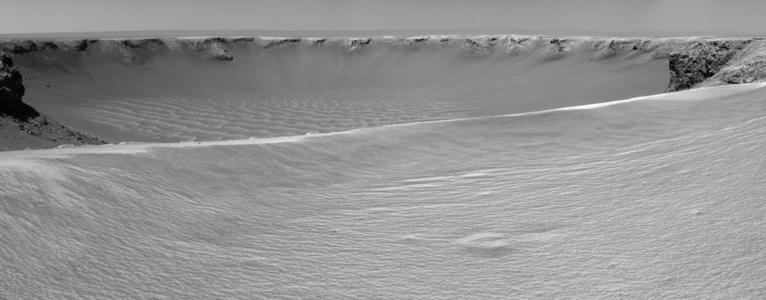
Martian Memories

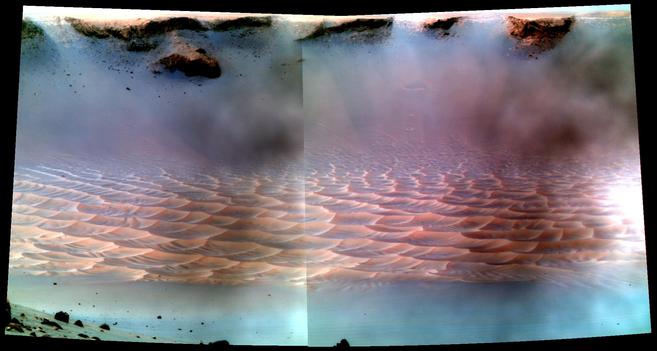
Victoria Dunes

This view of dunes and ripples inside Victoria Crater was captured by the Opportunity rover, February 8, 2008 (Sol 1437); full credits in ALT.

#Mars #Opportunity #Victoria #Mars #sol1437 #rover #MERB #space #crater #VictoriaCrater #impactcrater #Martian #memories #OpportunityRover #MartianMemories #science #photography #Astrodon #history

A Paleoarchaean #ImpactCrater in the Pilbara Craton, Western Australia: https://www.nature.com/articles/s41467-025-57558-3 -> "we report the discovery of shatter cones in a complex, dominantly metasedimentary layer, the Antarctic Creek Member (ACM) [...]. The shocked rocks of the crater floor are overlain by (unshocked) carbonate breccias and pillow lavas, stratigraphically constraining the age of the impact to 3.47 Ga and confirming discovery of the only Archaean crater known thus far."
A Paleoarchaean impact crater in the Pilbara Craton, Western Australia - Nature Communications

Shatter cones in rocks in the Pilbara craton provide unequivocal evidence for oldest known impact crater on Earth, which struck 3.5 billion years ago.

Nature

Martian Memories

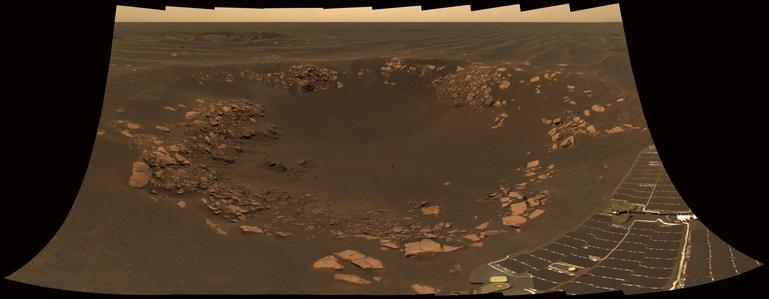
Opportunity at Naturaliste

Naturaliste is a small crater about 15 meters in diameter on the plains of Meridiani, about 1 km south of Endurance crater. Captured by the Opportunity rover on Mars 2, 2005 (Sol 393); full credits in ALT.

#Opportunity #Naturaliste #Mars #sol393 #rover #MERB #space #crater #NaturalisteCrater #impactcrater #Martian #memories #OpportunityRover #MartianMemories #science #photography #Astrodon #history

Martian Memories

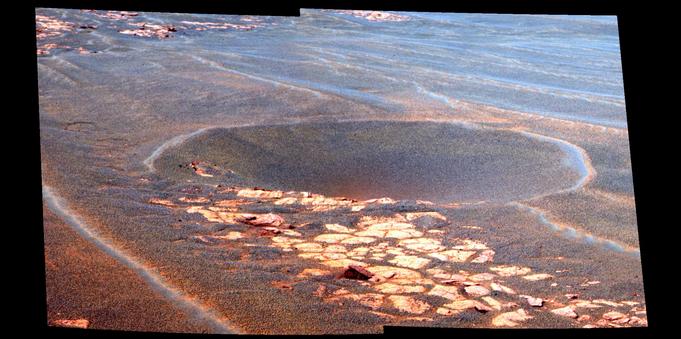
Opportunity meets Gumdrop

Named after the Apollo 9 command module's nickname, Gumdrop is a small crater (6 meters diameter) located on the edge of a larger, dark, filled-in crater. It was captured by the Opportunity Rover on May 30, 2011 (Sol 2612); full credits in ALT.

#Opportunity #Gumdrop #Mars #Sol2612 #rover #MERB #space #crater #GumdropCrater #impactcrater #Martian #memories #OpportunityRover #MartianMemories #science #photography #Astrodon #history #Apollo #Apollo9

Earth May Have Had A Ring System 466 Million Years Ago
--
https://phys.org/news/2024-09-earth-million-years.html <-- shared technical article
--
https://doi.org/10.1016/j.epsl.2024.118991 <-- shared paper
--
“HIGHLIGHTS:
• Earth may have had a ring during the middle Ordovician, from ca. 466 Ma.
• Breakup of an asteroid passing within Earth's Roche limit likely formed the ring.
• Among several features preserved is a near-equatorial band of impact craters.
• Shading of Earth by the ring may have triggered a global icehouse period…”
--
#GIS #spatial #mapping #model #modeling #geology #structuralgeology #planetarygeology #rings #climatechange #paleoclimate #Ordovician #asteroid #rochelimit #craters #impactcrater #crater #icehouse #meteorite #platetectonics #HirnantianIcehouse
Earth may have had a ring system 466 million years ago

In a discovery that challenges our understanding of Earth's ancient history, researchers have found evidence suggesting that Earth may have had a ring system that formed around 466 million years ago, at the beginning of a period of unusually intense meteorite bombardment known as the Ordovician impact spike.

Phys.org