“Individuals may form communities, but only institutions can create a nation”*…
Traffic police in Rome, 1981. Good institutions are social technologies that scale trust from personal relations to entire nations. Game theorist and social scientist Julien Lie-Panis unpacks the extraordinary phenomenon of human cooperation to explain how– and why– institutions work…
Every human society, from the smallest village to the largest nation, faces the same fundamental challenge: how to get people to act in the interests of the collective rather than their own. Fishermen must limit their catch so fish stocks don’t collapse. People must respect others’ property and safety. Citizens must pay taxes to fund roads, schools and hospitals. Left to pure self-interest, no community could endure; the bonds of collective life would quickly unravel.
The solutions we’ve devised are remarkably similar across cultures and centuries. We create rules. Then we appoint guardians to enforce them. Those who break the rules are punished. But there’s a problem with this approach, one that the Roman poet Juvenal identified nearly 2,000 years ago: Quis custodiet ipsos custodes? Who will guard the guards themselves?
Fisheries appoint monitors to prevent overfishing – but what if the monitors accept bribes to look the other way? Police officers exist to protect everyone’s property and safety – but who ensures that they don’t abuse their power? Governments collect taxes for public services – but how do we stop officials from diverting the funds to their own accounts?
Every institution faces the same fundamental paradox. Institutions foster cooperation by rewarding good behaviour and punishing rule-breakers. Yet they themselves depend on cooperative members to function. We haven’t solved the cooperation problem – we’ve simply moved it back one step. So why do institutions work at all? To understand this puzzle, we need to first ask what makes human cooperation so extraordinary in the natural world…
[Lie-Panis explores human cooperation, and examines the ways in which, while it follows the same evolutionary rules as cooperation among other species, humans have expanded the ambit of their coordination. He explains the ways in which institutions depend on “a present-future trade-off,” on its constituents’ patience as it works through problems. And he illustrates the ways in which constituents’ concerns with material security and social capital can generate that patience. He concludes…]
… Institutions can thus be understood as social technologies. We engineer them constantly, often without realising it. When neighbours organise to maintain a shared garden or playground, they appoint a small committee to manage funds and decisions. The arrangement works because it transforms the hard problem of coordinating dozens of contributors into the easier problem of trusting a few visible people who can be praised for diligence or blamed for misuse.
Like any tool, institutions cannot create what isn’t already there; they can only amplify existing cooperative capacity. Institutions rest on the conditions that make cooperation rational: material security and social capital. Where those conditions hold, reputation can work at scale. One layer of accountability supports the next, until cooperation extends far beyond the limits of familiarity. From the same force that binds vampire bats and coral reef fish, we have built cities, markets, and nations. Institutions are how trust is scaled to millions of strangers.
Eminently worth reading in full: “Guarding the Guardians,” from @jliep.bsky.social in @aeon.co.
Apposite (albeit a bit orthogonal): “Culture Is the Mass-Synchronization of Framings,” from @marco-giancotti.bsky.social.
* Benjamin Disraeli
###
As we get along, we might recall that it was on this date in 1938 that a film poking fun at a plethora of institutions, Howard Hawks’ comedy Bringing Up Baby, premiered at the Golden Gate Theater in San Francisco. Featuring Cary Grant, Katherine Hepburn, and a leopard, the film earned good reviews but suffered at the box office. Indeed, Hepburn’s career fell into a slump– she was one of a group of actors labeled as “box office poison” by the Independent Theatre Owners of America– that she broke with The Philadelphia Story (again with Grant) in 1940.
As for Bringing Up Baby, the film did well when re-released in the 1940s, and grew further in popularity when it began to be shown on television in the 1950s. Today it is recognized as the authentic screwball classic that it is; it sits at 94% on Rotten Tomatoes, and ranks among “Top 100” on lists from the American Film Institute and the National Society of Film Critics.
source
#BringingUpBaby #CaryGrant #cooperation #culture #film #history #HowardHawks #institutions #KatherineHepburn #movies #politics #reputation #socialCapital #socialInfrastructure #socialTechnology #society NUEVO IMAGENES DE ACTUALIDAD
 dounowhoiam.bsky.social
 cob
cob

 klu9
klu9
 Cinegenres


 (Roughly) Daily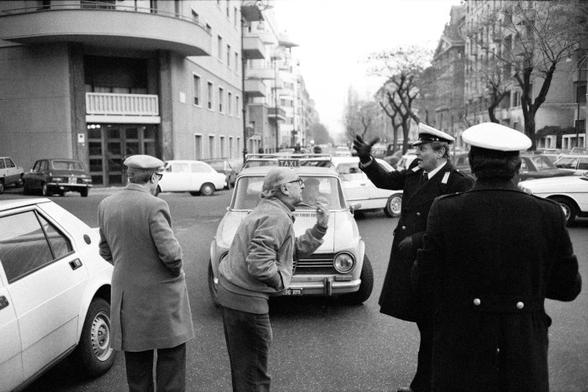

 Tommi Nieminen
 FILM TALK