 esplovago
 Milcom Miasma
Anticipation.
Off to volunteer our help for a friend who owns the local bookstore. She needs some bookshelves and their contents moved.
You know you're old when you start taking aspirin in anticipation of the day you're about to have.
Anticipation.
Off to volunteer our help for a friend who owns the local bookstore. She needs some bookshelves and their contents moved.
You know you're old when you start taking aspirin in anticipation of the day you're about to have.
A very thoughtful post from Disroot [1] regarding the time we share.
> In the world we currently live in, the most common thing that all living beings have and share —time— has become a scarce, exchangeable, and marketable resource. We work, produce, consume, and rest within a system that measures, regulates, and captures that time, turning it into an economic unit. What was once a shared, vital flow is now managed like a commodity. And as everything seems to speed up, we find ourselves with less and less time of our own.
> We're surrounded by platforms that present themselves as spaces for connection, collaboration, or entertainment, but their real business is the time of the people who use them. They don't provide services: they extract attention, data, free labor, and creativity and turn it into profit. Every interaction, every click, every message generates economic value for someone else. In this unequal exchange, we as users don't just give information, we give hours of our lives. Meanwhile, those who manage these infrastructures have built a well-oiled system of time trafficking: a gigantic transfer of human energy to corporations that give back nothing but dependency and precariousness. In this context, self-hosted, self-managed, open, and community-driven projects don't just propose a different technological model but also a different relationship with time.
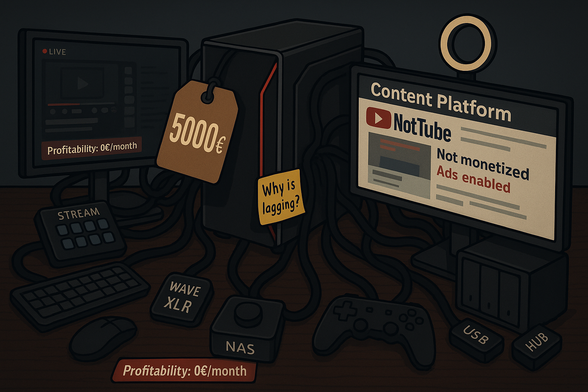
CREATING ON YOUTUBE MEANS PAYING TO WORK
YouTube is like Uber. Uber asks you to own, in your garage, a black sedan with less than 100,000 km on it—one you’re not using—and claims you can start making money from it. “It doesn’t cost you anything,” Uber says, since the car is just sitting there anyway. But in reality, it’s the most financially vulnerable people who see it as an opportunity. They take out a loan to buy a car. And when that car hits 100,000 km and the loan isn’t paid off, they get a second one—and now they’re stuck with two loans. Uber “earns” you €5/hour, but the cost of maintaining your setup is €7.50/hour. The more you work, the more your tool degrades. You earn 25% more, but spend 25% more. The vehicle is repurposed for an economic model that only benefits Uber.
¯
_
YOUTUBE IS NO DIFFERENT
When you become a YouTuber, they make you believe that “anyone can stream with a smartphone.” That all you need is an idea, a bit of courage, and some basic gear. That you can compete with MrBeast—who spends a million per video—on a shoestring budget. That’s a lie.
¯
_
THE REAL COST OF A SETUP
I spent five years, from 2018 to 2023, saving up to buy a €5,000 PC solely for production. Because streaming isn’t just “playing a game.” Your PC becomes a 4K broadcasting server. You need two graphics cards—or even two separate machines:
- One to run the software or the game
- The other to encode, stream, and record
You also need:
- A second monitor (for video return and replay)
- A replay buffer (to capture instant replays)
- A Stream Deck for seamless transitions
- A Wave XLR for professional audio quality
- Audio interfaces, mixers, USB cameras, XLR microphones
All these high-end peripherals constantly tax your system. You need two USB hubs capable of handling 15 devices at once with no signal loss. A single weak link can ruin everything. And that’s not all. To stream a Nintendo Switch, you need a capture card—and you can’t rely on your streaming software’s preview because of input lag. You have to play directly on the other screen already in place.
¯
_
ONGOING TECHNICAL LEARNING
Streaming requires broad technical expertise:
- Lighting, audio, capture devices, networking
- Compression, codecs, editing, formatting
- Live direction, visual/audio transitions, real-time coordination
And you’re doing all this with zero support from YouTube.
¯
_
STORAGE AND ENERGY COSTS
Your PC isn’t enough anymore. You’ll need a NAS—a network-attached storage system—cheaper than the cloud in the long run, but which demands:
- Two 20 TB drives (mirrored) → 40 TB
- A dedicated server, which adds another €1,000
It’s become a mini television studio. Which brings with it:
- Planned obsolescence
- Frequent breakdowns
- Hardware wear and tear
- Electricity costs of a 1,000-watt PC plus a 24/7 server
Altogether, the setup costs more than a car.
¯
_
AND YOUTUBE PAYS NOTHING
And yet, it’s YouTube that cashes in. It runs ads on your videos—even if you’re not monetized. It hijacks your gear, your energy, your skills. And if your content doesn’t “perform,” it simply ignores you. A PC, cameras, capture cards, hubs, microphones, lights—tens of thousands of euros invested just to exist. And the platform invests nothing in return. No visibility. No value sharing. Not even a word of encouragement.
¯
#InvisibleLabor #PlatformCapitalism #CreatorEconomy #DigitalPrecarity #FreeLabor #YouTubeProblems #Shadowban
 Srijit Kumar Bhadra
 Giacomo Tesio
 cathill
 Dash Remover
 Michaël | HouseStationLive.com