© C A Lovegrove The Lie Tree by Frances Hardinge.
Macmillan Children’s Books, 2015.
‘Listen, Faith. A girl cannot be brave, or clever, or skilled as a boy can. If she is not good, she is nothing. Do you understand?’
— Chapter 9: Confession.
A novel that hovers in the No Man’s Land between the borders of magical realism, fantasy, myth and social commentary is sure to draw me in, and Hardinge’s award-winning novel does exactly this.
But it’s also an angry novel, and despite a slow-ish but scene-setting start it soon becomes clear where the anger comes from: patriarchy, patronising sexism and misogyny which, although The Lie Tree is set in 1865, is no less rampant now even if expressed in different ways.
And it’s also a murder mystery cloaked as historical fiction, and a metafictional narrative, one that in exploring the effects which falsehoods have on truth, is meant – I think – to cast suspicion on the role of the author in presenting fiction as fact, and to question our willing acceptance of this state of affairs.
© C A Lovegrove Aged fourteen, Faith and her family – her parents Myrtle and the Reverend Erasmus Sunderly, Howard her young brother, and her uncle Miles – have to suddenly up sticks and travel from Kent to an isolated Channel island called Vane, and all Faith knows is that it’s because of the whiff of some scandal nobody will tell her about.
But on Vane the initial welcome they get, due to Erasmus being a noted natural scientist, is soon turned to ostracism: the family is shunned as the news that he created hoax fossils leaks out. And then the Reverend is found dead: but is it suicide, as appears the case, or is it murder? If the former, then he will be denied Christian burial, and his family left homeless and in penury; but Faith believes it is murder, and it’s somehow connected with the shrouded plant specimen she and her father had clandestinely hidden in a sea cave, away from all light – what Erasmus called the Mendacity Tree.
For the Lie Tree is a plant that flourishes in the dark, its bifurcated leaves like the forked tongues that utter falsehoods. And lies represent power, as Erasmus knew:
‘Choose a lie that others wish to believe. They will cling to it, even if it is proven false before their face. If anyone tries to show them the Truth, they will turn on them and fight them tooth and nail.’ — Chapter 15: Lies and the tree.
The possession of power is a powerful draught and a stimulant, as all politicians know, and the Mendacity Tree could give access to that power: as well as its intoxicating fruit providing visions and revealing mysteries, it’s a plant that “could show governments their enemies’ plans, scientists the secrets of the ages, journalists the vices of the powerful.” Does Faith dare take the dangerous path giving her that power and use her own lies to sow fear, dissent and suspicion among the islanders, all in order to reveal who murdered her father and why?
Hardinge’s immersive novel is peopled by a fascinating cast of characters, from squirarchy to servants and from islanders to Faith’s immediate family. Whom can she trust – her flirtatious mother and slippery uncle or any one of the hostile inhabitants of Vane? Is there no-one who isn’t what they seem? The names they bear frequently seem to be either apt (Faith’s loyalty to her father, for instance) or inappropriate (Agatha Lambent, whose forename means ‘good’ in Greek but who’s anything but benevolent).
The text is crawling with symbols and metaphors: attempted murder involving a weakened chain link – later conveniently lost – echoes evolutionary ideas about ‘missing links’. There are also passages of vivid descriptive writing – as, for example, when Faith looks down from the edge of a cliff and sees “the shallow waves drag their foam crescents like fingernails down the beach.” In addition, Hardinge is good at evoking the import of Victorian manners, such as the customary funerary ritual requiring visits during a wake: “For there was death in the house, and death was a business.”
It’s not till quite late on that we get a mention of what might be the most obvious counterpart or mirror image of the Lie Tree, namely the Tree of the Knowledge of Good and Evil: and to the fruit of the biblical tree we may add those from other traditions, such as the Bo tree’s fig of enlightenment. But the visions and insights that such fruits provide – are they reliable, or do they remain open to interpretation? Those are the kinds of conundrums that Faith has to ponder, with the possibility that her trance-induced suspicions and surmises may be unfounded.
I found reading The Lie Tree a revelatory journey through several layers of suggestions and meanings: it touches on evolution’s challenges to established religions, on the power of malicious rumours (‘Nobody can spread lies like a politician’) and on casual sexism and prejudices. Above all this was a clarion call for young females like Faith to take back agency in the face of curtailment and repression; as her mother Myrtle tells her, ‘When every door is closed, one learns to climb through windows.’
#WyrdAndWonder 2024: Ariana @ The Book Nook, Annemieke @ A Dance With Books, Jorie Loves A Story, Lisa @ Dear Geek Place, and imyril @ There’s Always Room For One More Read for Wyrd and Wonder 2024.
https://calmgrove.wordpress.com/2024/05/07/31174/
#19thCentury #FrancesHardinge #TheLieTree
 Hoochie Daddy moved to mas.to
 Sarah & Frederique
 Iridella
 S.T. Veje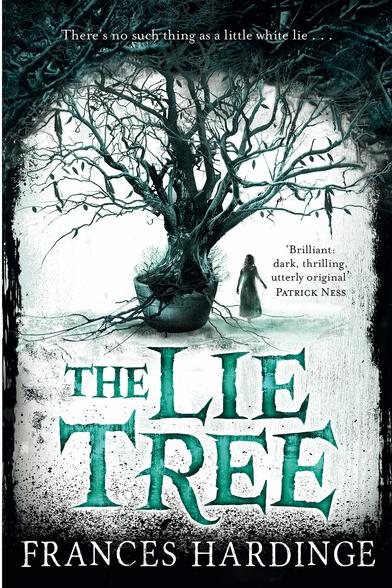
 Calmgrove
 Octothorpe

 handmade ghost
 Sheila M. Averbuch - Author
 Gaminette