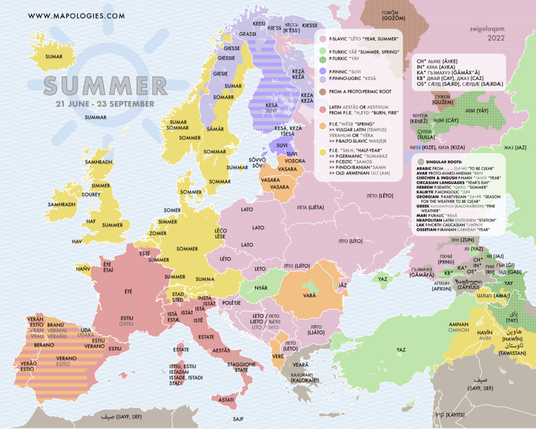
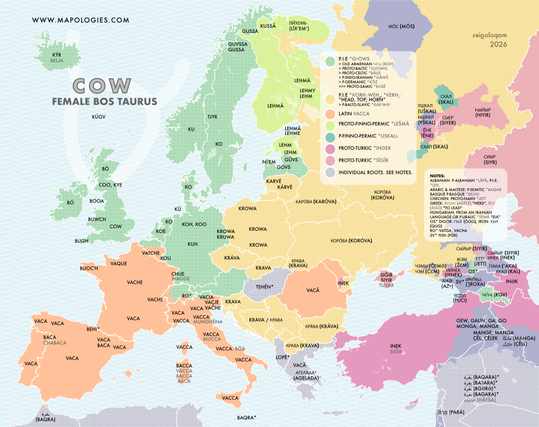
The English word cow is related to other Germanic words: Icelandic kýr and Swedish ko. These words are also connected to a surprising group of words across other Indo‑European branches thought to derive from a common Proto‑Indo‑European root, *gʷṓws, for example Irish bó, Latvian govs, and Armenian  կով (kov).

https://mapologies.com/animals/

#map #mapologies #etymology #etymologymap #language #lingusiticmap #languagemap #cartography #mapa #karte #lingustics #languages #learnlanguages #geography
@futurebird
Look, what I just found:

@mapologies 🔗 https://mastodon.social/users/mapologies/statuses/116471504187488342
-
Last map has ants in its pants

https://mapologies.com/bugs/

#insects #map #mapologies #etymology #etymologymap #ant #ants #languagemap

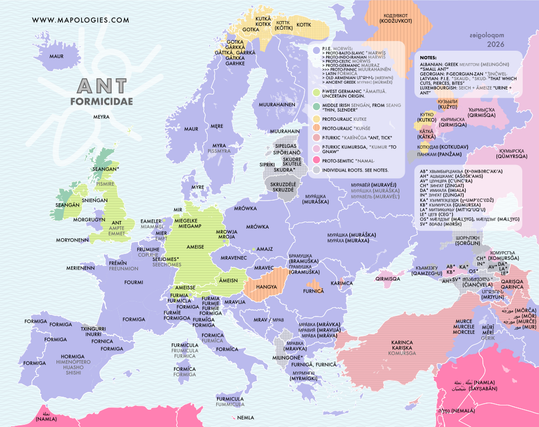
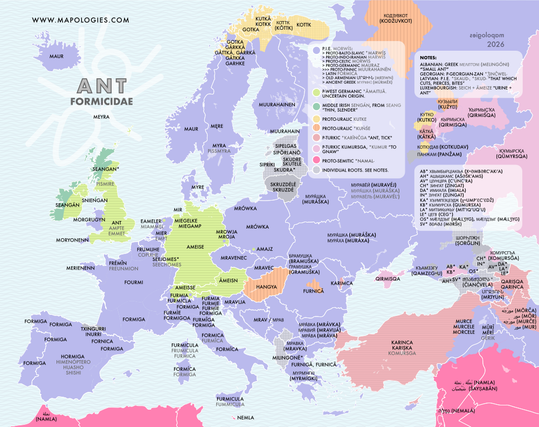
Most European languages are united by a common thread: the word for ant. From the Galician formiga to the Romanian furnică, and from Greek μυρμήγκι (myrmígki) to Finnish muurahainen. Surprising, huh? We can find the traces of a single Proto-Indo-European ancestor: *mórwis.

Bugs • M A P O L O G I E S

Etymology maps of different bugs like (bee, beetle, tick, grasshopper, and spider) in several languages

M A P O L O G I E S

Last map has ants in its pants

https://mapologies.com/bugs/

#insects #map #mapologies #etymology #etymologymap #ant #ants #languagemap

Most European languages are united by a common thread: the word for ant. From the Galician formiga to the Romanian furnică, and from Greek μυρμήγκι (myrmígki) to Finnish muurahainen. Surprising, huh? We can find the traces of a single Proto-Indo-European ancestor: *mórwis.

I really feel my oats after posting this map #mapologies #map #etymology #etymologymap #languagemap #cereals #languages #mapping #oats

www.maplogies.com/cereals

pig, swine, pork... are some of the words used to name "pigs". Which one do you use in your language?
https://mapologies.com/animals/
#animal #etymology #etymologymap #languages

The conquistadors encountered the plant, known as "tlālcacahuatl" in Nahuatl, in the marketplace of Mexico Tenochtitlan, the Aztec capital. Interestingly, if you think it sounds similar to cacao, you are correct in that intuition: it means "earth cocoa bean."

However, the plant was originally from South America. You might conclude that "maní" is perhaps from Quechua (the language of the Inca). Wrong. "maní" is a Taino word, a Caribbean language.

https://mapologies.com/el-atlas/

#etymologymap #spanish

Have a nice summer time!
More maps in www.mapologies.com/time

#map #etymologymap #etymology #lingusiticmap #languagemap #language #summer #mapologies

#Plum comes from two Ancient #Greek words: proûmnon (like in #English) & damaskēnós (like #Czech & #Portuguese) In many languages from Proto-Slavic "sliva".

We have more etymology maps about fruits:
https://mapologies.com/fruits

#language #mapologies #fruit #etymologymap #etymology

Fruits • M A P O L O G I E S

As humans spread all over the world, so fruit trees did. The etymologies of their names give us information about their origin and travels

M A P O L O G I E S

The word “tea” takes on various forms in different languages. Yetit does not matter weather you say te or cha, herbata or çay, they all trace their origins back to the Chinese character for tea 茶.

https://mapologies.com/herbs/

#herb #drink #tea #te #caj #cha #cay #etymology #etymologymap #mapologies #mapologic #map

Herbs • M A P O L O G I E S

Etymological map of several herbs in different languages of Europe and its surroundings, like basil, thyme or parsley

M A P O L O G I E S