 Dominus Markham
 Jonathan Emmesedi
...the New Standard Institute.
https://www.newstandardinstitute.org/
I'm aware, of course, how Kpop is part of a global popular music industry fuelling the rise of fast fashion.
#Fashion #Apparel #Labor #Environment #EthicalConsumption #FairTrade
...the New Standard Institute.
https://www.newstandardinstitute.org/
I'm aware, of course, how Kpop is part of a global popular music industry fuelling the rise of fast fashion.
#Fashion #Apparel #Labor #Environment #EthicalConsumption #FairTrade
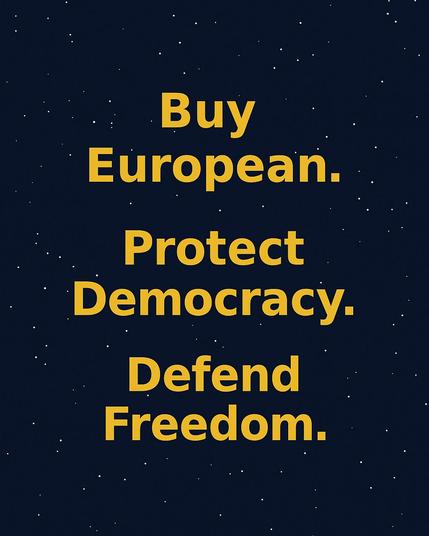
What is Eurocrazy?
A civic project that connects democracy with everyday consumption.
We design our own products and curate items made exclusively in full democracies under the Made in Democracy® standard.
We also donate 5% of profits to projects supporting freedom and human rights.
Because democracy is not abstract. It is something we practice daily.
Behind it, there is a growing community: Euroguardians.
#Democracy #Europe #EthicalConsumption #MadeInDemocracy #HumanRights #Eurocrazy
I've been a little less active lately, it's been a busy season here at the Ranch! Though, I am excited to share that we just shared our free October newsletter: Eating Ethically on a Shoestring Budget. In it we share some important information and ideas about eating more ethically without falling for greenwashing and ridiculous price tags on, let's face it, products that probably aren't *that* much better than the cheaper alternatives.
Share it with a friend if it helps you out, because that helps us out!
https://rancholibertad.com/eating-ethically-on-a-shoestring-budget/
#Food #Economy #EatingWell #EthicalConsumption #Ethics #FoodEthics #FoodSovereignty #CommunitySovereignty #Tips

There are eight of us living at the Ranch right now, and only one full time day job among the eight of us. This is not a flaw, but rather by design: we hope that our residents, beyond the time spent helping with projects that are related to stewarding the
Humane Beef: Worth the Life - Peter Godfrey Smith and Alex O Connor
Earth’s Resources and the Illusion of Scarcity
Opening Insight
Every generation inherits a set of fears. For ours, one of the loudest is the idea that humanity itself has grown too numerous for the Earth to sustain. The fear of overpopulation is repeated in policy debates, climate warnings, and casual conversation. Yet this fear obscures a deeper truth. The Earth holds extraordinary capacity. It still has the resources to nourish and support billions more lives. What it cannot sustain is the cultural engine we call consumerism, a system that transforms abundance into waste and turns sufficiency into scarcity.
The Real Constraint is Not People
Overpopulation is often used as shorthand for environmental collapse, but it is a misleading equation. A human being in one part of the world lives a radically different material life than a human being elsewhere. A child born in Canada or the United States will, over their lifetime, consume vastly more energy, food, water, metals, and plastics than a child born in rural Tanzania or Nepal. Population numbers, in isolation, do not explain planetary stress.
What drives collapse is not sheer numbers, but patterns of consumption. The richest ten percent of the global population account for more than half of all carbon emissions. Meanwhile, entire regions live with minimal ecological footprints, often out of necessity rather than choice. When critics claim “there are too many people,” they rarely direct their gaze toward the overbuilt suburbs, sprawling supply chains, and energy-hungry lifestyles of wealthy nations.
This imbalance is not a natural law. It is a design. Global systems of production reward volume, speed, and disposability. Goods are shipped across oceans not because it is efficient in resource terms, but because it is profitable in financial terms. Abundance exists, but it is skewed and squandered.
Earth’s Capacity for Abundance
The planet remains rich in possibility. Renewable energy technologies such as solar, wind, geothermal, and hydro can provide far more power than humanity currently consumes. Advances in vertical farming, aquaponics, and regenerative agriculture show that food production need not destroy topsoil or drain rivers. Desalination, once energy-prohibitive, is becoming more feasible with green energy integration. These approaches echo the United Nations Sustainable Development Goals, which emphasize responsible consumption and production as essential to global stability.
There is no shortage of sunlight, wind, or biological cycles. What is scarce is foresight and political will. Instead of scaling sustainable models, governments often double down on fossil fuel subsidies or industrial agriculture that burns through water and soil fertility.
It is worth remembering that much of what we call scarcity is artificial. Grain is wasted to maintain market prices. Fisheries collapse not because fish have vanished, but because profit drives overextraction before populations can replenish. Energy crises are less about geological limits than about outdated infrastructure and short-term thinking.
Earth’s abundance has not failed us. We have failed to align our systems with that abundance.
The Trap of Consumerism
If resources exist to sustain billions more, why do we feel constantly on the brink of shortage? The answer lies in consumerism’s logic. Consumerism thrives not on meeting needs, but on creating perpetual desire. A phone designed to last twenty years would collapse the market. Clothes built to endure decades would reduce sales. Planned obsolescence, seasonal fashion, and disposable goods are not accidents. They are features of an economy that equates growth with turnover.
In this model, abundance is dangerous. If people feel they have enough, they stop buying. So advertising tells us we are never enough without the latest product. Supermarkets discard edible food to preserve margins. Fast-fashion factories churn out garments designed to fray quickly, ensuring the next purchase is never far away.
Consumerism does not care about the survival of humanity or the planet. It cares about the survival of its own cycle. That cycle feeds on waste, and in doing so, it transforms sufficiency into scarcity. The Earth is abundant, but consumerism translates that abundance into landfill.
Inequality of Burden
One of the cruelest ironies of consumerist unsustainability is how its consequences are distributed. Those who consume the least often face the harshest impacts of climate change and resource depletion. Droughts hit subsistence farmers hardest. Rising seas displace coastal villages long before they threaten luxury waterfront apartments. The people least responsible for global excess are the ones most likely to pay the price.
This is not just an environmental issue, but an ethical one. To say the Earth cannot sustain more people is, in many ways, to shift blame away from the wealthiest consumers. The unspoken message becomes: it is their existence that is the problem, not our habits. This framing is not only false, it is profoundly unjust.
Population is not destiny. Patterns of resource use are.
Redefining Prosperity
If Earth’s resources are sufficient, but consumerism makes them unsustainable, what path remains open to us? The answer lies in redefining prosperity itself. Prosperity need not mean endless accumulation of goods. It can mean resilience, health, education, creativity, dignity.
A society that measures success by disposable income and luxury purchases will always believe it lacks enough. A society that measures success by the well-being of its people and ecosystems will recognize abundance where it already exists.
This is not a call for austerity or asceticism. It is a call for design. Technologies can be built to endure. Food systems can be designed to eliminate waste. Energy infrastructures can be reoriented around renewables. Wealth can be measured by freedom from need, rather than the size of closets or garages.
The Responsibility of Choice
We are not helpless in the face of these dynamics. Consumers are not mere victims; we are participants. Every purchase reinforces or undermines the system. Governments are not powerless; they set subsidies, standards, and incentives. Corporations are not immovable; they respond to regulation, social pressure, and changing demand.
But responsibility must not become a smokescreen for guilt. Individual recycling efforts will not save the world while fossil fuel giants pump billions of tons of carbon into the air. The point is not to shame people for existing, but to hold systems accountable for how resources are allocated.
The Earth has given us abundance. The challenge is to choose what we do with it.
Reflection: Abundance or Scarcity by Design
When we step back, the picture clarifies. The Earth is not exhausted. Its cycles of renewal remain intact. The Sun still pours energy upon us every day. Oceans still teem with life. Forests still absorb carbon and breathe oxygen into the air. The capacity to sustain billions more humans exists.
What threatens collapse is not humanity’s numbers, but humanity’s choices. We have built a system that thrives on waste, rewards disposability, and equates prosperity with consumption. If that system continues unchanged, no resource base will ever be enough.
But if we redefine prosperity, align our systems with the planet’s cycles, and refuse to equate dignity with consumption, abundance becomes possible again. The Earth can sustain us. The question is whether we will sustain the Earth.
#abundance #consumerism #dignity #earthResources #environment #ethicalConsumption #futureOfHumanity #overpopulation #philosophy #scarcity #Sustainability #SustainableLiving
I could see on X that they are making fun of China, saying things like, "What has China invented without copying others?" It seems like this isn't a healthy question. You know, China can make everything, including accessibility, and sell it at better prices, such as for Malaysia's MYR. China has addressed the world's issues of accessibility and affordability. It seems that those users on X do not appreciate what China has achieved.
#ChinaContribution #GlobalAccessibility #AffordableTech #ChineseInnovation #EconomicImpact #MalaysianMarket #ConsumerBenefit #TechAffordability #Appreciation #GlobalTrade #EconomicDevelopment #Innovation #FairTrade #ConsumerRights #RespectForAchievements #MarketDynamics #PositiveDialogue #EthicalConsumption #GlobalCooperation #ResponsibleLiving
It seems that for me, if I choose to be a survivalist individualist person, genuinely based on hardships and effort in trading, then I follow the Chinese way. If I want to be a narcissist who doesn't feel how those poor people feel in the streets every day, making fun of others and using freedom of speech as justification at the expense of respect for others, then U.S. ideologies are better for me. It seems that the Chinese way represents real trading for me; it is based on efforts and hardships, not on control, vendor lock-in, narcissistic reputability, and brands.
#SurvivalistMindset #Individualism #ChineseWay #USIdeologies #HardshipAndEffort #EconomicPhilosophy #Consumerism #Narcissism #RealTrading #VendorLockIn #RespectForOthers #FreedomOfSpeech #PersonalValues #EconomicFreedom #GlobalEconomics #MarketDynamics #ConsumerBehavior #EthicalConsumption #ResponsibleLiving #MoralCompass
Apparently MUD Jeans these days (since 2016) has nothing to do with the old company. All the #jeans are made from post-consumer #recycled material or organically farmed cotton. It's not a worker-owned cooperative, but at least it's a B Corporation. They claim to be trying but seems like it's still pretty bad working conditions for production.
Anyway, that's the best I could do without wearing myself out on research. Buying jeans is always stressful af.

 Eurocrazy™
 Rancho de la Libertad
 what's trending
 Michael N. Kingsnorth
 colordefects
 Kalvin Carefour Johnny
 Sunflower Björnskalle 🌻