 Palm Oil Detectives
#eu commission should not trust #ecolabels: e.g. #RSPO and #FSC to prevent #deforestation. Decades of failure to stop #humanrights abuses #deforestation shows their deep systemic weaknesses #Boycottpalmoil 🌴☠️🧐🚫 #Boycott4Wildlife @palmoildetectives https://palmoildetectives.com/2022/06/18/10-reasons-why-ecolabels-commodity-certification-are-not-a-solution-to-stop-the-eu-importing-tropical-deforestation/?utm_source=mastodon&utm_medium=Palm+Oil+Detectives&utm_campaign=publer
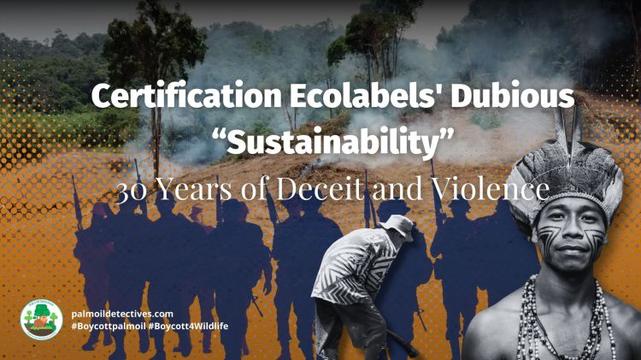
#Ecolabels like #RSPO and #FSC are accused of greenwashing, hiding corporations’ environmental #ecocide from consumers 💩🛒 rather than fighting #corruption. Fight back with your wallet and #Boycottpalmoil 🌴🪔🩸🧐🙊⛔️ #Boycott4Wildlife @palmoildetectives https://palmoildetectives.com/2023/06/18/certification-ecolabels-dubious-sustainability-30-years-of-deceit-and-violence/?utm_source=mastodon&utm_medium=Palm+Oil+Detectives&utm_campaign=publer
Around 400 #ecolabels 🏆 claim to provide #consumers with choice ⁉️ Yet they’re unreliable in holding #corporates to account for widespread #deforestation and #humanrights abuses and #greenwashing #Boycottpalmoil 🌴🪔🔥 ⛔️#Boycott4Wildlife @palmoildetectives
https://wp.me/pcFhgU-8Y6?utm_source=mastodon&utm_medium=Palm+Oil+Detectives&utm_campaign=publer
https://wp.me/pcFhgU-8Y6?utm_source=mastodon&utm_medium=Palm+Oil+Detectives&utm_campaign=publer
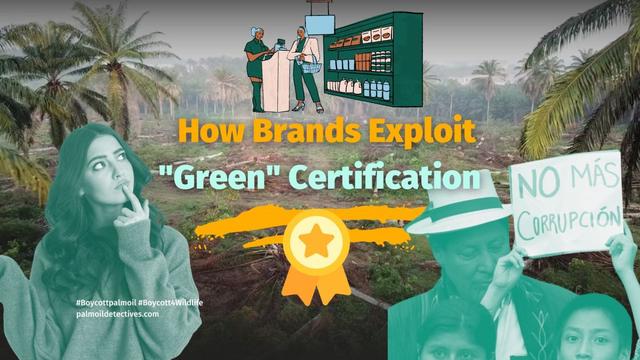
Around 400 #ecolabels 🏆 claim to provide #consumers with choice ⁉️ Yet they’re unreliable in holding #corporates to account for widespread #deforestation and #humanrights abuses and #greenwashing #Boycottpalmoil 🌴🪔🔥 ⛔️#Boycott4Wildlife @palmoildetect.bsky.social
https://wp.me/pcFhgU-8Y6?utm_source=mastodon&utm_medium=Palm+Oil+Detectives&utm_campaign=publer
https://wp.me/pcFhgU-8Y6?utm_source=mastodon&utm_medium=Palm+Oil+Detectives&utm_campaign=publer
 Matthew Rimmer
World’s largest krill harvester at centre of row over ‘blue tick’ sustainability label https://www.theguardian.com/environment/2026/mar/04/worlds-largest-krill-harvester-row-blue-tick-sustainability-label
Aker QRILL is facing criticism of its fishery management amid calls by environmentalists for curbs on Antarctic fishing of the keystone species #ecolabels #SDGs #sustainability
Aker QRILL is facing criticism of its fishery management amid calls by environmentalists for curbs on Antarctic fishing of the keystone species #ecolabels #SDGs #sustainability

 Palm Oil Detectives
RSPO’s Dubious “Sustainability”: 30 Years of Deceit
Ecolabels like RSPO and FSC are involved in networks of extensive greenwashing. They exist to conceal corporations’ environmental damage rather than fighting it. With three decades dubious promises from environmental certifications, World Rainforest Movement calls for a swift end to this disgraceful palm oil, soy and timber industry greenwashing. You can help resist palm oil colonialism and ecocide #Boycottpalmoil #Boycott4Wildlife every time you shop!
#Ecolabels like #RSPO and #FSC are accused of greenwashing, hiding corporations’ environmental #ecocide from consumers 💩🛒 rather than fighting #corruption. Fight back with your wallet and #Boycottpalmoil 🌴🪔🩸🧐🙊⛔️ #Boycott4Wildlife @palmoildetect https://palmoildetectives.com/2023/06/18/certification-ecolabels-dubious-sustainability-30-years-of-deceit-and-violence/
Share to BlueSky Share to TwitterWorld Rainforest Movement and Palm Oil Detectives call for an end to #palmoil #greenwashing from #RSPO “sustainable” palm oil 🙊🧐⛔️ Resist the greenwash and #Boycottpalmoil #Boycott4Wildlife in the supermarket! 🌴💀🩸🚫 @palmoildetect https://palmoildetectives.com/2023/06/18/certification-ecolabels-dubious-sustainability-30-years-of-deceit-and-violence/
Share to BlueSky Share to TwitterThis article was originally published by World Rainforest Movement as “Certification schemes on “sustainability”: 30 years of deceit and violence” on 25 March, 2023 and was republished with permission here alongside other reports from World Health Organisation, Global Witness and others. Read original.
The shelves in supermarkets and stores are full of certified products. The packaging displays different labels indicating products were made with “sustainable” paper or wood, food or cosmetic products made with “sustainable” palm oil, “responsible” soybeans and so on and so forth.
Even when it comes to buying an airplane ticket, consumers can pay a little more
to ensure that their carbon emissions are (supposedly) “neutralised”, so as to guarantee that much touted “sustainability”.
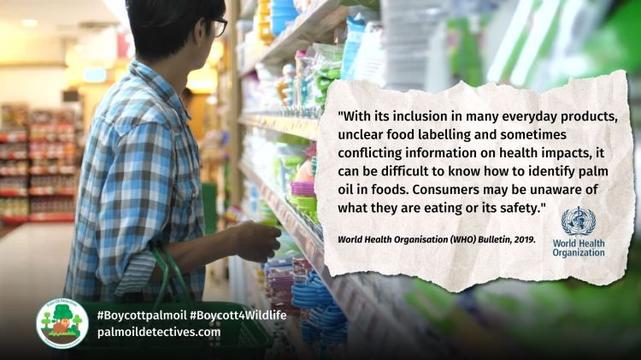
Read more: WHO Bulletin Report: Palm Oil and Human Health Impacts
So why is there this need for so many labels and forms of certification? What is actually being certified? And who is benefiting from this?
After 30 years of certification schemes with environmental and social bias, what is clear is that the only “sustainability” that they guarantee is that of corporations’ lucrative business.
The first environmental certification mechanism for a specific product (wood) and its production chain emerged in the early 1990s, with the creation of the Forest Stewardship Council (FSC). Although its origin is connected with civil society pressure on corporations, FSC has been fully incorporated into the production logic of logging companies operating in forests, of giant paper and pulp corporations using tree monoculture plantations, as well as of producers and distributors of consumer goods.
Over time, having shown that it did not constitute any threat – on the contrary: an opportunity – to the accumulation strategy of the corporations involved, other sectors started creating similar mechanisms. Hence, starting in the 2000s, initiatives and so-called roundtables for “sustainable” or “responsible” production of palm oil, soybeans, cocoa, sugarcane, among others, proliferated.
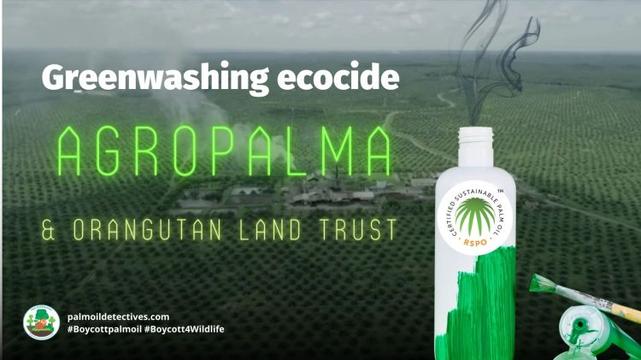
Greenwashing ecocide – Agropalma & Orangutan Land TrustRead more: Greenwashing Ecocide: Agropalma and Orangutan Land Trust
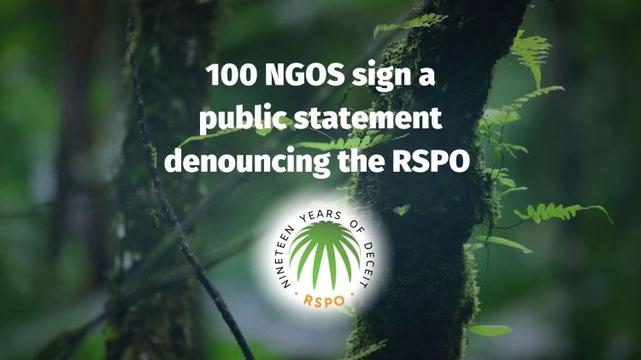
100 NGOS signed a public statement denouncing the RSPO in late 2022
Read moreThese “sustainable” initiatives have various aspects in common
1. They are dominated, compromised and funded by corporate interests
They are schemes that present themselves as non-profit associations including many apparently diverse actors and interests (companies, NGOs, governments etc.) However, in practice, the business sector participants andtheir allies, like the big conservationist NGOs, dominate these initiatives and impose their interests in a highly unequal power relation between the members.
2. They promote toothless and unenforceable guidelines
They are mechanisms that establish operational guidelines and directives for companies to adhere to on a voluntary bases, leaving no possibility of legal consequences when rules are broken – rules formulated and judged by the companies themselves, it should be noted.
3. They promote an endless growth model of capitalism in spite of our limited and finite natural world
They are initiatives submitted to the logic of the market and its expansion, that is to say, certification labels have become important both to obtain funding for companies’ expansion projects and to win over consumers, mainly urban consumers and those from the global North. Read more about the limits of the Endless growth model.
4. The mechanism for conflict resolution is set and decided upon by the certification label itself – amplifying racial and gender inequities
They are mechanisms headquartered in countries of the North, and with management boards mainly composed of men and white people, leaving the rural communities of the South that have to face the certified plantations, to play the role of mere receivers of determinations imposed from outside about the use of the space where they live. And if they want to question the actions of any of the certified companies, they must submit to the protocol created by the certification system itself on how to proceed.
5. They use greenwashing language and false promises even though this does not reflect reality
Certification schemes are used by companies as defence mechanisms whenever they are faced with criticism over the impacts of their activities:
“Our products are certified…”, “The project has certification…”, as if this has guaranteed that there is no cause for concern.
One way or another, such certification mechanisms have not stopped the destructive expansion of industrial tree plantations, oil palms, soy, etc. Read more about using Design and Words as a greenwashing tool.
6. The predatory nature of corporate land-grabbing and expansionism cannot ever work in favour of indigenous peoples
A still from the documentary: by Mama Malind su Hilang (Our Land Has Gone) Nanang Sujana Watch on Youtube: https://www.youtube.com/watch?v=RqYoRh1aApgCertification labels have not been able to resolve the conflicts generated with traditional communities and Indigenous Peoples. Nor do they have the potential to do so, since they are designed to allow the continuity and expansion of corporate accumulation patterns that are intrinsically dependent on a predatory dynamic.
In fact, the main common denominator of such certification schemes is that they guarantee a green label to the companies involved, thus contributing to their primary objective, i.e., the maximisation of profit.
7. Certification labels like FSC and RSPO are vital to for companies gain consumer buy-in and greenwash away harms
Certifiers have hence become a key element through which companies seek to legitimize their territorial and economic expansion in the global South, deceiving consumers with the “sustainability” discourse.
In other words, these destructive corporations need certification labels to obtain some legitimacy in the eyes of consumers and investors, bearing in mind the vast number of reports, news and studies showing their harmful effects, such as:
- Violent corporate land-grabbing aided by private enforcement or military/police intervention
- Problematic, deceptive or non-existent community consultation processes
- Contamination by agro-chemicals and its human health and environmental impacts
- Soil degradation
- Dangerous and humiliating jobs
- Sexual abuse and other forms of violence against women
- Child slavery and indentured slavery
among many other impacts related to extensive monoculture plantations.
This permits one to affirm without reservation that certification itself has become an underlying cause of deforestation.
10 Tactics of Sustainable Palm Oil Greenwashing
Greenwashing Tactic #1: Hidden Trade Off
When a brand makes token changes while continuing with deforestation, ecocide or human rights abuses in another part of their business – this is ‘Hidden Trade Off’
For example, Nestle talks up satellite monitoring to stop palm oil deforestation. Yet…
Greenwashing Tactic #2: No Proof
Greenwashing Tactic 5. Palm oil companies make environmental claims without providing proof or evidence of these claims or using spurious evidence.
Greenwashing Tactic #3: Vagueness
Claiming a brand or commodity is ‘green’ or ‘sustainable’ based on broad generalisations, unclear language or vague statements Jump to section Greenwashing: Vagueness in Language Greenwashing: Vagueness in certification standards Reality: Auditing of RSPO a failure Quote: EIA: Who Watches…
Greenwashing Tactic #4: Fake Labels
Claiming a brand or commodity is green based on unreliable, ineffective endorsements or eco-labels such as the RSPO, Forest Stewardship Council (FSC) or FairTrade coffee and cocoa. Examples of this form of greenwashing Original tweet [Tweet above by Ruben Brunsveld…
Greenwashing Tactic #5: Irrelevance and Deflection
Claiming a brand, commodity or industry is green based on irrelevant information Jump to section Greenwashing: Irrelevant Topics Greenwashing: Colonial Racism Research: Palm oil greenwashing and its link to climate denialism Reality: RSPO Certification Doesn’t Stop Deforestation, Human Rights Abuses…
Greenwashing Tactic #6: The Lesser of Two Evils
Claiming that a brand, commodity or industry is greener than others in the same category, in order to excuse ecocide, deforestation, human rights and animal rights abuses. Jump to section Greenwashing: Lesser of Two Evils: Palm Oil Uses Less Land…
Greenwashing lies are falsifying support from authorities to back up claims or using spurious research data to back up the greenwashing, boycott palm oil!
Greenwashing Tactic 8: Design & Words
Greenwashing Tactic 8. Companies use design principles and subliminal language to signal ‘greenness’ and trigger unconscious emotional responses in consumers
Greenwashing Tactic 9: Partnerships, Sponsorships and Research Funding
Greenwashing Tactic 9. Corporations use NGOs, Zoo partnerships, sponsorships, and research funding to give an industry or brand a ‘green image.
Greenwashing Tactic 10: Gaslighting, Harassment, Stalking and Threats
Gaslighting, harassing or stalking vocal critics of a brand, commodity or industry certification in order to silence these critics – this is greenwashing!
Ten Tactics of ‘Sustainable’ Palm Oil Greenwashing
Learn ten marketing and PR tactics used for “sustainble” palm oil greenwashing to justify endless growth by the palm oil industry. Boycott palm oil now!
New forms of greenwashing: Carbon Credits and Biodiversity Credits
Furthermore, it is important to mention that the idea of certification has been taking on new shapes. With the creation of offset mechanisms for carbon emissions and biodiversity loss, new commodities have emerged already linked to certification mechanisms. In this new market, carbon credits and biodiversity credits – issued by certification schemes – represent a supposed guarantee that greenhouse gas emissions or the destruction of biodiversity are being duly offset elsewhere.
Differently from wood, paper, palm oil or soybeans, where the certification is “added” to the product by means of a label, in the carbon or biodiversity markets it is the
certification itself that makes it feasible for the product to be consumed.
In other words, the commodity in itself is supposedly a guarantee – though a virtual guarantee, obtained through dubious methodologies and permeated by openly suspect interests.
This compilation of articles from the WRM Bulletin aims to underscore the damaging role played by companies and organisations involved in certification schemes. WRM considers it important to highlight that after three decades with ever more environmental certification labels on the market, it is urgent to put an end to this greenwashing.
Ultimately, instead of combating environmental devastation and the social ills linked
to corporations’ and other players’ operations, these labels cover up and
sustain their destructive logic.
Sexual Exploitation and Violence against Women at the Root of the Industrial Plantation Model
The industrial plantation model is intrinsically linked with patriarchal oppression, serving as a cornerstone for corporate profitability. Companies often exploit women, recognizing their integral role within community dynamics, as a means to augment their bottom line. The intersection of gender and economic exploitation exemplifies the profound social implications of this oppressive system.
Read moreRSPO: outsourcing environmental regulation to oil palm businesses and industry
The RSPO certification, cleverly turning the palm oil industry’s legitimacy crisis to its favor, uses it as a stepping stone to further strengthen the industry’s position. It provides certificates claiming to meet sustainability standards—a clear advantage to the industry. However, it’s important to note that these standards are largely controlled by and designed to benefit companies operating within the palm oil sector itself.
Read more“Gender” in the palm oil industry and its RSPO label
Implementing gender policies in oil palm companies and the RSPO certification scheme is a start. But do they truly tackle the violence, patriarchy, and racism in the plantation model, or merely mask them? It’s crucial to examine how these policies are enacted and if they genuinely drive substantial change, or just scratch the surface of these systemic issues.
Read moreColombia: Palm-Producing Company Poligrow Plans to Grab more Land under the “Small Producers” Scheme
The harsh realities of violence, mass killings, and forced relocations amid the armed conflict in Colombia have disturbingly paved the way for the expansion of industrial oil palm cultivation. The palm oil company and RSPO member Poligrow, has been significantly implicated in these issues, with credible allegations of land seizure and intimidation tactics within the region of Mapiripán.
Read moreGreenwashing Words: Language that kills forests
Language never operates in a vacuum. Historically, specific terms have been leveraged as tools for exercising control over populations and territories. This article throws light on certain terms which, while seemingly positive, often shield economic interests detrimental to forests, forest animals and forest peoples.
Read moreAfrica: The RSPO certification for palm oil plantations is greenwash!
The Roundtable on Sustainable Palm Oil (RSPO) is a widely used certification system promising environmental, safety, and human rights standards in the palm oil industry. However, Friends of the Earth Africa groups contest its effectiveness, citing ongoing environmental degradation, human rights breaches, biodiversity loss, and increased poverty in Africa linked to the activities of palm oil companies.
Read morehttps://www.youtube.com/watch?v=SnXISnURIBA
Communities resisting the impunity and impacts of oil palm growers in Ecuador: Cases from Esmeraldas
The palm industry in Ecuador, encompassing 270,000 hectares of plantations, has been using the Roundtable on Sustainable Palm Oil (RSPO) certification to project an image of sustainability, setting itself apart from Asian palm oil. However, critics argue that this certification merely muffles community objections. Resistance from communities such as La Chiquita, Guadualito, and Barranquilla de San Javier in the Esmeraldas region continues to fuel discontent and foster international solidarity.
Read moreRSPO Certification despite land conflicts, violence and criminalisation
Nearly 1,500 members of MALOA in Sierra Leone are challenging RSPO’s certification of a SOCFIN subsidiary. They cite a string of conflicts and grievances tied to land use. This move follows controversial certifications of SOCFIN group’s operations in Nigeria, Cameroon, and Ivory Coast. Critics question if RSPO, perceived as industry-biased, can truly guarantee sustainability and human rights in the palm oil sector.
Read moreAre FSC and RSPO accomplices in crime? Agropalma’s Unresolved Land Question in the Brazilian Amazon
The Palmas del Ixcán company in Guatemala is accused of implementing systematic dispossession of land from indigenous communities for oil palm cultivation, using tactics such as deceptive RSPO certification and independent producers. The company’s strategic approach replaced the traditional collective land management by indigenous people in the Municipality of Ixcán, which had been disrupted by development plans since the 1960s. Despite filing a complaint to the RSPO and participating in consultations, the communities found their concerns disregarded, leading them to criticize the RSPO and label it a sham, asserting that its true intention is to facilitate palm planting at any cost.
Read moreWater is life – stop planting palms! reads a sign in Guatemala
“Water is life. Stop planting oil palms”. Photo: Movimiento Social Intercultural del Pueblo de Ixcán, GuatemalaThis article was originally published by World Rainforest Movement as “Certification schemes on “sustainability”: 30 years of deceit and violence” on 25 March, 2023 and was republished with permission alongside other reports from World Health Organisation, Global Witness and others. Read original.
ENDS
Read more about human rights abuses and greenwashing associated with “sustainable” palm oil
Family Ties Expose Deforestation and Rights Violations in Indonesian Palm Oil
An explosive report by the Environment Investigation Agency (EIA) details how Indonesia’s Fangiono family, through a wide corporate web, is linked to ongoing #deforestation, #corruption, and #indigenousrights abuses for #palmoil. Calls mount for…
Corporate Control of Food Harms Us All
Around 800 million people in our world go hungry each day. Yet around the globe we have enough food to go around. So why the discrepancy? Market concentration and corporate monopoly of our…
MSC and RSPO Absolutely Untrustworthy, Greenpeace Report
Greenpeace report reveals severe failures of ecolabel RSPO certifying palm oil and FSC certifying seafood. Consumers are being greenwashed. Boycott palm oil!
Guaranteeing Ecocide: The Green Lie of Palm Oil Certification
For decades, the palm oil industry, backed by the RSPO, has misled consumers with the false promise of “sustainable” palm oil. Behind this green façade lies a brutal reality of deforestation, human rights…
How Brands Exploit “Green” Certification
Brands and businesses may be tempted to exploit “green” certifications to garner a larger market share at the expense of integrity.
Load more posts
Something went wrong. Please refresh the page and/or try again.
Take Action in Five Ways
1. Join the #Boycott4Wildlife on social media and subscribe to stay in the loop: Share posts from this website to your own network on Twitter, Mastadon, Instagram, Facebook and Youtube using the hashtags #Boycottpalmoil #Boycott4Wildlife.
2. Contribute stories: Academics, conservationists, scientists, indigenous rights advocates and animal rights advocates working to expose the corruption of the palm oil industry or to save animals can contribute stories to the website.
Mel Lumby: Dedicated Devotee to Borneo’s Living Beings
Anthropologist and Author Dr Sophie Chao
Health Physician Dr Evan Allen
The World’s Most Loved Cup: A Social, Ethical & Environmental History of Coffee by Aviary Doert
How do we stop the world’s ecosystems from going into a death spiral? A #SteadyState Economy
3. Supermarket sleuthing: Next time you’re in the supermarket, take photos of products containing palm oil. Share these to social media along with the hashtags to call out the greenwashing and ecocide of the brands who use palm oil. You can also take photos of palm oil free products and congratulate brands when they go palm oil free.
https://twitter.com/CuriousApe4/status/1526136783557529600?s=20
https://twitter.com/PhillDixon1/status/1749010345555788144?s=20
https://twitter.com/mugabe139/status/1678027567977078784?s=20
4. Take to the streets: Get in touch with Palm Oil Detectives to find out more.
5. Donate: Make a one-off or monthly donation to Palm Oil Detectives as a way of saying thank you and to help pay for ongoing running costs of the website and social media campaigns. Donate here
Pledge your support#auditFraud #Boycott4wildlife #BoycottPalmOil #corruption #deforestation #ecocide #ecolabels #fraud #FSC #greenwashing #humanRights #indigenousRights #landRights #landgrabbing #OrangutanLandTrust #palm #palmOilDeforestation #palmoil #RSPO #RSPOGreenwashing
Workers on Sri Lanka’s estates reveal the bitter truth behind ethical labels on tea packets https://www.abc.net.au/news/2025-03-05/tea-ethical-label-estates-investigation-sri-lanka/104889838 #trademark #certification #laborrights #Rainforestalliance #ecolabels #greenwashing? #tea #SDGs

 Giuseppe Zolli
Around 400 #ecolabels 🏆 claim to provide #consumers with choice ⁉️ Yet they're unreliable in holding #corporates to account for widespread #deforestation and #humanrights abuses and #greenwashing #Boycottpalmoil 🌴🪔🔥 ⛔️#Boycott4Wildlife @palmoildetectives https://wp.me/pcFhgU-8Y6
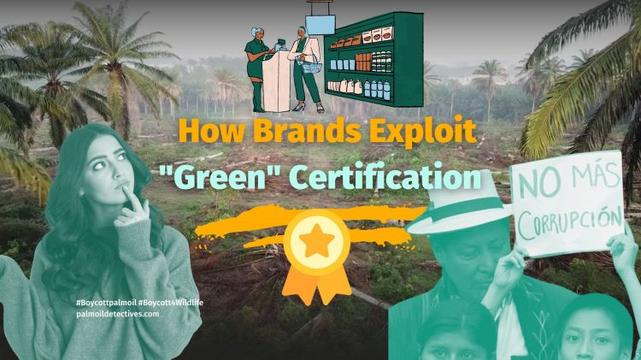
How Brands Exploit “Green” Certification
Brands and businesses may be tempted to exploit “green” certifications to garner a larger market share at the expense of integrity.
Around 400 #ecolabels 🏆 claim to provide #consumers with choice ⁉️ Yet they’re unreliable in holding #corporates to account for widespread #deforestation and #humanrights abuses and #greenwashing #Boycottpalmoil 🌴🪔🔥 ⛔️#Boycott4Wildlife @palmoildetect https://wp.me/pcFhgU-8Y6
Share to BlueSky Share to Twitter#Brands and giants of #FMCG may be tempted to exploit “green” certifications like #FSC, MSC and #RSPO to reassure consumers. Yet ecolabels have deep flaws in enforcement of standards. #ecocide #greenwashing #Boycottpalmoil #Boycott4Wildlife @palmoildetect https://wp.me/pcFhgU-8Y6
Share to BlueSky Share to TwitterWritten by Dr Arne Nygaard, professor at the School of Communication, Leadership and Marketing at Kristiania University College, Norway. His primary research interests include sustainable supply chains, greenwashing, geopolitical risk and strategic uncertainty, economic contracts and incentives, sustainability and green marketing, technology, and entrepreneurship. Originally published under Creative Commons by 360info™, read the original.
Analyses conducted in the study indicate that while certifications can help prevent greenwashing, they can also contribute to eco-opportunism […] the theory of eco-opportunism warns that this can lead to free riding and greenwashing, where products are falsely advertised as sustainable but fail to meet certified standards.
Nygaard, A. (2023). Is sustainable certification’s ability to combat greenwashing trustworthy? Frontiers in Sustainability, 4, Article 1188069. https://doi.org/10.3389/frsus.2023.1188069
As the global fight against climate change intensifies, certifications have become crucial tools for industries to address environmental, business and social challenges. Sustainability certifications promote eco-friendly practices, protect human rights and boost the credibility of environmentally responsible brands.
But although certifications often enhance the perceived value of sustainable products and services, challenges remain.
There are concerns about greenwashing and free riding plus the inability of certification systems to adapt to changes and failing to incentivise the adoption of newer, more sustainable technologies.
At the supermarket, a shopper carefully studies a label, thinking, “This product has a certification. Must be environmentally friendly. I’ll buy it.” And like that shopper, millions around the world make that same decision every day.
Greenwashing, where companies falsely claim eco-friendly credentials without meeting required standards, is a significant issue. Similarly, free riding allows businesses to benefit from the positive image of certifications without genuinely implementing sustainable practices.
The number of sustainability certifications has surged globally in recent years. The International Institute for Sustainable Development (IISD) reports that more than 400 certifications now cover sectors such as food, agriculture, energy, environment, health and social responsibility.
Consumer awareness
This growth reflects increasing consumer awareness of sustainability and the desire of companies to showcase their commitment to eco-friendly practices.
Certifications serve as essential market signals, enabling businesses to distinguish themselves by adhering to recognised environmental and social standards.
Some of the internationally recognised certifications include the Leadership in Energy and Environmental Design for green buildings, the Forest Stewardship Council for sustainable forestry and the Fair Trade certification, which ensures that products meet strict social, environmental and labour criteria.
Another key example is the Roundtable on Sustainable Palm Oil certification, which promotes the production of palm oil in a way that minimises environmental harm, protects biodiversity and ensures fair treatment of workers and local communities.
Certifications typically involve third-party evaluations to assess compliance with criteria such as environmental and economic impact or fair labour practices.
Despite widespread adoption, certifications face growing scrutiny.
For instance, consumer demand for eco-friendly products has led to companies charging higher prices for green products. While many consumers are willing to pay this premium, it can create perverse incentives for companies to engage in greenwashing.
Certifications, intended to assure consumers of a product’s environmental and social standards, can paradoxically encourage companies to exploit these authentications for profit.
When businesses realise they can charge a premium for eco-labelled goods, the temptation to stretch the truth or manipulate the certification increases.
Erosion of trust
Greenwashing erodes consumer trust and devalues the certifications of genuinely sustainable products.
As more companies exploit these eco-friendly claims without verification, it becomes harder for consumers to differentiate between authentic and deceptive environmental practices, potentially undermining the credibility of certification systems.
This highlights the urgent need for stronger mechanisms to mitigate these risks, ensuring that certification systems are not only effective but also resilient against exploitation.
Certification bodies can tighten standards, increase transparency and implement stronger verification processes to reflect evolving sustainability standards and prevent misuse. Additionally, independent audits and greater rigour throughout the supply chain would hold companies accountable for their claims.
Investigation into the root causes of greenwashing is necessary to understand how and why companies manipulate sustainable claims.
One key issue is that certification processes often focus on specific criteria and may not capture the broader environmental or social impacts of a product.
Selective compliance
A company may meet the minimum requirements for certification in one area, such as reducing carbon emissions, while ignoring other important sustainability factors such as labour conditions or biodiversity conservation.
This selective compliance allows companies to appear more sustainable than they truly are, feeding into the cycle of greenwashing.
Consumers can be educated on how to critically evaluate certification labels to avoid falling prey to greenwashing tactics.
By reinforcing certification systems with robust monitoring and compliance mechanisms, the credibility of sustainable products can be preserved, and the integrity of genuine sustainability efforts can be upheld.
Non-governmental organisations and activist groups play a critical role in developing and implementing certification systems. These organisations provide valuable input during the creation of sustainability standards and help monitor compliance, ensuring that certification systems remain credible.
For example, the Forest Stewardship Council certification system for responsible forestry was developed in 1993 with input from environmental NGOs such as Greenpeace and the World Wildlife Fund.
NGOs advocate for higher sustainability standards, while certifications give them leverage to hold businesses accountable. By working together, NGOs and certification bodies can drive meaningful change toward a more sustainable future.
The interaction between state institutions, laws, and certification systems is also vital to ensuring the credibility and effectiveness of sustainability efforts.
Governments often set baseline sustainability requirements, while certification systems provide an additional layer of accountability. A clear example is the Roundtable on Sustainable Palm Oil certification now used in 21 countries.
Resistance to change
One challenge facing certification bodies is internal structural inertia. This refers to resistance to change, preventing the adoption of innovative green technologies.
This occurs when certification bodies become too rigid in their processes, policies, or standards, making it difficult for them to quickly adapt to new environmental paradigms.
For example, the Leadership in Energy and Environmental Design initially focused on energy efficiency in buildings but was slow to incorporate newer technologies like green roofs or biophilic design which enhance sustainability.
Similarly, in the agricultural sector, government certification systems such as the United States Department of Agriculture Organic can be slow to recognise advancements in vertical farming or aeroponics, even though these methods significantly reduce land use, water consumption, and pesticide reliance.
This type of institutional resistance can delay the transition to more sustainable practices, as certification bodies may cling to outdated standards that fail to incentivise the latest green technologies.
To stay relevant and support ongoing environmental progress, certification organisations can work to overcome structural inertia and actively seek ways to update their standards in response to new innovations.
By updating their standards to reflect these disruptive technologies, certification systems can stay relevant and effective, driving sustainability across industries and supporting innovation while addressing evolving environmental challenges.
However, certifications, while essential tools for promoting sustainable practices, face limitations. Greenwashing, free-riding, and institutional inertia can undermine their value, posing challenges for businesses and consumers alike.
As markets evolve, certifications risk becoming obsolete unless they adapt to new environmental and technological challenges.
Nygaard, A. (2023). Is sustainable certification’s ability to combat greenwashing trustworthy? Frontiers in Sustainability, 4, Article 1188069. https://doi.org/10.3389/frsus.2023.1188069
Dr Arne Nygaard is a professor at the School of Communication, Leadership and Marketing at Kristiania University College, Norway. His primary research interests include sustainable supply chains, greenwashing, geopolitical risk and strategic uncertainty, economic contracts and incentives, sustainability and green marketing, technology, and entrepreneurship. Originally published under Creative Commons by 360info™, read the original.
ENDS
Read more about greenwashing associated with certified “sustainable” palm oil and other commodities
Finance giants fuel $8.9 trillion deforestation economy
Forest 500 report shows 150 of the world’s largest financial institutions invested nearly $9 trillion in deforestation-linked industries. Support EUDR!
Investigation by Bloomberg exposes that despite being RSPO members, #SOCFIN plantations in #WestAfrica are the epicentre of #humanrights abuses, sexual coercion, environmental destruction, and #landgrabbing. Operating in #Liberia, #Ghana, #Nigeria, and beyond, SOCFIN’s…
The Indigenous Malaysian concept of ‘Badi’: respecting the land and wildlife
The Indigenous Semai #indigenous people of #Malaysia can teach us a lot about how to protect people, planet and biodiversity. The Indigenous concept of #badi is not superstition or taboo, it’s about respecting…
Family Ties Expose Deforestation and Rights Violations in Indonesian Palm Oil
An explosive report by the Environment Investigation Agency (EIA) details how Indonesia’s Fangiono family, through a wide corporate web, is linked to ongoing #deforestation, #corruption, and #indigenousrights abuses for #palmoil. Calls mount for…
Rivers are still people in South East Asia despite court showdown
Healthy rivers are essential for community wellbeing. India and Bangladesh legally recognise rivers as natural persons with rights and powers. Take action!
Load more posts
Something went wrong. Please refresh the page and/or try again.
Take Action in Five Ways
1. Join the #Boycott4Wildlife on social media and subscribe to stay in the loop: Share posts from this website to your own network on Twitter, Mastadon, Instagram, Facebook and Youtube using the hashtags #Boycottpalmoil #Boycott4Wildlife.
Enter your email address
Sign Up
Join 3,172 other subscribers2. Contribute stories: Academics, conservationists, scientists, indigenous rights advocates and animal rights advocates working to expose the corruption of the palm oil industry or to save animals can contribute stories to the website.
Mel Lumby: Dedicated Devotee to Borneo’s Living Beings
Anthropologist and Author Dr Sophie Chao
Health Physician Dr Evan Allen
The World’s Most Loved Cup: A Social, Ethical & Environmental History of Coffee by Aviary Doert
How do we stop the world’s ecosystems from going into a death spiral? A #SteadyState Economy
3. Supermarket sleuthing: Next time you’re in the supermarket, take photos of products containing palm oil. Share these to social media along with the hashtags to call out the greenwashing and ecocide of the brands who use palm oil. You can also take photos of palm oil free products and congratulate brands when they go palm oil free.
https://twitter.com/CuriousApe4/status/1526136783557529600?s=20
https://twitter.com/PhillDixon1/status/1749010345555788144?s=20
https://twitter.com/mugabe139/status/1678027567977078784?s=20
4. Take to the streets: Get in touch with Palm Oil Detectives to find out more.
5. Donate: Make a one-off or monthly donation to Palm Oil Detectives as a way of saying thank you and to help pay for ongoing running costs of the website and social media campaigns. Donate here
Pledge your support#BoycottPalmOil #Boycott4wildlife #BoycottPalmOil #brandCertification #Brands #consumers #corporates #corruption #deforestation #ecocide #ecolabels #FMCG #FSC #greenwashing #HumanRights #OrangutanLandTrust #PalmOil #palmOilDeforestation #RSPO #RSPOGreenwashing
 oberonsghost
TIL, there is a list of over 450 #ecolabels.