Conference announcement!

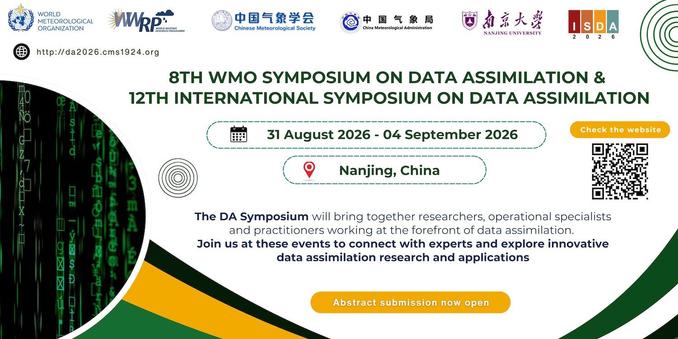
The 8th WMO Symposium on Data Assimilation & 12th International Symposium on Data Assimilation

Nanjing, China - August/September this year.

https://da2026.cms1924.org

(I am on the organising committee so happy to answer any questions)

#DataAssimilation #DA
#WMO
#ISDA2026

ECMWF annual seminar 2026 is on "Advancing the assimilation of Earth system observations with new methodology and Machine Learning"

Registration is open:
https://events.ecmwf.int/event/513/overview

#DataAssimilation #MachineLearning #NWP #WeatherForecasting

Annual Seminar 2026

Advancing the assimilation of Earth system observations with new methodology and Machine Learning Data Assimilation continues to underpin all operational weather forecasting, initialising physics-based models as well as initialising and training data-driven models. The 2026 Annual Seminar will look at how the deployment of Machine Learning (ML) technology and innovative methodology is changing the way we assimilate observations for numerical weather prediction, atmospheric composition and...

ECMWF Events (Indico)

Anyone want to read (or review) our latest paper on #SeaIce #DataAssimilation?

It has just appeared in preprint here https://egusphere.copernicus.org/preprints/2025/egusphere-2025-3991/

Get it while it's (not) hot

Sea ice data assimilation in ORAS6

Abstract. Accurate weather and climate forecasting relies heavily on the precise modeling of sea ice, a critical component of the Earth's climate system. Sea ice influences global weather patterns, ocean circulation, and the exchange of heat and moisture between the atmosphere and oceans. Initialisation of the sea ice component of global coupled models relies on data assimilation techniques to incorporate information from observations to constrain the system. This study focuses on the development of sea ice data assimilation for ECMWF’s latest Ocean Reanalysis System 6 (ORAS6) that includes a multicategory sea ice model. The research addresses the challenge of appropriately distributing sea ice concentration increments across various thickness categories in the model. Here, we show that using a simple proportional increment splitting method improves the accuracy of sea ice concentration analyses compared to previous approaches. Our findings indicate that adding an additional sea ice-sea water temperature balance brings further performance benefits. These results suggest that the choice of increment distribution strategy significantly impacts the accuracy of sea ice representation in reanalysis systems. The system presented here will form the basis of ECMWF's data assimilation system for numerical weather prediction, as well as the next generation coupled reanalyses.

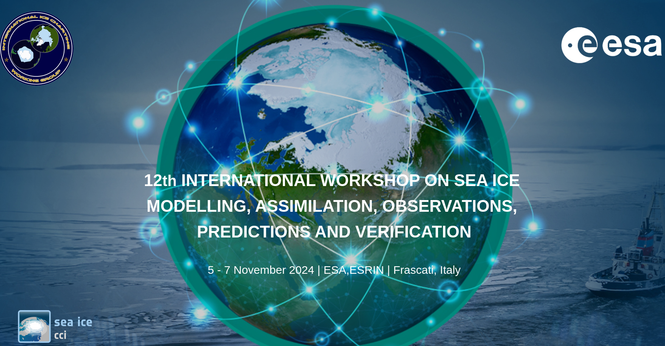
So next week there is a big #SeaIce #DataAssimilation workshop hosted by the European Space Agency in Frascati (Italy).

I'm one of the organizers, and I'll be there 🙋 with #CIMR 🛰️ and #CCI content. Who will I meet there?

#IICWGDA12

The improvements in #weatherForecasting in the last 20-30 years are sometimes called "the quiet revolution" - not just improved resolution and processes but especially data assimilation of satellite and ground observations have been key..

#DataAssimilation #DAMSdk #DAMSsommerMøde

Looking for technical information on assimilating @dwd #RadarData into #WRF . Would appreciate any pointers to papers or people.

I've not been able to find anything that goes into the technical details.

#WeatherForecasting #DataAssimilation
#4DVar

Davi Mignac Cameiro, from UK Met Office, presents about #SeaIce thickness #DataAssimilation in the #FOAM system. Both SMOS and CRYOSAT2 data are assimilated independently. #IICWGDA11 #SeaIceDataAssimilation

To DTU for a meeting with @esaclimate #SeaIce people ..
Talking #ClimateModels #SatelliteData + #DataAssimilation

It's a beautiful #Frost day on the #DTU campus on #Lyngby

#ESACCI

My paper with Michael Ghil on a multi-model ensemble Kalman filter is now out in JAMES!
https://agupubs.onlinelibrary.wiley.com/doi/full/10.1029/2022MS003123
#DataAssimilation
Internships | Computational and Information Systems Lab