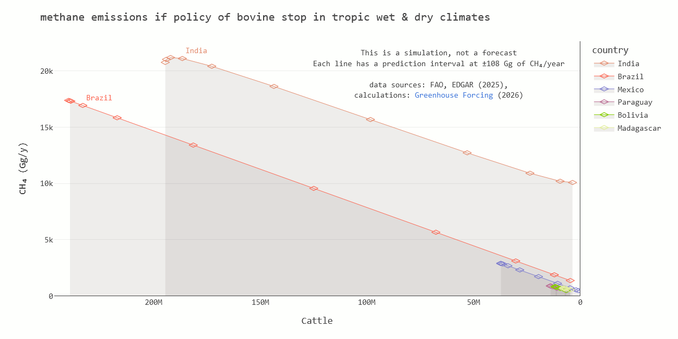
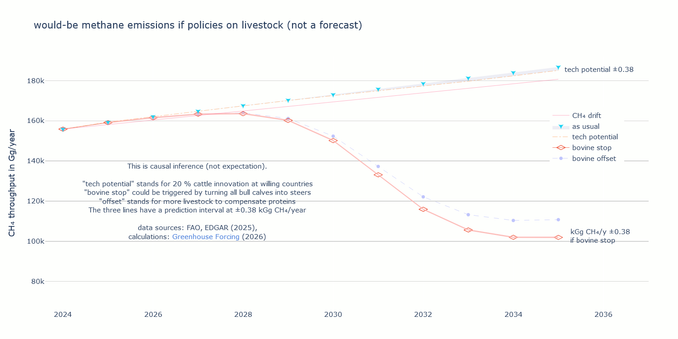
New study uses causal inference to demonstrate that we would avoid 20 % methane emissions if one commodity was replaced.
I have just published a preprint article at https://doi.org/10.5281/zenodo.19019693

#decoupling #agriculture #beef #cattle #carbon #causality #causalInference #causation #confounding #counterFactuals #emissions #GHG #methane #offPolicy #policy #publicPolicy #vegan #climateChange #GreenhouseForcing #greenhouseEffect

New study uses causal analysis to demonstrate big reductions in carbon emissions if fewer bovines.
In ten years, methane emissions from all activities if bovine stop would be 80 % of methane emissions from all activities if no intervention.
Results and causation are presented at https://doi.org/10.5281/zenodo.19019693

#carbon #causality #causalInference #causation #confounding #counterFactuals #emissions #GHG #methane #offPolicy #policy #publicPolicy

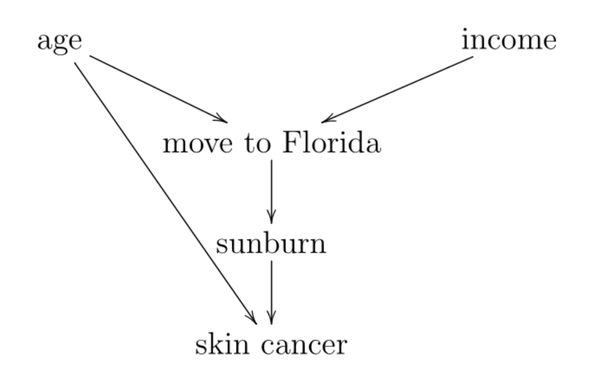
Mediators, confounders, colliders – a crash course in causal inference

Although one would think that the basic concepts of statistics should be the same across all sciences, there is an amazing heterogeneity between fields in how statistics is taught and practiced. On…

theoretical ecology

#statstab #471 Give Your Hypotheses Space!

Thoughts: "each hypothesis requires its own model" + "Only interpret the output for your exposure of interest"

#causalinference #modelling #hypothesis #tutorial #confounding #mbias

https://brian-lookabaugh.github.io/website-brianlookabaugh/blog/2025/mutual-adjustment/

Give Your Hypotheses Space! – Brian Lookabaugh

It’s tempting to throw a bunch of variables of interest into a model and evaluate each variable’s ‘impact’ on the outcome, but proceed at your own caution! Check this blog out to see why that approach is most likely not the best idea…

#statstab #391 {sensemakr} Sensitivity Analysis Tools for OLS

Thoughts: No unobserved variables is an untestable assumption, but you can quantify the robustness of your ATE.

#R #causalinference #observational #inference #confounding #bias #sensitivity

https://carloscinelli.com/sensemakr/

Sensitivity Analysis Tools for Regression Models

Implements a suite of sensitivity analysis tools that extends the traditional omitted variable bias framework and makes it easier to understand the impact of omitted variables in regression models, as discussed in Cinelli, C. and Hazlett, C. (2020), "Making Sense of Sensitivity: Extending Omitted Variable Bias." Journal of the Royal Statistical Society, Series B (Statistical Methodology) <doi:10.1111/rssb.12348>.

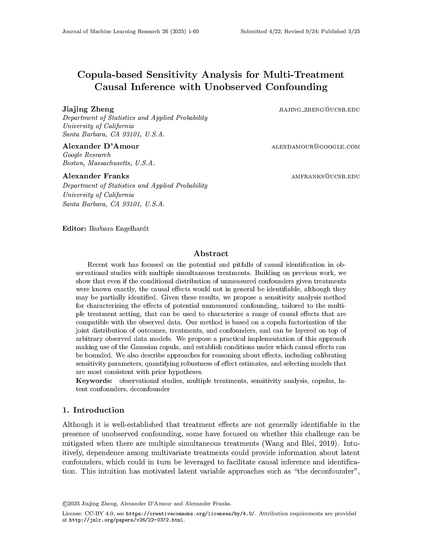
'Copula-based Sensitivity Analysis for Multi-Treatment Causal Inference with Unobserved Confounding', by Jiajing Zheng, Alexander D'Amour, Alexander Franks.

http://jmlr.org/papers/v26/22-0372.html

#confounders #copula #confounding

Copula-based Sensitivity Analysis for Multi-Treatment Causal Inference with Unobserved Confounding

'Data-driven Automated Negative Control Estimation (DANCE): Search for, Validation of, and Causal Inference with Negative Controls', by Erich Kummerfeld, Jaewon Lim, Xu Shi.

http://jmlr.org/papers/v25/22-1062.html

#confounder #causal #confounding

Data-driven Automated Negative Control Estimation (DANCE): Search for, Validation of, and Causal Inference with Negative Controls

Blasting this #Statistics #CausalInference #Confounding question that's vexing me out there into the aether:

I'm trying to build a Poisson model of a count variable as a function of a set of environmental variables. I have to transform the coefficients into rates by including an offset, as I have different levels of exposure for each measurement. However, I have strong reason to suspect that this offset is also influenced by the same environmental variables.

Am I screwed?

I try to establish the phrase: "You can not have no generative model."

#causality #measurement #selection #confounding #compliance #DAGs