Orthogonal Representation Learning for Estimating Causal Quantities
#statstab #474 {DeclareDesign} Observational : causal
Thoughts: If you want to do causal research with OS there is a lot more to consider than in #473
#design #research #rstats #education #tutorial #pedagogy #DiD #DAGs #causalinference
https://book.declaredesign.org/library/observational-causal.html
Surprising result, nice study design
When "Likes" went private on X there was no detectable change in the number of Likes received on posts by "high reputational risk" accounts
https://arxiv.org/pdf/2601.11140
#CausalInference #DifferenceInDifference #SocialMedia #Research
#statstab #457 Race as a Bundle of Sticks: Designs that Estimate Effects of Seemingly Immutable Characteristics
Thoughts: The theoretical framework a researcher uses will affect the causal inference they can make.
#estimand #causalinference #rubin
https://www.annualreviews.org/content/journals/10.1146/annurev-polisci-032015-010015

Although understanding the role of race, ethnicity, and identity is central to political science, methodological debates persist about whether it is possible to estimate the effect of something immutable. At the heart of the debate is an older theoretical question: Is race best understood under an essentialist or constructivist framework? In contrast to the “immutable characteristics” or essentialist approach, we argue that race should be operationalized as a “bundle of sticks” that can be disaggregated into elements. With elements of race, causal claims may be possible using two designs: (a) studies that measure the effect of exposure to a racial cue and (b) studies that exploit within-group variation to measure the effect of some manipulable element. These designs can reconcile scholarship on race and causation and offer a clear framework for future research.
Already have my 2026 resolution ready
#statstab #471 Give Your Hypotheses Space!
Thoughts: "each hypothesis requires its own model" + "Only interpret the output for your exposure of interest"
#causalinference #modelling #hypothesis #tutorial #confounding #mbias
https://brian-lookabaugh.github.io/website-brianlookabaugh/blog/2025/mutual-adjustment/
#statstab #456 Shall we count the living or the dead?
Thoughts: survival ratio -> if the intervention increases risk of the outcome
risk ratio -> if the intervention reduces risk of the outcome

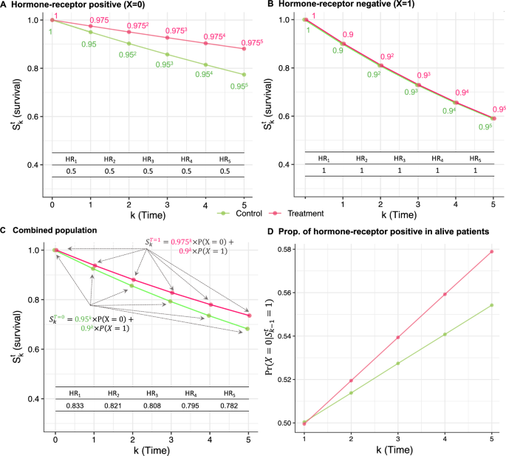
In the 1958 paper "Shall we count the living or the dead?", Mindel C. Sheps proposed a principled solution to the familiar problem of asymmetry of the relative risk. We provide causal models to clarify the scope and limitations of Sheps' line of reasoning, and show that her preferred variant of the relative risk will be stable between patient groups under certain biologically interpretable conditions. Such stability is useful when findings from an intervention study must be generalized to support clinical decisions in patients whose risk profile differs from the participants in the study. We show that Sheps' approach is consistent with a substantial body of psychological and philosophical research on how human reasoners carry causal information from one context to another, and that it can be implemented in practice using van der Laan et al's Switch Relative Risk, or equivalently, using Baker and Jackson's Generalized Relative Risk Reduction (GRRR).
#statstab #446 {causaldata} Packages of Example Data for The Effect
Thoughts: On your journey to learning Causal Inference you can use some nice datasets to figure out how horrible it can all go.
“Correlation is causation” 😈
New #substack going over the maths of correlation, t-test, and linear models. https://open.substack.com/pub/mzloteanu/p/correlation-is-causation?r=3b457w&utm_campaign=post&utm_medium=web&showWelcomeOnShare=true
#statstab #440 Computing Statistical Power for the Difference in Differences Design
Thoughts: DiD studies are all the rage in Obs research. But how does the concept of power apply to them?
#poweranalysis #DiD #causalinference #samplesize #observational