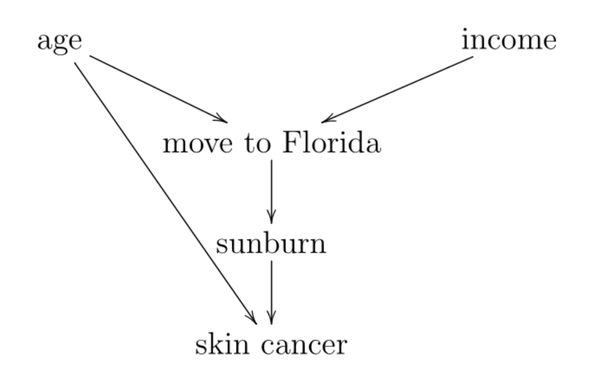
Mediators, confounders, colliders – a crash course in causal inference

Although one would think that the basic concepts of statistics should be the same across all sciences, there is an amazing heterogeneity between fields in how statistics is taught and practiced. On…

theoretical ecology

#statstab #471 Give Your Hypotheses Space!

Thoughts: "each hypothesis requires its own model" + "Only interpret the output for your exposure of interest"

#causalinference #modelling #hypothesis #tutorial #confounding #mbias

https://brian-lookabaugh.github.io/website-brianlookabaugh/blog/2025/mutual-adjustment/

Give Your Hypotheses Space! – Brian Lookabaugh

It’s tempting to throw a bunch of variables of interest into a model and evaluate each variable’s ‘impact’ on the outcome, but proceed at your own caution! Check this blog out to see why that approach is most likely not the best idea…

#statstab #391 {sensemakr} Sensitivity Analysis Tools for OLS

Thoughts: No unobserved variables is an untestable assumption, but you can quantify the robustness of your ATE.

#R #causalinference #observational #inference #confounding #bias #sensitivity

https://carloscinelli.com/sensemakr/

Sensitivity Analysis Tools for Regression Models

Implements a suite of sensitivity analysis tools that extends the traditional omitted variable bias framework and makes it easier to understand the impact of omitted variables in regression models, as discussed in Cinelli, C. and Hazlett, C. (2020), "Making Sense of Sensitivity: Extending Omitted Variable Bias." Journal of the Royal Statistical Society, Series B (Statistical Methodology) <doi:10.1111/rssb.12348>.

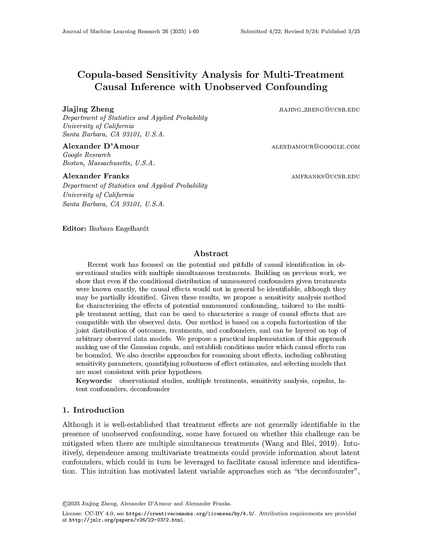
'Copula-based Sensitivity Analysis for Multi-Treatment Causal Inference with Unobserved Confounding', by Jiajing Zheng, Alexander D'Amour, Alexander Franks.

http://jmlr.org/papers/v26/22-0372.html

#confounders #copula #confounding

Copula-based Sensitivity Analysis for Multi-Treatment Causal Inference with Unobserved Confounding

'Data-driven Automated Negative Control Estimation (DANCE): Search for, Validation of, and Causal Inference with Negative Controls', by Erich Kummerfeld, Jaewon Lim, Xu Shi.

http://jmlr.org/papers/v25/22-1062.html

#confounder #causal #confounding

Data-driven Automated Negative Control Estimation (DANCE): Search for, Validation of, and Causal Inference with Negative Controls

Blasting this #Statistics #CausalInference #Confounding question that's vexing me out there into the aether:

I'm trying to build a Poisson model of a count variable as a function of a set of environmental variables. I have to transform the coefficients into rates by including an offset, as I have different levels of exposure for each measurement. However, I have strong reason to suspect that this offset is also influenced by the same environmental variables.

Am I screwed?

I try to establish the phrase: "You can not have no generative model."

#causality #measurement #selection #confounding #compliance #DAGs

Pretty good and non technical (meaning no math, other than addition, multiplication, and division) to marginal structural models and time depending #confounding in #epidemiology.
https://www.ncbi.nlm.nih.gov/pmc/articles/PMC7429147/
Understanding Marginal Structural Models for Time-Varying Exposures: Pitfalls and Tips

Epidemiologists are increasingly encountering complex longitudinal data, in which exposures and their confounders vary during follow-up. When a prior exposure affects the confounders of the subsequent exposures, estimating the effects of the time-varying ...

PubMed Central (PMC)
Pretty good and non technical (meaning no math, other than addition, multiplication, and division) to marginal structural models and time depending #confounding in #epidemiology.
https://www.ncbi.nlm.nih.gov/pmc/articles/PMC7429147/
Understanding Marginal Structural Models for Time-Varying Exposures: Pitfalls and Tips

Epidemiologists are increasingly encountering complex longitudinal data, in which exposures and their confounders vary during follow-up. When a prior exposure affects the confounders of the subsequent exposures, estimating the effects of the time-varying ...

PubMed Central (PMC)

cool example of fixing #confounding - antibiotics and stone edition (no, it ain't any fancy regression or propensity score matching)

https://journals.lww.com/jasn/Fulltext/2023/08000/Outpatient_Antibiotic_Use_is_Not_Associated_with.11.aspx in JASN with a #VisualAbstract from @CorinaT #Epidemiology

Outpatient Antibiotic Use is Not Associated with an... : Journal of the American Society of Nephrology

higher during the first year after antibiotic use. However, this risk was no longer evident after adjustment for comorbidities and excluding participants with prior urinary symptoms. Findings were consistent across antibiotic classes and the number of antibiotic courses received. This suggests that antibiotics are not important risk factors of kidney stones. Rather, kidney stones when they initially cause urinary symptoms are under-recognized, resulting in antibiotic use before a formal diagnosis of kidney stones (i.e., reverse causality). Background Antibiotics modify gastrointestinal and urinary microbiomes, which may contribute to kidney stone formation. This study examined whether an increased risk of a first-time symptomatic kidney stone episode follows antibiotic use. Methods A population-based case-control study surveyed 1247 chart-validated first-time symptomatic kidney stone formers with a documented obstructing or passed stone (cases) in Olmsted County, Minnesota, from 2008 to 2013 and 4024 age- and sex-matched controls. All prescriptions for outpatient oral antibiotic use within 5 years before the onset of symptomatic stone for the cases and their matched controls were identified. Conditional logistic regression estimated the odds ratio (OR) of a first-time symptomatic kidney stone across time after antibiotic use. Analyses were also performed after excluding cases and controls with prior urinary tract infection or hematuria because urinary symptoms resulting in antibiotic prescription could have been warranted because of undiagnosed kidney stones. Results The risk of a symptomatic kidney stone was only increased during the 1-year period after antibiotic use (unadjusted OR, 1.31; P = 0.001), and this risk was attenuated after adjustment for comorbidities (OR, 1.16; P = 0.08). After excluding cases and controls with prior urinary symptoms, there was no increased risk of a symptomatic kidney stone during the 1-year period after antibiotic use (unadjusted OR, 1.04; P = 0.70). Findings were consistent across antibiotic classes and the number of antibiotic courses received. Conclusions The increased risk of a first-time symptomatic kidney stone with antibiotic use seems largely due to both comorbidities and prescription of antibiotics for urinary symptoms. Under-recognition of kidney stones that initially cause urinary symptoms resulting in antibiotic use may explain much of the perceived stone risk with antibiotics (i.e., reverse causality)....

LWW