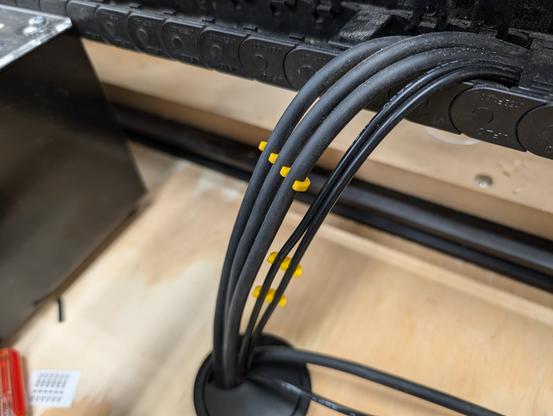
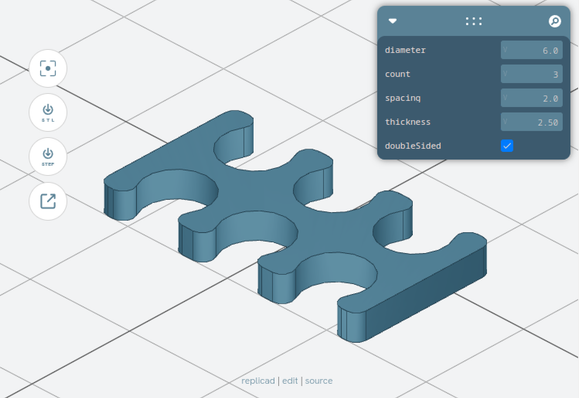
Another quicky, this is a parametric cable comb generator, built in #replicad.

I like building more elaborate parametric projects, but it's great to have a convenient tool to knock out these easy ones as well.

#codecad

https://www.printables.com/model/951121-parametric-cable-comb-generator
Printables

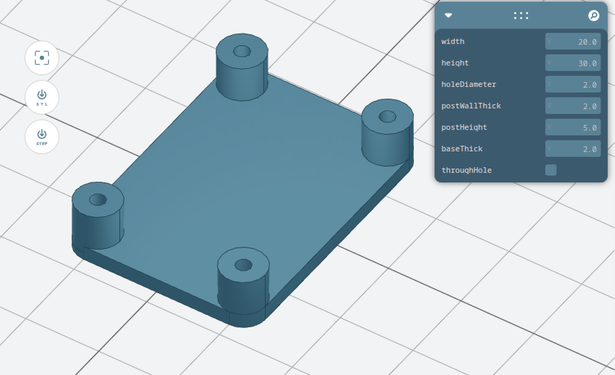
An extremely simple, parametric standoff generator, build in #replicad

I nearly did not bother making/publish this, but I end up using them on a lot of projects, so it's nice to have the configuration in one place.

#codecad

I needed a small tray for my bathroom - it took me a few minutes to model, but now it will take me even less time.

https://models.sgenoud.com/posts/simple-tray/

#3dprinting #replicad #codecad

Simple Tray | My 3D models

A very simple tray built for 3d printing.

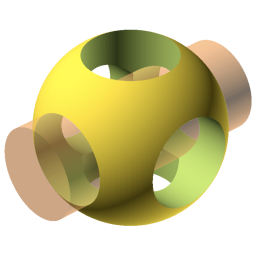
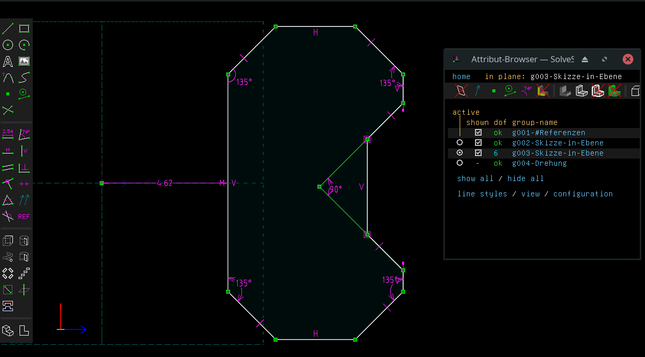
There is some really cool new features being worked on in #SolveSpace, bringing it a tad closer to #codeCAD like  #OpenSCAD: named parameters and equation constraints. This will make gearing logic and several other things feasible.

https://github.com/solvespace/solvespace/issues/1382#issuecomment-2052520765

Feature request: Gearing · Issue #1382 · solvespace/solvespace

Solvespace offers a special kind of drawing experience using constraint based designing. One feature I found missing though are gears (e.g. translating cogs or converting linear into rotational mot...

GitHub
@scruss Does #FreeCAD not have keybindings for the common constraints? #SolveSpace does at least and it makes sketching quite fast. But I'm totally with you that #codeCAD is so much quicker and more concise for many things.

Oh and there is a CAD program called Antimony that looks an awful lot like #codeCAD but with graphical interaction:

https://www.mattkeeter.com/projects/antimony/3/

🧵 A short thread of me looking at #AntimonyCAD and comparing it to #sdfCAD 👇

Antimony

TIL that there's #ImplicitCAD, a sort of #OpenSCAD dialect that's based on #SDF's, written in #Haskell. It's similar to #sdfCAD in many ways and has the sdf approach's smoothing powers, but also the same shitty meshes as sdfCAD 😅

https://github.com/Haskell-Things/ImplicitCAD

#codeCAD

GitHub - Haskell-Things/ImplicitCAD: A math-inspired CAD program in haskell. CSG, bevels, and shells; 2D & 3D geometry; 2D gcode generation...

A math-inspired CAD program in haskell. CSG, bevels, and shells; 2D & 3D geometry; 2D gcode generation... - Haskell-Things/ImplicitCAD

GitHub

Oh for christ's sake what is #pyvista doing here? Randomly moving the axis origins around when switching between rendering modes? How is one supposed to do #CAD like this? 🙄

I'm using pyvista to view the generated #sdfCAD models but shifting axes around is a pretty severe no-go for a 3D viewer. pyvista also recently started spitting out some weird vue2/vue3 errors... Are there any other good #STL viewers for #Jupyter?

#Python #codeCAD

@brett Right. I really want to like #SolveSpace. There aren't many FOSS CAD programs and SolveSpace's simple yet powerful approach fits a good niche between #codeCAD and e.g. #FreeCAD. However very basic operations like intersecting round objects seem to quickly cause problems and require triangulation or not work at all. Threads are also a big problem. I'll keep using it. FreeCAD is a bit too big for my taste.

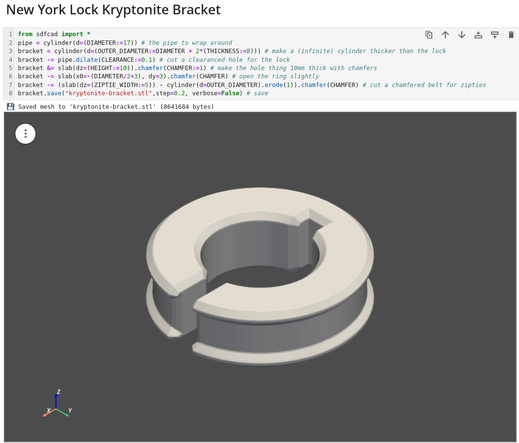
I tried approaching a small #3dDesign project first with graphical #SolveSpace, but quickly got annoyed by all the clicky-draggy bits and complicated constraints and switched to #sdfCAD. I love its new auto-chamfering capabilities, making the design of such a clamping ring with #3dPrinting in mind a bliss in eight lines of #Python code - including boilerplate.

#codeCAD