Определение положения объектов на изображении: как найти пространственные координаты объекта, используя OpenCV

Как найти 3D координаты объектов на изображении? Статья о задаче пространственной локализации объектов на изображении с одной камеры и о её решении с помощью OpenCV

https://habr.com/ru/articles/941842/

#opencv #opencv_python #фотограмметрия #numpy #aruco #pnp #машинное_зрение #положение_в_пространстве #solvepnp #3d

Определение положения объектов на изображении: как найти пространственные координаты объекта, используя OpenCV

Привет, Хабр! Меня зовут Брискиндов Леонид, я школьник, участник соревнований и олимпиад по робототехнике и программированию. Нередко для решения задач таких олимпиад предоставляется доступ...

Хабр

Определение положения объектов на изображении: как найти пространственные координаты объекта, используя OpenCV

Как найти 3D координаты объектов на изображении? Статья о задаче пространственной локализации объектов на изображении с одной камеры и о её решении с помощью OpenCV

https://habr.com/ru/articles/941842/

#opencv #opencv_python #фотограмметрия #numpy #aruco #pnp #машинное_зрение #положение_в_пространстве #solvepnp #3d

Определение положения объектов на изображении: как найти пространственные координаты объекта, используя OpenCV

Привет, Хабр! Меня зовут Брискиндов Леонид, я школьник, участник соревнований и олимпиад по робототехнике и программированию. Нередко для решения задач таких олимпиад предоставляется доступ...

Хабр

Here's an example how to detect #ArUco markers in current p5js versions. A lot of older examples didn't work anymore.
https://editor.p5js.org/michaelzoellner/sketches/fYng2El-k

Based on js-aruco2.
https://damianofalcioni.github.io/js-aruco2/

#p5js #marker #opencv

Aruco CV Markers by michaelzoellner -p5.js Web Editor

A web editor for p5.js, a JavaScript library with the goal of making coding accessible to artists, designers, educators, and beginners.

AR using OpenCV with ArUco Markers - vvvvTv S02 E12

YouTube
I am looking for a substitute for fideucials with ROS. I have used raspicam_node from Ubiquity Robotics and it does work but it took a lot of playing. I wonder if opencv would work better. #ros #opencv #camera #aruco-tags #fiducials #ubiquity-robotics : "Cube Pose Tracking using OpenCV and ArUco in ROS: A Step-by-Step Guide"(https://medium.com/@ammar.n.abbas/cube-pose-tracking-using-aruco-in-ros-a-step-by-step-guide-1801a82fc546)
Cube Pose Tracking using OpenCV and ArUco in ROS: A Step-by-Step Guide

Welcome to our latest project that combines the power of ArUco marker detection with the versatility of ROS (Robot Operating System). In this article, we’ll guide you through the process of setting…

Medium
D-POINT: A Digital Pen With Optical-Inertial Tracking

[Jcparkyn] clearly had an interesting topic for their thesis project, and was conscientious enough to write up a chunk of it and release it to the wild. The project in question is a digital pen tha…

Hackaday
D-POINT: A Digital Pen With Optical-Inertial Tracking

[Jcparkyn] clearly had an interesting topic for their thesis project, and was conscientious enough to write up a chunk of it and release it to the wild. The project in question is a digital pen tha…

Hackaday

Invisible 3D Printed Codes Make Objects Interactive

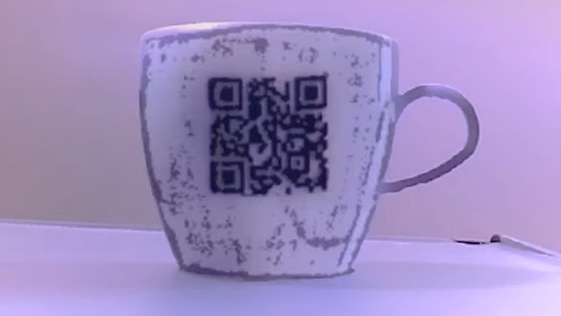
An interesting research project out of MIT shows that it's possible to embed machine-readable labels into 3D printed objects using nothing more than an FDM printer and filament that is transparent to IR. The method is being called InfraredTags; by embedding something like a QR code or ArUco markers into an object's structure, that label can be detected by a camera and interactive possibilities open up.

One simple proof of concept is a wireless router with its SSID embedded into the side of the device, and the password embedded into a different code on the bottom to ensure that physical access is required to obtain the password. Mundane objects can have metadata embedded into them, or provide markers for augmented reality functionality, like tracking the object in 3D.

How are the codes actually embedded? The process is straightforward with the right tools. The team used a specialty filament from vendor 3dk.berlin that looks nearly opaque in the visible spectrum, but transmits roughly 45% in IR. The machine-readable label gets embedded within the walls of a printed object either by using a combination of IR PLA and air gaps to represent the geometry of the code, or by making a multi-material print using IR PLA and regular (non-IR transmitting) PLA. Both provide enough contrast for an IR-sensitive camera to detect the label, although the multi-material version works a little better overall. Sadly, the average mobile phone camera by itself isn't sufficiently IR-sensitive to passively read these embedded tags, so the research used easily available cameras with no IR-blocking filters, like the Raspberry Pi NoIR.

The PDF has deeper details of the implementation for those of you who want to know more, and you can see a demonstration of a few different applications in the video, embedded below. Determining the provenance of 3D printed objects is a topic of some debate in the industry, and it's not hard to see how technology like this could be used to covertly identify objects without compromising their appearance.

#3dprinterhacks #videohacks #aruco #infrared #infraredtags #ir #label #machinereadable #machinevision #qrcode

Invisible 3D Printed Codes Make Objects Interactive

An interesting research project out of MIT shows that it’s possible to embed machine-readable labels into 3D printed objects using nothing more than an FDM printer and filament that is transp…

Hackaday
Ok open cv and aruco are installed and the examples are running. Now how do it do the magic it does
#OpenCV #MachineVision #aruco