
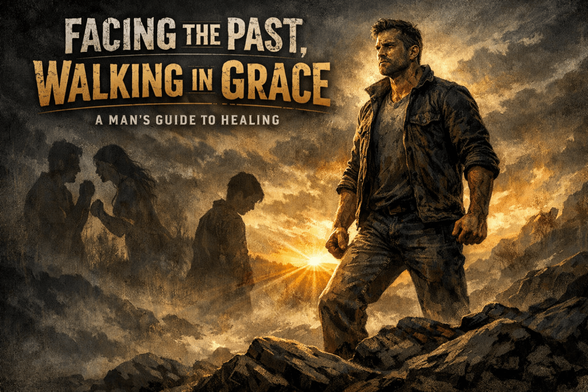
Facing the Past, Walking in Grace: A Man’s Guide to Healing

1,271 words, 7 minutes read time.

Scripture Anchor: “The Lord is close to the brokenhearted and saves those who are crushed in spirit.” —Psalm 34:18 (NIV)

When the Past Won’t Let Go

Let’s cut the crap: family can hurt. Badly. And it’s not always obvious. Sometimes it’s fists or yelling. Sometimes it’s quiet poison—the gaslighting, the twisted stories, the manipulation that leaves you doubting your own memory. You grow up thinking maybe you imagined it. Maybe you deserved it. Maybe it’s just your fault.

Here’s the brutal truth—sometimes the people who caused it don’t want the truth out. They want the “sins” of the past buried, rewritten, polished. Your pain? That’s inconvenient. Your memories? That’s a threat. They want a clean story, a family narrative that looks flawless while you carry the scars.

And it gets worse: the abuse you survived doesn’t stay in your past. It leaks into everything you do. The man you try to be, the father you hope to raise, the spouse you want to love—childhood trauma doesn’t vanish. It shapes your anger, your patience, your fears, your sense of worth. If you don’t face it, if you let it simmer in silence, it can infect your relationships, repeat the patterns, and leave you unknowingly passing the pain to the next generation.

If that resonates, I see you. That tension in your chest, the rage, the self-doubt—these aren’t flaws. They’re echoes of what you survived. And God sees it all. Psalm 34:18 says, “The Lord is close to the brokenhearted and saves those who are crushed in spirit.” He’s not just watching from a distance—He’s in the mess with you, seeing what no one else will.

Face It or Keep Getting Played

Here’s a hard truth: you can’t heal what you refuse to confront. The patterns, the anger, the shame—they won’t disappear. They’ll follow you into your marriage, your parenting, your work, your friendships. That’s the vicious cycle of unresolved trauma.

Some memories are ugly. Some truths are messy. Pretending they don’t exist is cowardice. You’ll keep getting played by the ghosts of your past until you grab the truth by the throat and refuse to let it run your life.

Pastors are vital—they can pray, counsel, and guide—but they’re not trained to untangle deep, layered trauma. If what you’re reading here applies to you, resonates, or describes patterns in your life, seek professional help beyond what the church or your pastor can provide. Therapists, counselors, and trauma specialists are trained to help men process abuse, repressed memories, and the long-term effects of trauma safely. Asking for help isn’t weakness—it’s war strategy. It’s reclaiming your life and breaking cycles that could otherwise carry on to the next generation.

Some of this work will piss people off. It will make your family uncomfortable. They may resist or deny the truth. Good. That just means you’re doing it right. Freedom doesn’t require their acknowledgment—it requires your courage to face the truth and refuse to let their lies control your life.

Gaslighting, Lies, and the Fight for Freedom

Abuse often comes with an accomplice: deception. They’ll gaslight you until you doubt everything—your memory, your instincts, your reality. You’ll replay every word, every action, wondering if you’re losing your mind. That’s the point.

Freedom starts with naming it. Saying, “I see what you did. I see the lies. I see the manipulation. And I will not let it control me anymore.” John 8:32 says it plainly: “Then you will know the truth, and the truth will set you free.”

You won’t do this alone. God is with you, yes—but He also gives allies: trusted friends, mature men, counselors. People who hold the mirror steady when your family tries to gaslight you back into silence. The lies are loud, the pressure is heavy, but you’ve got a choice: live under their story, or reclaim your story and break the cycle.

Healing Isn’t Pretty—It’s Tactical

Healing isn’t some soft, feel-good exercise. It’s tactical. Brutal. And it takes guts.

1. Write your story. Every fragment counts. Even rage. Even shame. Own it on paper. Seeing it outside your head takes power from the hidden lies.

2. Name your triggers. People, places, words—whatever sparks the old pain. Awareness is your first weapon.

3. Get professional support. Counselors, therapists, trauma specialists—these are not optional. They know how to walk a man through the ugly truth without breaking him further.

4. Ground yourself in Scripture and prayer. Psalm 34:18 isn’t a feel-good verse; it’s a battle cry. Speak it. Claim it. Wrestle with it. God won’t let go.

5. Set boundaries. Protect your mental, emotional, and spiritual space. If your family resists your truth, create distance until you can face it safely. Healing isn’t about making anyone else comfortable—it’s about reclaiming your life.

The process will be messy. Anger will flare. Tears will come. That’s normal. God is steady. Psalm 34:18 is a promise: He’s in the trenches with you.

Hope Beyond the Pain

Here’s the raw truth: your family might never admit it. They might resist. They might actively fight your progress. That sucks. It’s unfair. But they don’t get to control your healing. God does.

Even crushed, broken, silenced, and doubted, you can be saved. Psalm 34:18 says it bluntly: He saves those who are crushed in spirit. That includes you, your anger, your shame, and your past they want buried.

And part of hope is practical: professional help, counseling, therapy—these aren’t concessions. They’re weapons God gives you. Don’t be a macho idiot and try to “man up” alone. Take the tools. Take the help. Take your life back. And break the cycle so the next generation doesn’t carry the same hidden chains.

This is your story. Not theirs. Not sanitized. Not rewritten. Yours. God wants you whole. And it’s time to fight for it.

Closing Prayer

God, I’ve carried the weight of family lies, abuse, and silence for too long. I’m done letting rewritten history run my life. Give me courage to face the truth, strength to seek help, and wisdom to set the boundaries I need. Heal what they broke, reclaim what was stolen, and help me to break the cycle for those I love. Amen.

Reflection / Journaling Questions

  • What parts of my past have my family tried to hide or rewrite?
  • What patterns of anger, fear, or shame in my life come from unresolved childhood trauma?
  • How has my past affected the way I try to love, parent, or lead today?
  • Who can I enlist as allies to help me confront these truths safely?
  • Where do I need professional help beyond what the church or pastor can provide?
  • What boundaries do I need to protect my emotional, mental, and spiritual health?
  • Call to Action

    If this devotional encouraged you, don’t just scroll on. Subscribe for more devotionals, share a comment about what God is teaching you, or reach out and tell me what you’re reflecting on today. Let’s grow in faith together.

    D. Bryan King

    Sources

    Psalm 34:18 – NIV
    John 8:32 – NIV
    Isaiah 61:1-3 – NIV
    2 Corinthians 1:3-4 – NIV
    Psychology Today – Trauma and Relationships
    American Psychological Association – Trauma
    Courageous Conversations on Trauma & Abuse
    Focus on the Family – Men and Emotional Healing
    Cloud & Townsend – Boundaries Resources
    National Counseling Resources – Finding Professional Help

    Disclaimer:

    The views and opinions expressed in this post are solely those of the author. The information provided is based on personal research, experience, and understanding of the subject matter at the time of writing. Readers should consult relevant experts or authorities for specific guidance related to their unique situations.

    Related Posts

    #abuseRecovery #BiblicalGuidanceForTrauma #biblicalHealing #breakingGenerationalCycles #brokenheartedMen #childhoodTrauma #ChristianCounseling #ChristianCounselingAdvice #ChristianDevotionalForMen #ChristianMenSGuide #ChristianMentalHealthResources #ChristianSelfHelp #ChristianTherapy #ChristianTherapyForMen #confrontingAbuse #confrontingFamilyLies #confrontingHiddenFamilyPain #counselingForMen #dealingWithFamilyDenial #emotionalBoundaries #emotionalHealing #faithBasedTherapy #familyAbuseRecovery #fatherhoodAndTrauma #gaslighting #gaslightingRecovery #generationalTrauma #GodSGraceAndHealing #healingBrokenhearted #healingFamilyWounds #journalingForMen #maleDevotional2026 #maleHealingDevotional #maleMentalHealthSupport #maleFocusedDevotional #masculineSpirituality #menAndTrauma #menSMentalHealth #menSDevotionalResources #mentalHealthAndSpirituality #mentalHealthInChristianity #overcomingChildhoodAbuse #personalGrowthForMen #prayerForHealing #processingChildhoodAbuse #Psalm3418 #repressedMemories #safeHealingResources #spiritualFreedom #spiritualHealing #traumaAndFaith #traumaAwareness #traumaHealingForMen #traumaRecoveryPrayer #traumaRecoverySteps #traumaInformedSpirituality
    One of the ways in which abusers - and especially my abusive sibling - have hurt me was to teach me that abuse is not a choice. That's of course how they justified it: The poor sobs just couldn't HELP it!

    I've known for a long time that lasting patterns of abuse, as well as extreme abusive behaviours (even if they're one-off), are choices or follow a person's chosen moral convictions. Neither genes nor mental illness nor drugs nor mind control nor torture can cause someone to act against their deep moral convictions, like for example murder a loved one. And even in less extreme cases, it's up to the abuser's responsibility to make significant changes in their life to stop destructive patterns like guilt tripping.

    But intellectually knowing something and really knowing it are two different things. I keep getting triggered into "questioning" whether I'm actually evil (abusive, oppressive, ableist etc) because if abuse is not a choice, then I might be abusive despite not WANTING to be!

    It occurs to me as I'm writing this, how much this has to do with deep distortions based on confusing outer perception with truth. What *I* care about is truth. I care about whether or not my actions hurt innocent people. Abusers on the other hand only care about perceptions, to the point where they stop distinguishing between perception and reality. They don't care that they're causing harm, but they care obsessively and intensely and violently about not being PERCEIVED as an abuser!

    Yeah no, that part is not a choice, that's true, it is outside someone's control how others perceive or label or judge them (to some extent/depending on circumstances).

    But I'd rather be seen as an abuser than actually causing that kind of harm. Whereas my sibling and other abusers act as though the fear of potentially maybe getting criticised for abusive actions gives them the right to retaliate violently. (emotional violence counts as violent in this context)

    They see this as self defense! 🤯

    Because in their worldview, how others perceive them is where their "personal" boundary needs to be protected, because there's no difference between perception and truth?? idek, it makes no sense to me but this is how they act. And the flip side is true too: If they perceive me as a threat or as pathetic or as dangerous or as lazy or as having it too easy or as incompetent or whatever it is today - then I must accept it as truth and repent and do better and suffer the consequences. (me feeling bad is what's important, not fixing anything in the real world, which is how abusers differ from non-abusers)

    Of course the double standards: If they are perceived as anything less than pristine, they get to attack me. If I am perceived as lacking, they also get to attack me. They need to be protected from feeling bad at all costs! After all, they're poor suffering victims of abuse and oppression! But despite being just as much (actually more) of a victim, I need to swallow any and all bad feelings they sling at me without ever complaining, let alone defending myself.

    #AbuseCulture #abuse #AbuseSurvivor #AbuseRecovery #AbusiveSibling #RedFlags

    I am ruminating lots lately about whether or not I have an (unhealthy) helpers syndrome and about my NEED to help others.

    I definitely have a lot of trauma around being made responsible for "helping" people who didn't want to get better, including both my parents and my elementary school teacher and my sibling and in some way even my therapist (among others, this is such a constant theme in my life). Being discarded once I was no longer useful or needed by some, getting trauma-bound by others.

    I am coming to a place where I can see these dynamics more and more clearly and can therefore avoid falling into those kinds of traps again - better than if I hadn't processed these things, that is better than most people who haven't been through it.

    And I do want to help people in these ways, in emotional support ways. All I have to do is to find people who actually want to get better, who want a chance to be themselves and heal and grow, instead of keeping me small as a substitute for their own growth. Obviously such people exist in abundance 🥰 (abusers just try to paint a picture that "everyone thinks like this"/like them).

    I know that I have knowledge and experience and skills and compassion that many need, that the world needs. I want to use whatever skills and inner and outer resources I have to the best effect, I want to do the most good that I can.

    And that's a whole lot.

    #AbuseRecovery #HelperSyndrome #HelferSyndrom #MentalHealth

    This came up in a conversation and I edited it and made this rebloggable version.

    I think the first and most important point is to learn how to spot abusive and manipulative behaviour and how to stay safe, set boundaries or get away.
    I can't recommend Lundy Bancroft's book Why Does He Do That enough for this purpose! He leaked the abusers' playbooks. You'll gain invaluable insight even if your abuse didn't take place in the male-on-female domestic violence scenario that he is an expert on.

    For mutual support that doesn't need experts but has some structure to it, I'm currently on a co-counseling kick, I love that method. Though I'm sure it's not the only one.

    Whether there's structure or it's spontaneous, whether experts are present or not: What's important are boundaries and consent and that consent needs to apply to situations where you deal with triggering material or trauma - with everyone involved. So that includes people who just happen to be within earshot, their consent matters.

    Talk about ways to check in with your body, to make sure you're as connected as you can be and that the conversation brings you closer to yourself, not further away. This also goes for everyone involved, including counselors.

    Challenge ableism: No judgement or shaming for expressing emotions, feelings or thoughts, for fears or for laughing without a reason or yawning or crying or even raging/tantrums, or for channeling inner children or for switching (plural systems). Only when ppl do harm to selves or others should they be stopped, but even then in a respectful way.

    If it's a setting with professional staff around, make sure they're safe to talk to in cases where such conversations went wrong or left someone feeling overwhelmed or having boundaries disrespected or needing additional support. Meaning, don't tell them they shouldn't have tried to talk about the thing. If it was a bad idea, they might come to that conclusion on their own.

    For all my trauma therapy (individual and groups), I have had most of my best healing conversations when no therapists were around. It really works when ppl respect consent.

    #trauma #TraumaRecovery #recovery #AbuseCulture #AbuseSurvivor #AbuseRecovery #ableism #AntiAbleism

    7 Lügen der Manipulatoren

    Ich fand besonders die möglichen Antworten ab Minute 16:02 spannend.
    (insgesamt 22:23 min langes Video, nur auto-generierte CC, keine visuellen Informationen außer dass der Mensch in die Kamera spricht)

    https://m.youtube.com/watch?v=06fOCEaxyAE#

    #Psychologie #manipulation #EmotionaleMisshandlung #EmotionaleGewalt #AbuseRecovery

    Die unsichtbare Falle: 7 Lügen, die Sie schwach halten sollen

    YouTube

    Healing from trauma is crazy. It is unstable and it destabilises self and others.

    Why? Because it requires me to grow beyond the "stable" pseudo-personality that the traumatising family-, cult- or societal systems pushed on me.

    Society is sick and sickening, it causes trauma and dissociation. Then it tells us that WE are crazy, unstable, perhaps ridiculous and perhaps dangerous for doing what we need to do to heal. In order to truly heal, one HAS TO become even more crazy than before, as in more "unstable" in society's eyes. Less adjusted to its "stable" structures and demands.

    I know, I know, the first step of trauma therapy is stabilisation. But what we want to be stable is stuff like having basic needs met, having housing and food and at least one stable, respectful and nurturing relationship. We DON'T need to stabilise the pseudo-personality! That's the crime of therapy that I'm rebelling against. They stabilise the wrong thing and they destabilise the wrong thing. They take away our agency to let our true self emerge and make choices.

    It's like telling a caterpillar that emerging from its cocoon is "unstable" and pathological and that it should go back to the nice stable larval version of itself.

    In my case, that was the version that is easily lead and that assimilates into existing systems. Not a threat.

    But we deserve to destabilise the systems that did this to us. The families, cults, religions, therapies, states, capitalism - all of it. And that includes getting rid of the rules and beliefs and triggers and feelings that they installed inside us. Killing the cops in our heads. Killing the despotic parents, the double-standardised inner critic, the victim blamer in our heads.

    🧵

    #trauma #TraumaRecovery #crazy #mad #MadLib #AbuseCulture #AbuseSurvivor #AbuseRecovery #VictimBlaming #RapeCulture #MentalHealth #crisis #resilience #anarchy #KillTheCopInYourHead

    I used to be ruled by fear. All the abuse and trauma throughout my life meant that I never had a safety net and never anyone or anything I could trust or fall back on. I trusted myself and my own discernment least of all because I was the one who got blamed for everything.

    No longer. Two years ago, I made a commitment to not let fear hold me back from doing what I know is right. And I stuck with it. It changed the way I live my life.

    Last year, I made another commitment to myself, one which I didn't know how to put into words, but I stuck with anyway: That I would no longer separate myself from myself. I would no longer abuse my own body by pushing past my limits, for example.

    I am now staying with myself, staying connected to my body, staying ME, despite all the trauma and fear I'm suffering. It is hard but it is worth it. Not only am I growing and learning and HEALING old wounds despite the current circumstances - I am also bringing all of my abilities, strengths and knowledge to the fight.

    I'm no longer letting myself get cut off from myself. It's the equivalent of having functioning supply and communication lines while under attack. It can't give me everything or protect me from all dangers, but it's giving me the best chance I'm gonna get.

    1/5 🧵

    #AbuseRecovery #TraumaRecovery #CultRecovery #about #fear #EmotionalHealing #dissociation #DID #AbuseSurvivor #RapeSurvivor

    Responsibility Restores Agency

    (adding to my post about setting healthy boundaries with abuse survivors)

    The reason that getting pushback against letting their toxicity spill out is so important to abuse survivors is that it forces them to make a decision: Do I WANT to let the toxicity spill out to others?

    If they answer with yes or that they don't care, then they're deciding to be abusers. They'll deny and rationalise it, but that's what it comes down to.

    If they answer with no, then they FINALLY have an antidote against that deepseated, horrible shame that probably ate at them since they were tiny: I can work on avoiding specific, toxic behaviours and that is GOOD ENOUGH. I am not bad or tainted to my core. I am ok as who I am and I have agency to work on my behaviour from that foundation onwards.

    What abuse survivors (and anyone else for that matter) need more than anything is agency, not false reassurances or platitudes. Don't make unreasonable demands, do point them to support if possible, but stay honest about whether or not they caused harm. You can be as gentle or abrupt as seems appropriate in the circumstances, just don't lie to them.

    And remember: Your boundaries, needs, perspective and voice matter!

    #abuse #MentalHealth #AbuseRecovery #recovery #agency #AbuseSurvivor #toxicity #ToxicPeople #boundaries

    You can go farther than that, too, where you experiment with what happens when you follow whims despite having a rational reason to go against that impulse. What happens if I go out without a jacket in cold weather? What happens when I eat something just because it looks delicious, even though I'm full? What happens when I roll my eyes at my boss? What happens when I don't cut my toenails for a while?

    You shouldn't make yourself try out new things just to try out new things. If you want to wear that jacket as you always do and smile at your boss like everyone expects you to, do so! Likewise, sometimes you already know what could happen and the risk is too high for you. If the thought of offending a stranger sends you into a panic, you don't have to! If you saw your neighbour bang their door in anger, you can decide to avoid provoking them.

    Obviously don't risk death unless you're really sure you wanna take that risk. But it is up to you whether you decide that some things are that important. No one else can tell you that you have to be willing to lay your life down for them, their cause, or their doctrine though!

    But most decisions aren't life or death! There are a lot of grey and rainbow coloured areas where something isn't 100% safe or approved or predictable. That's where you have the most agency.

    Do what YOU want, not what others tell you that you want.

    And if it takes some experimenting to figure that out, that is absolutely ok and normal! A healthy childhood and adolescence comes with a LOT of such experimentation and if you didn't have that experience in your youth, you totally get to make up for lost time! Plus, the experimentation never stops. Every major life transition comes with opportunities to broaden your horizons. As do crises. And if you feel stuck or in a rut or having a midlife crisis, that's a signal that you need more agency.

    Change, experimentation and agency are very closely linked, but they're not interchangeable. Getting a new haircut and hobby doesn't fix someone's problem if they are staying in an unfulfilling job or abusive relationship. On the other hand, deciding to keep things going as before IS ALSO agency! That is your right!

    #agency #MentalHealth #AbuseRecovery #abuse

    Brainstorming a list of agency exercises:

    - When someone asks you what you want, see if it is possible to come up with something other than "whatever is most convenient for others"
    - When someone serves you food, put spices or condiments on it, add sugar or milk to tea/coffee
    - modify things
    - rearrange items on your shelf or your furniture
    - When someone asks for a small favour, say no or find another way to decline
    - make a habit to check in with your body, are you comfortable? Or are you hot, cold, hungry, thirsty, overstimulated, understimulated, tense, in pain? See if you can do something to change that
    - change the music volume, turn it on or off
    - When you have an urge to do something, check whether that thing would be harmful and if not DO IT, even and ESPECIALLY when it is silly, ridiculous, frivolous, childish, nonsensical, weird, sticks out or is new to you:
    - like changing your position, lying down on the floor, skipping, stretching, yawning
    - like eating weird food combinations
    - like changing up a routine
    - like wearing something different, changing your style, accessories, haircut or colour
    - like getting yourself a little (or big!) gift without blowing your budget
    - like procrastinating on an unpleasant chore
    - like just not doing something unpleasant if it's not actually necessary (cleaning windows)

    #AbuseRecovery #recovery #MentalHealth #agency