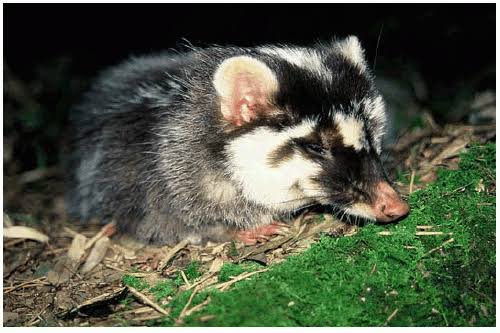
African Palm Civet Nandinia binotata

African Palm Civet Nandinia binotata

Red list status: Least concern (in 2016) but likely becoming endangered now.

Locations: Senegal, Gambia, Guinea-Bissau, Guinea, Liberia, Sierra Leone, Côte d’Ivoire, Ghana, Togo, Benin, Nigeria, Cameroon, Equatorial Guinea, Gabon, Republic of the Congo, Central African Republic, Democratic Republic of the Congo, Angola, Zambia, Uganda, South Sudan, Kenya, Rwanda, Burundi, Tanzania, Malawi, Mozambique, Zimbabwe.

African Palm Civets Nandinia binotata are ecosystem-critical seed dispersers in Africa’s forests. Their spotted coats blend into the dappled forest shadows of #Liberia and #Gabon in #Africa. Although they were once widespread, the African palm civet now faces mounting pressure from palm oil-driven deforestation, mining, and relentless hunting for #bushmeat. Their survival hangs in the balance —fight for their survival every time you shop, be #Vegan for them and #BoycottPalmOil #Boycott4Wildlife.

https://www.youtube.com/watch?v=gFpLVDC6IM0

Vital seed dispersers in #African forests, African palm civets are hunted for #bushmeat in #Gabon 🇬🇦 #Liberia 🇱🇷 Say NO to #palmoil #deforestation and hunting. Fight for them! Be #Vegan 🫑🍆 #BoycottPalmOil 🌴🩸🚜☠️🔥❌ #Boycott4Wildlife @palmoildetect https://palmoildetectives.com/2022/11/13/african-palm-civet-nandinia-binotata/

Share to BlueSky Share to Twitter

Appearance & Behaviour

The African palm civet is a small, cat-like omnivore, their slender body and long, ringed tail perfectly adapted for life in the treetops. Their fur ranges from grey to dark brown, with distinctive dark spots decorating their back. Males are slightly larger than females, typically weighing between 1 and 3 kilograms and measuring 30 to 70 centimetres in length. Two scent glands beneath their abdomen allow them to mark territory and communicate with potential mates. African palm civets are nocturnal, spending most of their lives high in the canopy, where they forage, rest, and raise their young. They are nocturnal and spend the majority of their lives in the tree canopies of rainforests eating from fruit-bearing trees like banana, papaya, fig and corkwood.

Threats

The main threats to African palm civets are anthropogenic and include:

Large tracts of rainforest where African palm civets live are threatened by commercial logging and large-scale oil palm plantations owned by foreign multinational companies.  

Hunting for bushmeat trade

Around 8,000 palm civets are hunted in the Nigerian and Cameroon part of the Cross-Sanaga-Bioko coastal forests. Throughout Africa these small animals are treated as hostile by locals and are killed for this reason. They are regularly found in bushmeat markets.

Palm oil deforestation: a major threat

The upper Guinean rainforests in Liberia are a biodiversity rich hotspot and they are rapidly being fragmented and destroyed by palm oil and timber deforestation, along with mining.

Habitat

The African palm civet’s range spans much of sub-Saharan Africa, from Senegal and Gambia in the west, through Guinea, Liberia, Sierra Leone, Côte d’Ivoire, Ghana, Togo, Benin, Nigeria, Cameroon, Equatorial Guinea, Gabon, Republic of the Congo, Central African Republic, Angola, Zambia, Uganda, South Sudan, Kenya, Rwanda, Burundi, Tanzania, Malawi, Mozambique, and Zimbabwe. They inhabit deciduous forests, lowland rainforests, gallery forests, riverine peatlands, and swamplands. Once widespread, their habitat is now fragmented by deforestation, agriculture, and mining, leaving only scattered pockets of forest where the African palm civet can still be found.

Diet

African palm civets are omnivorous, their diet shifting with the rhythm of the seasons. Fruits such as persimmon, African corkwood, Uapaca, fig, papaya, and banana form the core of their diet. When fruit is scarce, they hunt rodents, lizards, birds, frogs, insects, and even raid farms for small livestock. Their foraging is a quiet, methodical search through the canopy, and they are vital seed dispersers, helping to regenerate the forests they call home.

Mating and breeding

African palm civets are mostly solitary, coming together only to mate. Males range over territories that overlap with those of several females. Breeding occurs year-round, with peaks during the rainy seasons, especially from September to January. After a gestation of about 64 days, females give birth in tree hollows to litters of up to four cubs. The young are weaned after about two months, remaining with their mothers as they learn to forage and navigate the treetops. Sexual maturity is reached at around three years, and the generation length is estimated at seven years. The bond between mother and cub is strong, forged in the safety of the canopy and tested by the dangers of the shrinking forest.

FAQs

Where do African palm civets sleep?

African palm civets are highly arboreal and seek shelter high in the treetops, where they find safety from predators and the elements. They commonly rest or sleep during the day in the forks of large trees, among lianas, or in tangled vines, blending into the foliage with their spotted coats. Occasionally, as forests shrink and human settlements expand, African palm civets adapt by sleeping in less typical places such as gutters, thick undergrowth at farm and village margins, woodpiles, old dead trees, piles of dead leaves, and even in thatched roofs or overgrown shrubbery in rubbish dumps. Their choice of sleeping site is always guided by the need for concealment and protection, reflecting their nocturnal and secretive nature.

Can African palm civets climb trees?

African palm civets are exceptional climbers, spending most of their lives in the forest canopy. Their bodies are built for agility among the branches: they have powerful limbs, long tails for balance, and sharp, retractile claws that allow them to grip bark and vines securely. African palm civets move swiftly and silently through the treetops, foraging, resting, and raising their young high above the ground, rarely descending except to cross open areas in search of food or new shelter. Their arboreal lifestyle is so pronounced that they are sometimes described as “tree cats,” and their climbing abilities are vital for evading predators and accessing fruit-laden branches.

Are palm civets carnivorous?

African palm civets are omnivores, with a diet that is more varied than simply carnivorous. While they do eat small mammals, birds, eggs, insects, and occasionally carrion or even raid farms for small livestock, fruit forms the largest part of their diet. They consume a wide range of fruits, including those from umbrella trees, sugar plums, corkwood, wild figs, and even the fleshy pulp from oil palms. African palm civets are opportunistic feeders, adapting their diet to what is available seasonally and in their environment, but they are not strictly carnivorous and play a significant role as seed dispersers in their forest habitats.

How big are African palm civets?

African palm civets are small to medium-sized mammals, with males generally larger than females. Adult males typically measure between 39.8 and 62.5 centimetres in body length, with tails adding another 43 to 76.2 centimetres, and can weigh from 1.3 to 3 kilograms. Females are slightly smaller, with body lengths of 37 to 61 centimetres and tails of 34 to 70 centimetres, weighing between 1.2 and 2.7 kilograms. Their long, muscular tails and compact bodies make them agile climbers, and their size allows them to navigate the dense forest canopy with ease.

Take Action!

The #Boycott4Wildlife offers a way for consumers to fight back against palm oil deforestation and other forms of animal cruelty and slavery. Please help us and raise your voice for African Palm Civets, join the #BoycottPalmOil #Boycott4Wildlife.

You can support this beautiful animal

There are no known formal conservation activities in place for this animal. Make sure that you #Boycottpalmoil and #Boycott4Wildlife in the supermarket and raise awareness of the plight of beautiful African palm civets in order to support their survival! Find out more here

Further Information

The IUCN has declared that this animal was of ‘Least Concern’ in 2016. However, their habitat is rapidly declining and they deserve more intensive protection and regular assessment.

Gaubert, P., Bahaa-el-din, L., Ray, J. & Do Linh San, E. 2015. Nandinia binotataThe IUCN Red List of Threatened Species 2015: e.T41589A45204645. https://dx.doi.org/10.2305/IUCN.UK.2015-4.RLTS.T41589A45204645.en. Accessed on 07 September 2022.

Kotelnicki, S. (2012). Nandinia binotata. Animal Diversity Web. https://animaldiversity.org/accounts/Nandinia_binotata/

Wikipedia. (n.d.). African palm civet. https://en.wikipedia.org/wiki/African_Palm_Civet

How can I help the #Boycott4Wildlife?

Take Action in Five Ways

1. Join the #Boycott4Wildlife on social media and subscribe to stay in the loop: Share posts from this website to your own network on Twitter, Mastadon, Instagram, Facebook and Youtube using the hashtags #Boycottpalmoil #Boycott4Wildlife.

✓ Subscribed

2. Contribute stories: Academics, conservationists, scientists, indigenous rights advocates and animal rights advocates working to expose the corruption of the palm oil industry or to save animals can contribute stories to the website.

Wildlife Artist Juanchi Pérez

Read more

Mel Lumby: Dedicated Devotee to Borneo’s Living Beings

Read more

Anthropologist and Author Dr Sophie Chao

Read more

Health Physician Dr Evan Allen

Read more

The World’s Most Loved Cup: A Social, Ethical & Environmental History of Coffee by Aviary Doert

Read more

How do we stop the world’s ecosystems from going into a death spiral? A #SteadyState Economy

Read more

3. Supermarket sleuthing: Next time you’re in the supermarket, take photos of products containing palm oil. Share these to social media along with the hashtags to call out the greenwashing and ecocide of the brands who use palm oil. You can also take photos of palm oil free products and congratulate brands when they go palm oil free.

https://twitter.com/CuriousApe4/status/1526136783557529600?s=20

https://twitter.com/PhillDixon1/status/1749010345555788144?s=20

https://twitter.com/mugabe139/status/1678027567977078784?s=20

4. Take to the streets: Get in touch with Palm Oil Detectives to find out more.

5. Donate: Make a one-off or monthly donation to Palm Oil Detectives as a way of saying thank you and to help pay for ongoing running costs of the website and social media campaigns. Donate here

Pledge your support

#Africa #African #AfricanPalmCivetNandiniaBinotata #animals #Benin #Boycott4wildlife #BoycottPalmOil #Burundi #bushmeat #Cameroon #CentralAfricanRepublic #Congo #CoteDIvoire #deforestation #EquatorialGuinea #ForgottenAnimals #Gabon #Ghana #hunting #Kenya #Liberia #Malawi #Mammal #mining #Nigeria #omnivore #omnivores #PalmOil #palmOilDeforestation #palmoil #poaching #Rwanda #SeedDispersers #seeddispersal #SierraLeone #Tanzania #Togo #Uganda #vegan #Viverrid #VulnerableSpecies

Bornean Ferret Badger Melogale everetti

Bornean Ferret Badger Melogale everetti

IUCN Red List Status: Endangered

Location: The Bornean Ferret Badger is endemic to the island of Borneo, specifically in the montane forests of northern Borneo. Key confirmed locations include Gunung Alab, Mount Kinabalu, and the Crocker Range in Sabah and Sarawak, Malaysia.

The Bornean Ferret Badger is an enigmatic nocturnal omnivore, known for their dependence on intact montane forests. Due to habitat destruction, primarily caused by deforestation for out-of-control palm oil plantations and agriculture in Malaysia, they are classified as endangered. These threats pose grave risk to these elusive creatures.
As omnivores and foragers, Bornean Ferret Badgers play a crucial role in their ecosystems. Their diet helps regulate pest populations, while their foraging aerates soil, promoting forest health. By consuming fruit, they may also aid in seed dispersal, contributing to the regeneration of their montane forest habitats. Immediate research and conservation action are needed to secure their future. Help their survival and use your wallet as a weapon when you shop, #BoycottPalmOil #Boycott4Wildlife

https://youtu.be/XqJuq3mevTg

Bornean Ferret #Badgers 🦡 are normally never seen. One of the least studied #omnivores is also one of the most #endangered. Mainly from #palmoil #deforestation. Help them survive when you #BoycottPalmOil 🌴🪔💩🤮⛔️ #Boycott4Wildlife @palmoildetect https://palmoildetectives.com/2021/02/05/bornean-ferret-badger-melogale-everetti/

Share to BlueSky Share to Twitter

Bornean Ferret #Badgers become aggressive when cornered and release a potent scent. Known as ‘Biul Slentek’ they’re #endangered by #palmoil #deforestation in #Borneo. Help them survive when you #BoycottPalmOil 🌴🪔💩🤮⛔️ #Boycott4Wildlife @palmoildetect https://palmoildetectives.com/2021/02/05/bornean-ferret-badger-melogale-everetti/

Share to BlueSky Share to Twitter

Appearance and Behaviour

• Known locally in Malay as “Biul Slentek,” these badgers of the mustelid family are culturally significant in the regions where they are found.

• Despite their small size, they exhibit fierce defensive behaviours, including releasing a skunk-like odour and displaying bold colouration to deter predators.

• Their nocturnal and elusive nature makes them one of the most challenging species to study in Southeast Asia.

The Bornean Ferret Badger is a mammal of the mustelid family, covered in fur that ranges from grey-brown to dark black, with a lighter underside. A bold facial “mask” of white or yellow stripes gives them a distinct, ferret-like appearance, and a dorsal stripe runs from the top of their head to their shoulders, varying in colour from white to red. Their small size—measuring 33–44 centimetres in body length, with a bushy tail of 15–23 centimetres—makes them agile and adept at navigating dense forests.

These badgers are nocturnal and primarily ground-dwelling, but they are also capable climbers, thanks to partial webbing between their toes and ridges on their footpads. Their strong claws allow them to dig efficiently, though they often repurpose burrows dug by other animals rather than digging their own.

When provoked or cornered, the Bornean Ferret Badger displays fierce defensive behaviours. They emit a pungent odour from their scent glands, similar to skunks, to deter predators. Additionally, their bold facial markings and dorsal stripe act as warning colouration, signalling potential danger to would-be threats.

Diet

The Bornean Ferret Badger is omnivorous, with a diet that includes insects, earthworms, small invertebrates, and fruits. They forage on the forest floor, sifting through leaf litter to locate food, demonstrating their adaptability to their montane ecosystem (IUCN, 2015; Wong et al., 2011).

Reproduction and Mating

Bornean Ferret Badgers exhibit year-round reproduction, with females capable of breeding at any time. The gestation period lasts 57 to 80 days, and litters typically consist of 1 to 5 young, born in May or June. The young are weaned and cared for in burrows for 2 to 3 months before becoming independent.

Interestingly, males undergo an annual period of reproductive dormancy from September to December, during which they cease sperm production. This adaptation may be linked to seasonal changes in resource availability in their montane habitats.

Geographic Range

Although their habitat associations are too poorly known to be sure that the recent widespread habitat change in their range poses an imminent threat, the ongoing paucity of incidental records (such as road-kills) in converted habitats suggests that the species is threatened by the ongoing land-cover transformations.

iucn RED lIST

This species is restricted to northern Borneo, including regions in Sabah and Sarawak, Malaysia. It inhabits montane and submontane forests at elevations above 1,000 metres, with confirmed sightings at Gunung Alab and the Crocker Range. Their reliance on intact forest ecosystems makes them highly vulnerable to habitat loss (Wong et al., 2011; IUCN, 2015).

Threats

  • Palm Oil and Timber Deforestation: The expansion of out-of-control palm oil plantations, logging, and slash-and-burn agriculture continues to destroy montane forest habitats. Roads cutting through Kinabalu National Park and Crocker Range National Park exacerbate habitat fragmentation, isolating populations and limiting their movements.
  • Climate Change: Rising temperatures and shifting weather patterns due to climate change force high-altitude specialists like the Bornean Ferret Badger further upslope. With limited elevation to escape to, they are at increased risk of habitat loss and extinction.
  • Natural Disasters: Concentrated in a small geographic range, the species is vulnerable to natural disasters such as typhoons and monsoons. Epidemics also pose a serious threat to their survival due to the limited separation between populations.
  • Human Encroachment: Encroachment on the edges of protected areas has led to habitat degradation. Illegal land clearing and the conversion of surrounding forest into agricultural fields further reduce the species’ already small habitat.

FAQs

What are ferret badgers?

Ferret badgers are small mammals belonging to the genus Melogale in the Mustelidae family, which also includes weasels, otters, badgers, and wolverines. These animals have a unique appearance that combines features of ferrets and badgers, with elongated bodies, short legs, and bushy tails. Their fur is typically dark brown or black with lighter underparts, and many species display striking facial markings or dorsal stripes. Unlike their larger badger relatives, ferret badgers are more agile and adapted to climbing and burrowing. They are nocturnal and secretive, with behaviours and adaptations that make them difficult to observe in the wild. Currently, six species are recognised, including the Bornean Ferret Badger (Melogale everetti), which is one of the least-studied species in this genus.

Are Bornean ferret badgers endangered?

Yes, the Bornean Ferret Badger is classified as Endangered on the IUCN Red List under criteria B1ab(ii,iii,v), primarily due to habitat destruction and fragmentation (IUCN, 2015).

How big are Bornean ferret badgers?

They are small omnivores, measuring 35–40 centimetres in body length, with a tail length of 15–20 centimetres, and weighing between 1 and 2 kilograms (Wong et al., 2011).

Where do ferret badgers live?

Bornean Ferret Badgers lives in montane and submontane forests in northern Borneo, particularly in Sabah and Sarawak, at elevations above 1,000 metres. Dense vegetation and intact forest ecosystems are critical for their survival (IUCN, 2015).

Ferret badgers are native to Asia and are found in countries such as China, Nepal, Indonesia, and Malaysia. They inhabit a variety of habitats, including mixed evergreen forests, montane forests, open woodlands, and pastures. Some species, like the Bornean Ferret Badger, are restricted to specific regions and high-altitude environments, such as the montane forests of northern Borneo. These adaptable animals often prefer forested areas with dense undergrowth but can also survive in scrubland or agricultural fields when their natural habitats are disturbed. However, their preference for cooler, elevated regions and intact forests makes them particularly vulnerable to deforestation and habitat fragmentation.

What do ferret badgers eat?

The Bornean Ferret Badger’s diet includes insects, earthworms, fruits, and small invertebrates. They forage on the forest floor, using their acute sense of smell to locate food (Wong et al., 2011).

Ferret badgers in general are omnivorous and highly adaptable in their diet, which typically includes insects, worms, amphibians, fruits, and small vertebrates. They are opportunistic feeders, foraging both on the ground and, in some cases, climbing trees to access food. This diverse diet plays an important ecological role, as they help control pest populations by consuming insects and aerate the soil through their digging. Additionally, their consumption of fruit may contribute to seed dispersal, supporting forest regeneration. The Bornean Ferret Badger’s diet aligns with this general pattern, including invertebrates and carrion, which further highlights their role as a valuable member of their ecosystem.

How do ferret badgers defend themselves?

Ferret badgers have a unique and effective defence mechanism to ward off predators: they emit a foul-smelling secretion from their anal glands. This pungent odour, similar to that of a skunk, is released when the animal feels threatened or cornered. In addition to this chemical defence, ferret badgers rely on their bold facial markings and dorsal stripes, which serve as a visual warning to potential predators. The Bornean Ferret Badger, in particular, exhibits this behaviour and is known for fiercely defending itself when provoked. These adaptations, combined with their secretive nature and nocturnal habits, help ferret badgers evade predation in the wild.

How do ferret badgers move around?

Ferret badgers are nocturnal animals, spending their nights foraging and their days resting in dens or burrows. They are not territorial and move from one resting spot to the next, rarely establishing permanent residences. Instead of digging their own burrows, they often use pre-existing burrows created by other animals. Their broad feet, strong claws, and partially webbed toes enable them to climb and dig efficiently, allowing them to navigate both forest floors and low tree branches. This combination of behaviours and adaptations makes them highly versatile in their movements, whether on the ground or in the canopy.

How do ferret badgers reproduce?

Female ferret badgers typically give birth to a litter of up to three young in late spring or early summer, often in May or June. The gestation period ranges from 57 to 80 days. At birth, the young are blind but already well-furred, with colour patterns resembling those of adults. They remain in burrows for about two to three months under the care of their mother, who provides food and protection until they are capable of foraging independently. The breeding habits of male ferret badgers are notable for their seasonal reproductive dormancy, during which they cease sperm production from September to December. This reproductive strategy may help align breeding with optimal environmental conditions, ensuring the survival of the next generation.

What are the threats to ferret badgers?

Ferret badgers face numerous threats, the most significant being habitat loss and fragmentation caused by deforestation, agricultural expansion, and infrastructure development. As forests are cleared for palm oil plantations, logging, and urbanisation, ferret badgers lose the dense undergrowth and connected habitats they rely on for shelter and foraging. Climate change poses an additional threat, especially for high-altitude species like the Bornean Ferret Badger, which cannot move further upslope to escape rising temperatures. Slash-and-burn agriculture and human encroachment into protected areas further exacerbate these challenges. These threats, combined with their naturally low population densities and restricted ranges, make ferret badgers particularly vulnerable to decline.

Take Action!

The survival of the Bornean Ferret Badger depends on preserving their montane forest habitat. Support conservation efforts by boycotting products containing palm oil, advocating for forest protection, and raising awareness about the importance of biodiversity. Every action counts. #BoycottPalmOil #Boycott4Wildlife #Vegan

Further Information

Wikipedia. (n.d.). Bornean Ferret Badger. Retrieved from https://en.wikipedia.org/wiki/Bornean_ferret_badger

Wilting, A., Duckworth, J.W., Hearn, A. & Ross, J. 2015. Melogale everetti. The IUCN Red List of Threatened Species 2015: e.T13110A45199541. https://dx.doi.org/10.2305/IUCN.UK.2015-4.RLTS.T13110A45199541.en. Downloaded on 04 February 2021.

Wong, A., Mohamed, N. S., Tuh, F. Y. Y., & Wilting, A. (2011). A record of the little-known Bornean Ferret Badger (Melogale everetti) at Gunung Alab, Sabah, Malaysia. Small Carnivore Conservation, 33, 55–60. Retrieved from: https://www.researchgate.net/publication/291505770_A_record_of_the_little-known_Bornean_Ferret_Badger_Melogale_everetti_at_Gunung_Alab_Sabah_Malaysia

You can support this beautiful animal

There are no known conservation activities for this animal. Share out this post to social media and join the #BoycottPalmOil #Boycott4Wildlife on social media to raise awareness

Bornean Ferret Badger Melogale everetti

How can I help the #Boycott4Wildlife?

Take Action in Five Ways

1. Join the #Boycott4Wildlife on social media and subscribe to stay in the loop: Share posts from this website to your own network on Twitter, Mastadon, Instagram, Facebook and Youtube using the hashtags #Boycottpalmoil #Boycott4Wildlife.

✓ Subscribed

2. Contribute stories: Academics, conservationists, scientists, indigenous rights advocates and animal rights advocates working to expose the corruption of the palm oil industry or to save animals can contribute stories to the website.

Wildlife Artist Juanchi Pérez

Read more

Mel Lumby: Dedicated Devotee to Borneo’s Living Beings

Read more

Anthropologist and Author Dr Sophie Chao

Read more

Health Physician Dr Evan Allen

Read more

The World’s Most Loved Cup: A Social, Ethical & Environmental History of Coffee by Aviary Doert

Read more

How do we stop the world’s ecosystems from going into a death spiral? A #SteadyState Economy

Read more

3. Supermarket sleuthing: Next time you’re in the supermarket, take photos of products containing palm oil. Share these to social media along with the hashtags to call out the greenwashing and ecocide of the brands who use palm oil. You can also take photos of palm oil free products and congratulate brands when they go palm oil free.

https://twitter.com/CuriousApe4/status/1526136783557529600?s=20

https://twitter.com/PhillDixon1/status/1749010345555788144?s=20

https://twitter.com/mugabe139/status/1678027567977078784?s=20

4. Take to the streets: Get in touch with Palm Oil Detectives to find out more.

5. Donate: Make a one-off or monthly donation to Palm Oil Detectives as a way of saying thank you and to help pay for ongoing running costs of the website and social media campaigns. Donate here

Pledge your support

#Badgers #BorneanFerretBadgerMelogaleEveretti #Borneo #Boycott4wildlife #BoycottPalmOil #deforestation #endangered #EndangeredSpecies #ForgottenAnimals #Indonesia #Malaysia #Mammal #mustelid #omnivore #omnivores #palmOilDeforestation #palmoil #pollination #pollinator #Sabah #SeedDispersers #vegan #Viverrid