News from...
For now, we’re going to try to ignore the jack-booted elephant in the room and all the M1 Abrams and M2 Bradleys in DC for a Kim Jong Un-like birthday party tomorrow on the streets of DC, and turn our gaze to (somewhat) less controversial and more cultural/culinary subjects. As many of you know - and have repeatedly reminded me (I know, already! What am I, a cave-dwelling hermit?) - Stanley Tucci’s “Searching for Italy” finally got to Abruzzo, our region of obsession, and so what do we think? It’s complicated. Let me start by saying that an hour-long format (that, excluding ads, totals about 45 minutes of real show) can’t do justice to any region. Not Abruzzo, not “La Toscana,” not Washington Township. Tucci, forever enshrined in the restaurateurs’ pantheon of benevolent gods for his role as Secondo in “Big Night” (does any film better explore the forces bearing down on independent, passion-driven joints in America than this one, which Tucci co-wrote and co-directed?), does his best. And Abruzzo, from the Gran Sasso National Park to the village of Castrovalva, just above the Sagittario Gorge (a WWF reserve), and the Trabocchi Coast, visually stuns. Dramatic, austere, beautiful. But this was Tucci’s first visit to Abruzzo, and so the show suffers some of the defects of other attempts - in Saveur, The New York Times, etc - to “speed-date” the region. While many moments were evocative of Abruzzo’s spirit (the restored communal oven in Villa San Sebastiano, cooking outdoors with “wild chef” Davide Nanni, driving across the Campo Imperatore, a high mountain plain known as “Italy’s Little Tibet,” past herds of sheep, making timballo in the isolated town of Senarica with the mother of a professional chef), a lot went unexplored. Stuff that’s maybe important to why Abruzzo is relevant to discussions of sustainability, preservation, how we might live in harmony with nature. These omissions were unavoidable, of course; we don’t know what we don’t know. So, while I am grateful to Tucci and the people who guided him for the overdue exposure they’ve provided this largely neglected region, I thought it might be useful to fill in some of the blanks in the next few newsletters. Some of you poor bastards who’ve discussed Abruzzo with me in the past know what’s coming: unleash the pedant! I’ll begin with what might seem to be small potatoes: in Senarica, a remote town in a wooded region of Teramo province, Tucci embeds with the family of Danilo Cortellini (currently the chef at London’s Italian Embassy), to make timballo, a dish particular to this part of Abruzzo. Danilo’s mom runs the operation (as you’d expect), and the dish - a remarkably light lasagna made with layered local-style crepes, mini- meatballs, meat ragu, peas, parmigiano, mozzarella, olive oil, egg wash, butter, etc. - follows tradition to the letter. Beautiful stuff. Tucci and Danilo make references to the French influence, much discussed in culinary books, stemming from a parenthesis of Napoleonic rule. The crepes (“crespelle” in formal Italian) Danilo’s mom is making, however, are not French. They’re made with eggs, flour, and water. No butter or milk, which accounts for the texture that makes timballo so singular. Tucci and Danilo touch on this, but there’s a bigger issue: they aren’t “crespelle,” which more or less follow the French method. These are “scrippelle.” Almost no one in Teramo province, even in restaurants that add butter and milk, would ever say “crespelle.” In our thirty years of travel there (including my cousin’s home in Castiglione Messer Raimondo - also in Teramo province - where I've been fed scrippelle in various preparations), I’ve never heard anyone, let alone a mamma in her kitchen, say crespelle. And it’s not just that they’re different, made without dairy. It’s that they’re particular to this place. So much of Abruzzo’s soul and identity is expressed in dialect (the Tuscan dialect, generally what you learn when studying Italian now, wasn’t made the national language until post-unification in 1861. And it was only after WWII that many Italians, particularly from Abruzzo on south, started using it fluently; most Abruzzese and other southern Italians still use some dialect at home, among family and friends, etc.). Another dish from Teramo is "scrippelle ‘mbusse," so the same “crepes” with pecorino in a rich broth. It’s not called "crespelle in brodo," as it would be if these folks were speaking “Italian.” By the way, these regional southern dialects often inform Italian-American modes of speaking and pronunciation. So, please remember that next time you hear someone making fun of an American paesano. FYI: Chef Andrew and we are serving our version of timballo di scrippelle alla teramana this weekend. Don’t miss it! As for arrosticini, grilled mutton skewers (the lamb we eat in the US wouldn’t be called lamb in Abruzzo: it’s been weaned off mother’s milk and eats grasses, wild herbs, etc. - our lamb might be called agnellone, kind of like an adolescent sheep), may be the food most identified with Abruzzo. Tucci kills two birds with one stone here, driving up to the gob-smackingly dramatic Campo Imperatore, one of Abruzzo’s principal pasturelands, to sample the sticks at Ristoro Mucciante, a popular Abruzzese grill joint (you usually order the meat inside, and grill it yourself), part of the comune of Castel del Monte. Amazing scenery and a typical regional dish. Ought to be simple, but things start to go sideways here, in ways big and small. Ristoro Mucciante is, without a doubt, a great place to eat arrosticini. As noted, the visuals are killer. While you eat (and quaff beer or Montepulciano) you can watch herds of sheep walk by, guarded by the white Abruzzese sheepdogs. There are free-range cattle and wild horses. The clouds sometimes settle dramatically in the calcareous crags of Monte Camicia, right above you. On clear days the Corno Grande, the highest point in the Apennine chain, is visible at the other end of the Campo. And the arrosticini are excellent. But are they the best? Most Abruzzese would say that the area just on the other side of Monte Camicia, in Pescara province, near the towns of Villa Celiera, Carpineto della Nora, and Civitella Casanova, the zone where they originated, is ground zero for arrosticini. They began as a way to make something appetizing from older sheep; a wild plant called “vingh” was used to form the skewers. Later, better cuts of meat were used. Far from being ancient (like the pecora alla cottora also featured later in the program), this treat didn’t surface until the 1930s (its invention in that period is usually attributed to two shepherds from the area) and wasn’t widely popular until after WWII. All this is debatable and potentially part of the fun. It’s in his narration where Tucci makes a big mistake. In discussing the transumanza, the yearly migration of sheep and shepherds from the mountains of Abruzzo to the plains of Puglia (also into lower parts of Lazio), he gets it all backwards. He discusses the millions of sheep that were part of the migration - moving along grass “highways” called tratturi, sometimes a few football fields wide and hundreds of miles long - and their importance to the local economy (though he omits the big reason: wool production, the reason wealthy families from Tuscany and Napoli tried to dominate the local towns), but at one point Tucci says that the shepherds were from Puglia, and migrated from south to north. Nope. Anyone who’s spent time in Abruzzo, let alone made himself read documents written during Norman and Aragonese dominations regulating the transumanza (am I the only guy raising my hand here?), knows that this is the wrong way around. In fact, Castel del Monte (15 minutes from where Tucci was gorging on sheep meat), is acknowledged as the local capital of the pastoral economy. Which is why all the great pecorino from all over Abruzzo. SHEEP. The women stayed in the mountains through late fall and winter, seeing to the fields and their families. The men migrated with the sheep to the “Tavogliere” in Puglia, staying so long that linguistic differences developed between them and their wives. The transumanza also created an exchange, with practices and products going both ways, that enriched Abruzzese and Pugliese cultures and cuisines. Abruzzo (and its sibling Molise which, until 1963, was part of what was called “Gli Abruzzi”) is known as THE region of shepherds. That should’ve been an easy fix. FYI Part 2: arrosticini are also a menu addition this weekend! Still, it’s a good show. For the scenery alone. You’ll plotz. And some of Tucci’s encounters are filled with the convivial spirit and unvarnished emotion that make Abruzzo our personal jones. Anyway, I will continue this discussion that no one asked for next week, focusing on places in Abruzzo that are integral to what we do at the restaurant - our cheese, olive oil, and wine producers, organizations, and parks that try (and often struggle) to survive doing things the right and sustainable way, places that are pioneering efforts in Italy and Europe to live in harmony with nature: La Porta dei Parchi farm in Anversa (15 minutes down the mountainside from Castrovalva); Alla Casa Vecchia in the town of Pacentro above Sulmona; Rewilding the Apennines, also near Sulmona, in Pettorano sul Gizio; the Maiella UNESCO Global Geopark (unique in Italy and one of Abruzzo’s three national parks), defined as “a perfect combination of geodiversity, biodiversity, and cultural heritage.” These are the folks approaching their work in ways meant to assure that we’ll still have all the great, delicious things twenty years from now. Their stories need to be told, too.
 PeachZ - Series & Film Reviews
 Italian News by RSS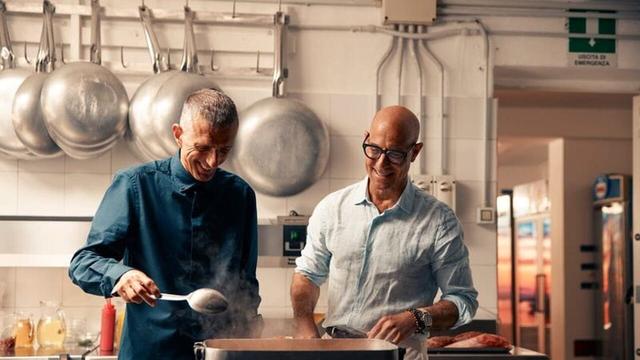
 RTL Nieuws

 Mark Squires
 Mark Squires
 michael fulgenzi
 Hanna
Hanna
 Greg Scallan