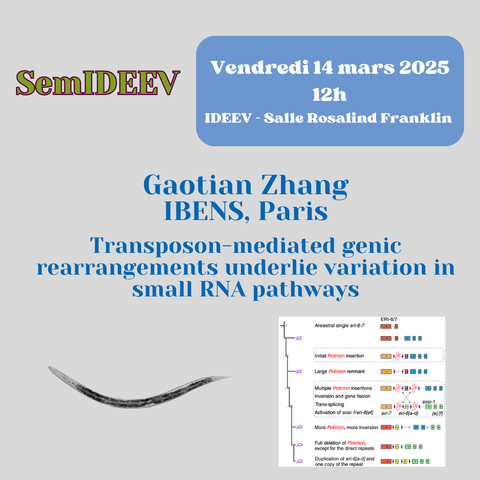
Seminar by Gaotian ZHANG at IDEEV
↪️ Friday March 14, 2025 - 12:00
"Transposon-mediated genic rearrangements underlie variation in small RNA pathways"
#SemIDEEV #gene #rna #caenorhabditiselegans #transposon #dna #gaotianzhang
#ibens @ENS
Transposable elements (TEs) can alter host gene structure and expression, whereas host organisms develop mechanisms to repress TE activities. In the nematode Caenorhabditis elegans, a small interfering RNA pathway dependent on the helicase ERI-6/7 primarily silences retrotransposons and recent genes of likely viral origin. By studying gene expression variation among wild C. elegans strains, we found that structural variants and transposon remnants likely underlie expression variation in eri-6/7 and the pathway targets. We further found that multiple insertions of the DNA transposons, Polintons, reshuffled the eri-6/7 locus and induced inversion of eri-6 in some wild strains. In the inverted configuration, gene function was previously shown to be repaired by unusual trans-splicing mediated by direct repeats. We identified that these direct repeats originated from terminal inverted repeats of Polintons. Our findings highlight the role of host-transposon interactions in driving rapid host genome diversification among natural populations and shed light on evolutionary novelty in genes and splicing mechanisms.
1-Jan-2025
Revealing a key mechanism of rapid centromere #evolution
Researchers clarify a key mechanism of genetic element insertions in the #centromere, the “waist” of a #chromosome
https://www.eurekalert.org/news-releases/1069128 #science #DNA #MolecularBiology #transposon
A joint research group team led by Sayuri Tsukahara and Tetsuji Kakutani of the University of Tokyo has clarified a mechanism of how retrotransposons, genetic elements that can “jump around” chromosomes and are known drivers of evolution, preferentially insert in the centromere. The findings were published in the journal Nature.
Happy to spread the word about our new paper in BioData Mining, mostly based on the work of my former student Jakub Horváth. We trained 3 different ML models to detect/classify long terminal repeats (LTR) from plant #retrotransposons, then looked at features that influenced their predictive ability the most.
TATA box related k-mers, 4-6 bp at sequence borders, and transcription factor binding sites were among signals the models leaned upon.
#Transposon #bioinformatics
Research unravels the enigma of #curly_birch and suggests marker to recognize it at the sprout stage.
#genomics #mutation #transposon
https://phys.org/news/2024-03-unravels-enigma-curly-birch-marker.html
Curly—or Karelian—birch is a mysterious tree with a patterned wood texture and a bizarre trunk shape. Unlike the elegant white-stemmed traditional birch, the Karelian one may seem unsightly at first glance: It is a low-growing, sinuous tree with bumps and bubbles. But the Karelian birch is famous for its wood. With its beautiful shade, patterns, and durability, the material has been used since the XVIII century in the manufacture of furniture, even for the royal chambers. For this reason, the Karelian birch was called the "royal tree" and "wooden marble."