 Peter Drake
Just devoured Ashley Shew's outstanding Against Technoableism. It will change the way you see the world.
 locus
locus@ai6yr i think the word this qualifies under is #technoableism ---
https://www.sciencefriday.com/articles/against-technoableism-excerpt/
https://www.sciencefriday.com/articles/against-technoableism-excerpt/
 Bloo (they/she) 🍓 🏳️⚧️ 🍉
I did a lil #blog post about #programming and #technoableism , and how irl ableism seeps into the architecture of the digital world:
https://thinkymeat.neocities.org/posts/developers-and-technoableism/
 MottG
MottG"Against Technoableist AI / Cyborg Meets AI: Technologized Disabled People in the Context of Corporatized Technological Development and Health Management"
Lecture in person or on Zoom on
March 27, 2025 3:30 PM - 5:00 PM Eastern Time
 Thomas Dorr
Picked up a copy of @ashleyshoo 's book Against #TECHNOABLEISM and cannot wait for her keynote for GAAD '24 https://accessibility.umn.edu/gaad/2024
 Anthony
Regarding the last boost, I wholeheartedly agree. I listen to @[email protected] 's show Techtonic on WFMU regularly ( http://wfmu.org/podcast/TD.xml ). I thought his interview with Ashley Shew, author of "Against Technoableism", that aired Monday Jan 22 was excellent. I have not read the book but I'd like to.
I'm a low vision person, and therefore disabled. I'm nowhere near able to pass a vision test to get a driver's license, for instance, and haven't been since before 2009. US car culture virtually makes me a non-entity. If it were not for the prevalence of remote work in my field--which the powers that be seem keen on clawing back from us--my employment options would be slim. So this episode's subject matter hit pretty close to home for me.
Listening to the interview helped me piece together a pattern I'd only half perceived before, which is the technoableism suffusing eye care in the US. If you wear glasses you've already experienced this but may not have noticed because it's so fully normalized. Your optometrist does not usually discuss your options for living life without corrective lenses. The typical choices in front of you are "glasses, contact lenses, or both?" and "which is clearer, this one or this other one?"
In other words the unspoken assumption is that you have a problem that needs to be fixed and it can be with a piece of technology. In this way of looking at it, you only need to decide which technology option you want and optimize it to your specific needs.
They're called "corrective lenses". It's right there in the name.
Isn't this harmless, though? What's the problem exactly? Glasses and contact lenses help a lot of people! Yes, it's true, and don't misunderstand; I'm not saying people shouldn't wear glasses. However, things get more sinister if your vision, like mine, cannot be corrected with lenses (1). The same mentality is there: we'll do some tests, figure out a technology that'll fix your problem as well as it can be fixed, and send you on your way. No technology we currently know of will work? No problem, let's get you into some clinical trials, where you'll be a test subject for the latest technological innovations, one of which may help (fix) you.
I've lost track of how many times I've been asked about whether I'm exploring clinical trials or been given materials to guide me in getting into one. I think the folks asking, and the doctors I've had, are caring and well-meaning people. But they're steeped in this. This is how care works, to them. That's where I think the technoableism manifests in this realm (that's where I first perceived it at least).
In reality, "have you explored clinical trials?" is code for "we don't know what to do for you but it's too uncomfortable to say so". It's the pit you land in after bouncing left too many times while falling through the medical establishment's Plinko board. Realistically, these trials are like buying a lottery ticket. In my case, a $3,000 lottery ticket. $3,000 is roughly the cost of the genetic test I'd need to learn enough about my condition to even be considered for such a trial, a cost I've been informed I'd have to pay out of pocket. There's no guarantee the test would reveal anything useful. There's no guarantee there are or ever will be any clinical trials about the specific condition I have. If there is an ongoing clinical trial I qualify for, there's no guarantee they'd accept me into it. There's no guarantee the trial would produce anything that would improve my vision. In essence, "have you explored clinical trials?" translates to "do you have $3,000 and a whole lot of time to throw at a slim chance?".
No, I don't.
Since saying "no" to that path, I've largely been on my own to figure out how to live with very limited vision. There are supports, yes, but I have to find those myself. There are options like remote work, yes, but I have to warp my life to fit into the shapes that make those options workable, and they are always under threat of being negated.
This society is structured to treat what I am as a problem that needs to be solved with technology, but when it fails to provide a technology solution to the problem it tells me I am, it abandons me to fend for myself. That's what's sinister. I used a lot of "I" and "me" because I was sharing a personal anecdote, but there are tens of millions of people in the US in similarly-shaped boats.
Anyway, thanks Mark and thanks Ashley! Very thought provoking.
#lowvision #accessibility #technology #technoableism #ableism
(1) The situation also gets more sinister if you don't have the means to pay for the technology solutions on offer, or if your ability to visit an optometrist is limited, or ... I chose to focus on just the one dimension I have immediate direct experience with, but there are lots of mechanisms via which people are abandoned.
I'm a low vision person, and therefore disabled. I'm nowhere near able to pass a vision test to get a driver's license, for instance, and haven't been since before 2009. US car culture virtually makes me a non-entity. If it were not for the prevalence of remote work in my field--which the powers that be seem keen on clawing back from us--my employment options would be slim. So this episode's subject matter hit pretty close to home for me.
Listening to the interview helped me piece together a pattern I'd only half perceived before, which is the technoableism suffusing eye care in the US. If you wear glasses you've already experienced this but may not have noticed because it's so fully normalized. Your optometrist does not usually discuss your options for living life without corrective lenses. The typical choices in front of you are "glasses, contact lenses, or both?" and "which is clearer, this one or this other one?"
In other words the unspoken assumption is that you have a problem that needs to be fixed and it can be with a piece of technology. In this way of looking at it, you only need to decide which technology option you want and optimize it to your specific needs.
They're called "corrective lenses". It's right there in the name.
Isn't this harmless, though? What's the problem exactly? Glasses and contact lenses help a lot of people! Yes, it's true, and don't misunderstand; I'm not saying people shouldn't wear glasses. However, things get more sinister if your vision, like mine, cannot be corrected with lenses (1). The same mentality is there: we'll do some tests, figure out a technology that'll fix your problem as well as it can be fixed, and send you on your way. No technology we currently know of will work? No problem, let's get you into some clinical trials, where you'll be a test subject for the latest technological innovations, one of which may help (fix) you.
I've lost track of how many times I've been asked about whether I'm exploring clinical trials or been given materials to guide me in getting into one. I think the folks asking, and the doctors I've had, are caring and well-meaning people. But they're steeped in this. This is how care works, to them. That's where I think the technoableism manifests in this realm (that's where I first perceived it at least).
In reality, "have you explored clinical trials?" is code for "we don't know what to do for you but it's too uncomfortable to say so". It's the pit you land in after bouncing left too many times while falling through the medical establishment's Plinko board. Realistically, these trials are like buying a lottery ticket. In my case, a $3,000 lottery ticket. $3,000 is roughly the cost of the genetic test I'd need to learn enough about my condition to even be considered for such a trial, a cost I've been informed I'd have to pay out of pocket. There's no guarantee the test would reveal anything useful. There's no guarantee there are or ever will be any clinical trials about the specific condition I have. If there is an ongoing clinical trial I qualify for, there's no guarantee they'd accept me into it. There's no guarantee the trial would produce anything that would improve my vision. In essence, "have you explored clinical trials?" translates to "do you have $3,000 and a whole lot of time to throw at a slim chance?".
No, I don't.
Since saying "no" to that path, I've largely been on my own to figure out how to live with very limited vision. There are supports, yes, but I have to find those myself. There are options like remote work, yes, but I have to warp my life to fit into the shapes that make those options workable, and they are always under threat of being negated.
This society is structured to treat what I am as a problem that needs to be solved with technology, but when it fails to provide a technology solution to the problem it tells me I am, it abandons me to fend for myself. That's what's sinister. I used a lot of "I" and "me" because I was sharing a personal anecdote, but there are tens of millions of people in the US in similarly-shaped boats.
Anyway, thanks Mark and thanks Ashley! Very thought provoking.
#lowvision #accessibility #technology #technoableism #ableism
(1) The situation also gets more sinister if you don't have the means to pay for the technology solutions on offer, or if your ability to visit an optometrist is limited, or ... I chose to focus on just the one dimension I have immediate direct experience with, but there are lots of mechanisms via which people are abandoned.
 Toby
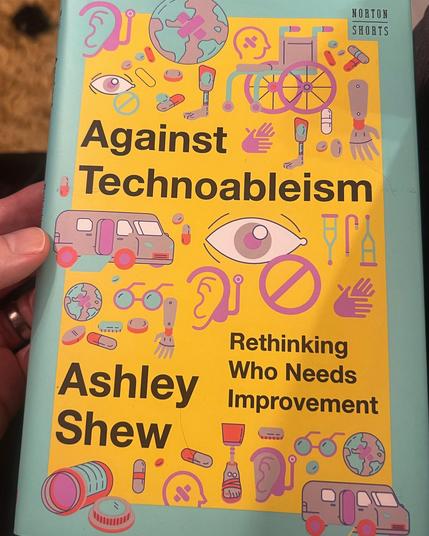
TobyEnjoying a book Elaine got me; Against Technoableism by Ashley Shew
 Kathrin Ganz
#4GenderStudies ist immer auch eine Gelegenheit, auf die aktuelle Ausgabe des Open Gender Journal hinzuweisen. Wir haben dieses Jahr wieder Artikel zu ganz unterschiedlichen Themen veröffentlicht: von feministischen Vernetzungspraxen, Plattformpolitiken, #KI und #Technoableism über sexualisierte Gewalt an Hochschulen bis zu Geschlechterstereotype in jüdisch-bürgerlichen Kochbüchern. Außerdem Rezensionen zu Neuerscheinungen aus den #GenderStudies, unter anderem ein Buch zur Kulturgeschichte von Autobahn und Männlichkeit. Alle Beiträge findet ihr hier: https://opengenderjournal.de/issue/view/7

 Dr. Claire Tupling
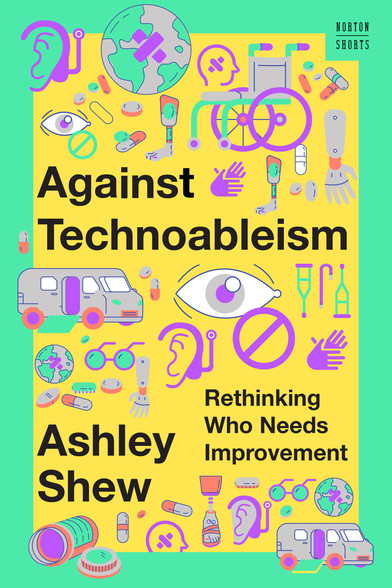
Against Technolableism: Rethinking who needs improvement by Ashley Shew. A short read introducing technoableism, the idea that technology can eradicate disabled ways of living. If you are working on disability, access & technology this is good place to start. #Disability #Ableism #Technoableism https://mitpressbookstore.mit.edu/book/9781324036661
Against Technoableism: Rethinking Who Needs Improvement (A Norton Short)
One of BookRiot's Ten Best Disability Books of 2023 A manifesto exploding what we think we know about disability, and arguing that disabled people are the real experts when it comes to technology and disability. When bioethicist and professor Ashley Shew became a self-described “hard-of-hearing chemobrained amputee with Crohn’s disease and tinnitus,” there was no returning to “normal.” Suddenly well-meaning people called her an “inspiration” while grocery shopping or viewed her as a needy recipient of technological wizardry. Most disabled people don’t want what the abled assume they want—nor are they generally asked. Almost everyone will experience disability at some point in their lives, yet the abled persistently frame disability as an individual’s problem rather than a social one. In a warm, feisty voice and vibrant prose, Shew shows how we can create better narratives and more accessible futures by drawing from the insights of the cross-disability community. To forge a more equitable world, Shew argues that we must eliminate “technoableism”—the harmful belief that technology is a “solution” for disability; that the disabled simply await being “fixed” by technological wizardry; that making society more accessible and equitable is somehow a lesser priority. This badly needed introduction to disability expertise considers mobility devices, medical infrastructure, neurodivergence, and the crucial relationship between disability and race. The future, Shew points out, is surely disabled—whether through changing climate, new diseases, or even through space travel. It’s time we looked closely at how we all think about disability technologies and learn to envision disabilities not as liabilities, but as skill sets enabling all of us to navigate a challenging world.
 George Baily
I've just pre-ordered: *Against #Technoableism: Rethinking Who Needs Improvement *by Ashley Shew
https://techanddisability.com/home/against-technoableism/
https://techanddisability.com/home/against-technoableism/