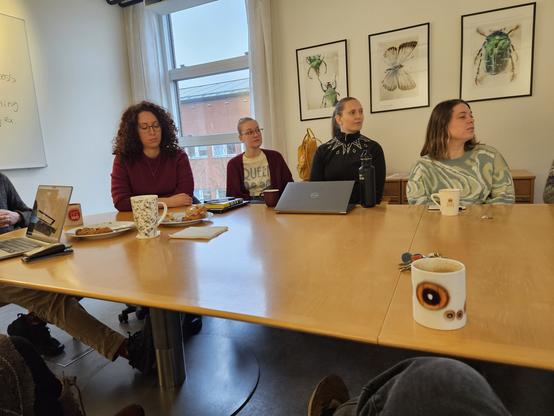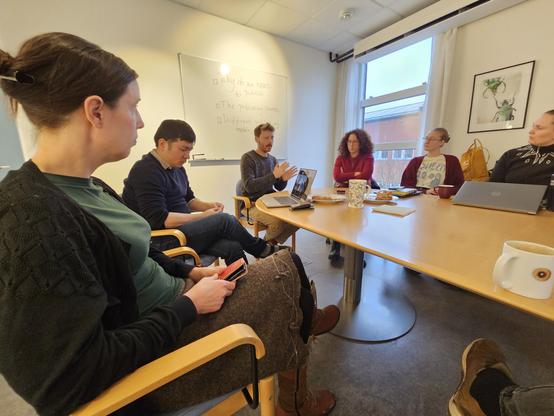
Our latest paper from #SvenssonLab is now published in Proc. R. Soc. B.!

We integrate population biology, sensory biology and gene expression studies to investigate the mechanistic basis of how plastic male mate preferences and colour vision help in mate detection.

Different opsin genes are differentially up- or downregulated in response to population variation in female colour morph frequencies in our study species the Common Bluetail Damselfly (Ischnura elegans):

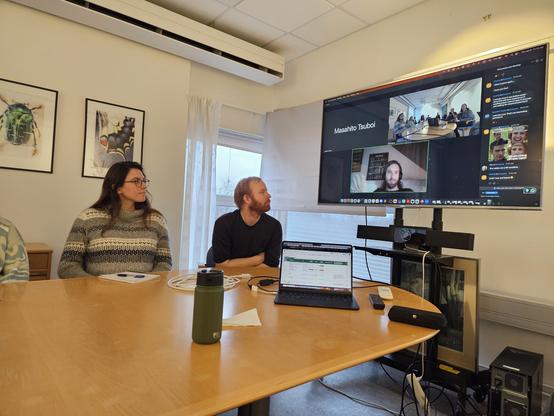
https://royalsocietypublishing.org/doi/10.1098/rspb.2024.2511?fbclid=IwQ0xDSwKbiHJjbGNrApuIWGV4dG4DYWVtAjExAAEe3kr-zv6WiXhIqwfQIKyebvD2rtGWxLO_rNCDz9Dw0b4jbIS-G5gDACXIElg_aem_vsa0PO7J-YIHJ8HJphA-wA

Ecology and sexual conflict drive the macroevolutionary dynamics of female-limited colour polymorphisms

Sexual conflict over mating has been documented in many species, both in the field and in experimental studies. In pond damselflies (family Coenagrionidae), sexual conflict maintains heritable female colour polymorphisms, with one female morph typically being a male mimic. However, it is not known whether sexual conflict can also explain the evolutionary origin of female-limited colour morphs, and if so, what ecological factors play a role in this macroevolutionary transition, by modulating the strength of the conflict. Furthermore, the effects of sexual conflict on phylogenetic diversification remain controversial, in particular, whether sexual conflict elevates speciation rates, extinction rates, or both. Here, we use phylogenetic comparative methods to show that female colour polymorphisms are more likely to evolve when population densities at breeding sites are high, and that these demographic conditions are more common at high latitudes and in open landscapes. We show that female-limited polymorphisms typically evolve from sexually dimorphic ancestors through the addition of a male-like female morph, consistent with the hypothesis of selection for male mimicry. Female colour polymorphisms increase both speciation and extinction rates, leading to higher evolutionary turnover of polymorphic lineages. We conclude that female colour polymorphisms evolve in a predictable fashion, and are likely driven by ecological conditions that increase the rate of pre-mating interactions and thus the intensity of sexual conflict. The effects of female colour polymorphisms on extinction differ from previous intraspecific studies and indicate contrasting long-term effects of sexual conflict at micro- and macroevolutionary scales. ### Competing Interest Statement The authors have declared no competing interest.

bioRxiv

Excellent presentation in #SvenssonLab today about Odonata genomics, synteny, B-chromosomes and the origin of recombination suppression of Chromosome 13 in Ischnura elegans by our postdoc Guillaume Lavanchy:

https://m.facebook.com/story.php?story_fbid=pfbid04iseGeTsX8qpXxqHgNcciDdaoxGr9iUqU4cm8vBmA4k1yy9MZVDACg1WhEay5VYYl&id=100063511053676

Facebook

We thank our two postdocs Guillaume Lavanchy and Anna Penna for leading an excellent discussion about scientific publishing for members of #SvenssonLab and #TsuboiLab at #LundUniversity yesterday, January 10 2024.

We congratulate our PhD-student Sofie Nilén in #SvenssonLab for successfully defending her Halftime Report and summarizing her research progress for an interested audience in the Biology Department today.

We also thank her opponent Dr. Anja Felmy from the Division for Functional Ecology for doing such a great job.

https://www.facebook.com/share/p/Ckk9XqUPgCdkAQuG/

Log into Facebook

Log into Facebook to start sharing and connecting with your friends, family, and people you know.

Facebook

We thank our postdoc Natalie Roberts for leading a stimulating lab-meeting today on #colour #vision and #opsin genes in damselflies and other insects for members of #SvenssonLab and #TsuboiLab.

In the evening some of the lab members went to Café Ariman in Lund and later to see the movie "The Apprentice" at #Kino in #Lund

First joint lab-meeting in autumn 2024 between #SvenssonLab and #TsuboiLab, organized by Masahito Tsuboi who lead a stimulating discussion about how intraspecific phenotypic variation and evolvability can help to bridge the micro- and macroevolutionary time scales.

#LundUniversity #Sweden #Evolution #EvolutionaryBiology

Field work and mate choice experiments with damselflies in #SvenssonLab during the summer of 2024 together with field assistants, internship students and PhD-students. All work takes place around Lund in southern Sweden.
Field season with #SvenssonLab, catching adults and larvae of Odonata around #Lund, southern #Sweden.

Last week the Nordic Oikos-conference happened in Lund, which gathered about 450 ecologists during four days.

From #SvenssonLab we had two presentations about our evolutionary and ecological research on damselflies by Masahito Tsuboi and Sofie Nilén, respectively.