 Journal of Plant Ecology
【💡High Cited 2020-2022 】
#ClimaticNicheShift of an #InvasiveShrub ( #UlexEuropaeus ): a global scale comparison in native and introduced regions
Core:
How the climatic niche shift could contribute to increasing #Invasibility.
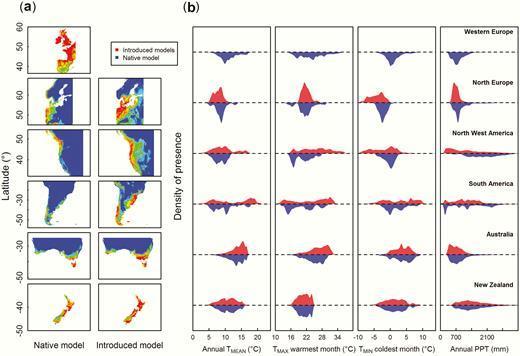
【💡High Cited 2020-2022 】
#ClimaticNicheShift of an #InvasiveShrub ( #UlexEuropaeus ): a global scale comparison in native and introduced regions
Core:
How the climatic niche shift could contribute to increasing #Invasibility.
【EDITOR'S CHOICE】
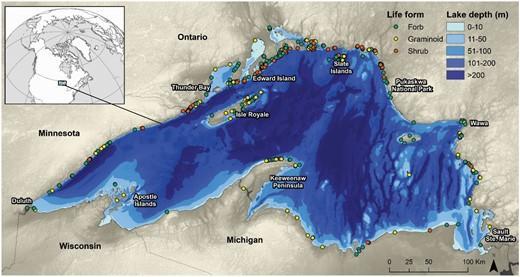
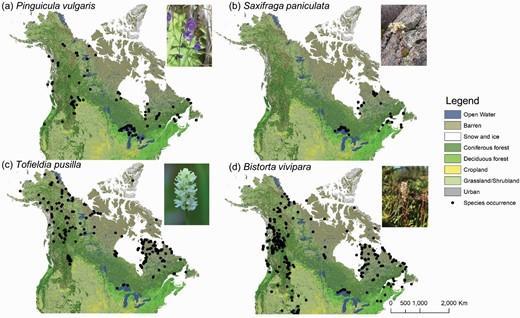
#ClimateRefugia along #LakeSuperior’s shores: disjunct arctic–alpine plants rely on cool shoreline temperatures but are restricted to highly exposed habitat under #ClimateWarming
#DisjunctPopulations | #LakeEffect | #SpeciesDistributionModels
And for those working with Species Distribution Models #SDM #ecologicalNiche or #alienspecies, the chapter 'Assumptions: Respecting the known unknowns' by @DrBruceWebber, Roger Cousens and Daniel Atwater is a must-read:
https://bookdown.org/rogerdavidcousens/_book/assumptions-respecting-the-known-unknowns.html
#ecology #modelling #SpeciesDistributionModels #ecologicalTheory

While most coastal communities are expected to, or have been, negatively impacted by climate change, cephalopods have generally thrived with shifting ocean conditions. However, whilst benefitting from the same physiological flexibility that characterizes cephalopods in general, cuttlefish have depth constraints imposed by the presence of a cuttlebone and are limited to specific locations by their particularly low vagility. To evaluate the potential effects of marine climate change on cuttlefish, Species Distribution Models (SDM) were applied to nine species of genus Sepiidae to assess potential changes to their future distribution (2050 and 2100), under four representative concentration pathway (RCP) scenarios (i.e., RCP 2.6, 4.5, 6.0, and 8.5; CMIP5). We show that future cuttlefish habitat suitability and distribution will potentially decrease. The species with the most extreme impacts, Doratosepion braggi (Verco, 1907), was observed to decline as much as 30.77% in average habitat suitability (from present 55.26% to 24.48% at RCP 8.5 in 2100), to Sepia officinalis Linnaeus, 1758 with a low maximum decrease of 1.64% in average habitat suitability (from present 59.62% to 57.98% at RCP 8.5 in 2100). Increases in habitat suitability were projected mostly at higher latitudes, while habitat decrease was predicted for the tropical regions and lower latitudinal limits of species’ distributions. As their habitats decrease in terms of habitat suitability, cuttlefish may not benefit from future changes in climate. Additionally, as potential “sea canaries” for coastal ecosystems, we may see many species and habitats from these systems affected by climate change, particularly in tropical regions.
https://conservancy.umn.edu/handle/11299/217469
Just Released: 2nd edition of our free textbook: Species-Habitat Associations: Spatial data, predictive models, and ecological insights.
#SHA #SDM #niche #SpatialEcology #PointProcesses #rstats #ecology #spatial #SpeciesDistributionModels
I’m a portuguese #biologist living in the margins of lake Constance (South #Germany) working with #fish #ecology, namely distribution (#SpeciesDistributionModels) and patterns of #biodiversity in #rivers. Dabbler in the arcane arts of #Bayesian modeling.
Father of 2 very interesting creatures(2,5 YO and 8MO). Besides walks with family, I like to cook, #DungeonsandDragons and #SciFi.
#Biology #Bodensee #DnD #D&D #Rstats @Rstats #BayeStats #SDMs #recipes #PosDoc
 Ingolf Kühn
 Miguel Guerreiro
 Dario
Dario Peer Community Journal
 Peer Community In
 Geert Aarts
 Mário Mota-Ferreira