 Journal of Plant Ecology
【🎉Latest accepted article】
Stronger microbial respiratory #ThermalAdaptation under higher warming levels
#CarbonCycling | #ClimateWarming | #MicrobialCommunity | #Carbon_climateFeedback | #FunctionalGeneDiversity
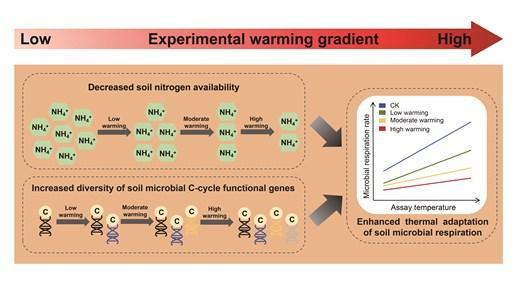
【🎉Latest accepted article】
Stronger microbial respiratory #ThermalAdaptation under higher warming levels
#CarbonCycling | #ClimateWarming | #MicrobialCommunity | #Carbon_climateFeedback | #FunctionalGeneDiversity
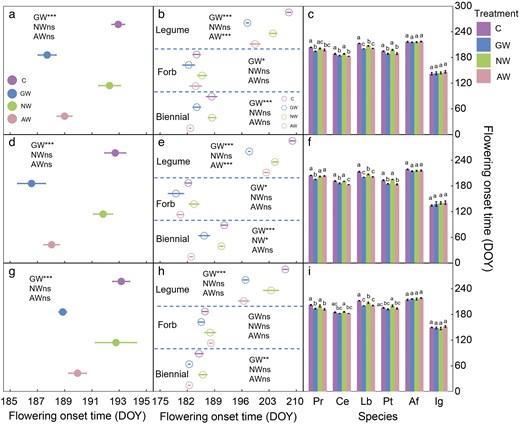
growing-season warming (GW) and non-growing-season warming (NW) interactively and differently influence reproductive phenology in a semi-arid steppe.
#ClimateWarming | #FloweringTime | #FruitingTime | #InteractiveEffects | #TypicalGrassland
Happy 420! #420 #ClimateWarming 🍸😺
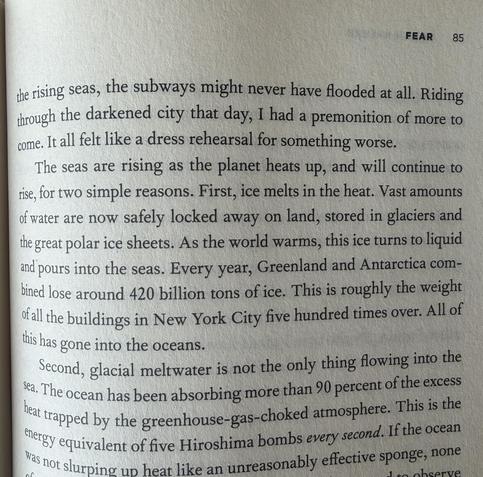
>>Every year, Greenland and Antarctica combined lose around 420 billion tons of ice. This is roughly the weight of all the buildings in New York City five hundred times over. All of this has gone into the oceans.<<
#Growing_seasonWarming (GW) and #Non_growing_seasonWarming (NW) interactively and differently influence reproductive phenology in a semi-arid steppe. GW advanced both #FloweringTime and fruiting time, whereas NW delayed only #FruitingTime.
I had missed this #GoodNews. In the #EU wind and solar electricity have overtaken fossils in 2025 for the first time: https://ember-energy.org/latest-insights/european-electricity-review-2026/
Well, it's not quite that #Solarpunk is coming immediately, but great news nevertheless 🪁 😎
Special Feature: A multi-species assessment of Arctic whales identified shared regions of maladaptive risk to climate warming, providing context for designing ecosystem-wide evolutionary enlightened conservation strategies.
Available now ahead of print!
https://www.journals.uchicago.edu/doi/10.1086/738889
#idw Study: “Hidden” #contrails in #cirrus clouds contribute to #climatewarming
Researchers at the Institute for #Meteorology at Leipzig University have, for the first time, determined the climatic impact of contrails that form within natural cirrus clouds. Contrails account for the largest share of aviation’s climate impact beyond carbon dioxide emissions. https://idw-online.de/en/news863338
🚨 New #preprint online! 🚨
"Forecasting #bryozoan assemblage dynamics under simulated #ClimateChange" by Mira Baer et al.
We use an #IndividualBasedModel to explore potential future bryozoan assemblage dynamics. We show that successional patterns strongly depend on the duration of the growing season as well as on the spatial distribution of predation events - which are both likely to change due to #ClimateWarming...
👉🏻 https://www.biorxiv.org/content/10.1101/2025.10.31.685734v1
 George Girton
 Lisa Crabtree
 Joseph
 American Naturalist
 Speckdäne
 Teddy / Domingo (🇨🇵/🇬🇧)
 Dr. Korinna Allhoff