 cally ^w^
wow don't i just love #CProgramming wow it's so nice to program in #CProgrammingLanguage i love #raylib and i love error handling in C and #segmentationfault and i should probably install gdb or something
 rogeliop
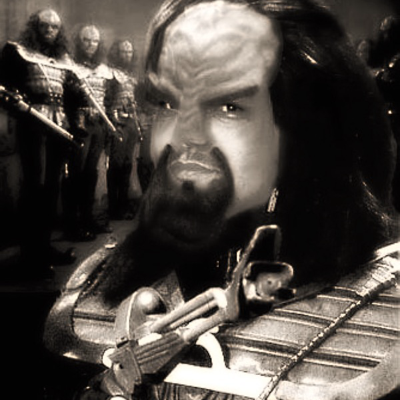
He's NOT the one...
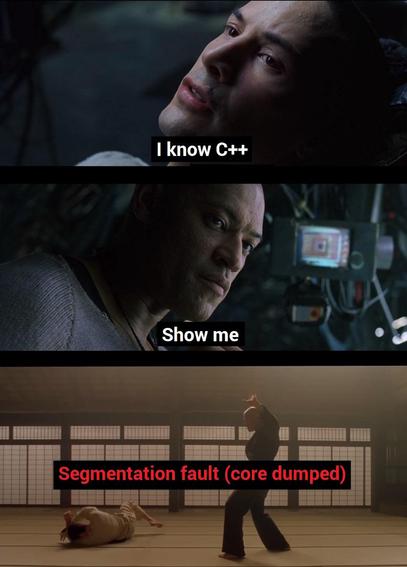
[1] 63902 segmentation fault ./blog
Have you ever wondered why segmentation faults are abbreviated "SIGSEGV" in Linux?
Where does the "V" come from? Shouldn't it be "SIGSEGF" instead? ("F" for Fault - not "Vault" 😉)
David Wragg and Marek Majkowski have a bit of UNIX history for you!
"Why is there a "V" in SIGSEGV Segmentation Fault?" -
https://blog.cloudflare.com/why-is-there-a-v-in-sigsegv-segmentation-fault
#linux #segmentationFault #sigsegv #unix #history #c #programming #developer #software #softwareDevelopment #embedded
My program received a SIGSEGV signal and crashed with "Segmentation Fault" message. Where does the "V" come from? Did I read it wrong? Was there a "Segmentation *V*ault?"? Or did Linux authors make a mistake? Shouldn't the signal be named SIGSEGF?
Has anyone tried to open a #LibreOffice #Calc spreadsheet from #Python? All I get is a #SegmentationFault.
I made all words deferred for more convenient live coding, makes recursion easier too.
The left stack (for regular evaluation) is fine, but the right stack (for local variables) overflows. The crash is because the C stack in the interpreter overflows too. The negative numbers are from signed integer overflow.
```
: fibs { a b -- b a+b } a . cr b a b + fibs ;
0 1 fibs
0
1
1
2
3
5
8
13
...
5167068349195539697
5957444661174968386
-7322231063339043533
-1364786402164075147
-8687017465503118680
8394940206042357789
ERROR: stack overflow
ERROR: stack overflow
-292077259460760891
ERROR: stack overflow
ERROR: stack overflow
8102862946581596898
Segmentation fault
```
 Mr. Hmpf
 Sigma
Sigma ZERO GmbH
 Luís de Sousa
 claude
 Leather Bastard
 heise online (inoffiziell)