 ⊹ Millennium 🇺🇦 ⊹
France 4 diffuse le film d'animation français Mars Express ce mardi :

 Nine Billion Names of God Bot
 Joachim Boaz
"Write a story that will give a few bigots the jolt they need. Write a story that will open the eyes of the unconsciously bigoted."
Exploration Log 14: Anti-Racism in Chandler Davis’ “Stereotypes Are Dangerous” (1950) https://sciencefictionruminations.com/2026/06/21/exploration-log-14-anti-racism-in-chandler-davis-stereotypes-are-dangerous-1950/

 Eurogamer.net [Unofficial]
Halo: Campaign Evolved PS5 players will require an Xbox account and gamertag to play – as well as PS Plus to play split-screen co-op
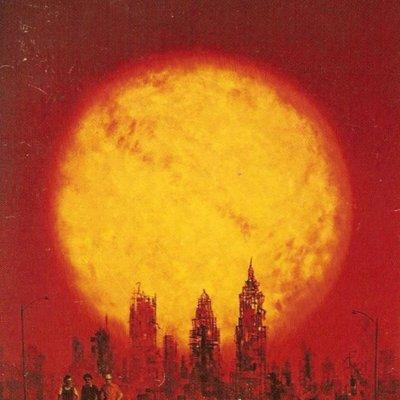 Dhalgren
You're—" Bill noticed Lanya and Denny but didn't say any thing to them—"very strict with your own, aren't you?
 Science Fiction and Other Suspect Ruminations
Exploration Log 14: Anti-Racism in Chandler Davis’ “Stereotypes Are Dangerous” (1950)
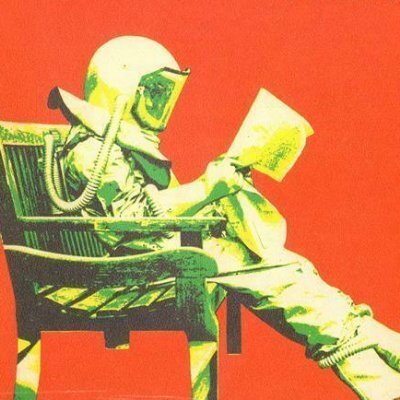
- John Grossman’s cover for vol. 1 of the fanzine Futurist, ed. Redd Boggs (Spring 1950)
“Write a story that will give a few bigots the jolt they need. Write a story that will open the eyes of the unconsciously bigoted” (8).
Chandler Davis (1926-2022) strikes a fascinating figure. He was a communist activist, science fiction author, fanzine editor, a Professor of Mathematics at the University of Michigan, and political prisoner. He was fired from the University of Michigan in 1954 and imprisoned for six months in 1960 on charges of contempt of Congress leveled by HUAC.1 Between 1946 and 1970, he published 12 short stories. One additional story, a casualty of Harlan Ellison’s infamous unpublished Last Dangerous Visions, appeared in 1994.2 I reviewed three of his 1940s short stories on the theme of nuclear war back in 2023: “The Nightmare” (1946), “To Still the Drums” (1946), and “The Aristocrat” (1949). He’s certainly an author I need to return to on the merits of his article “Stereotypes Are Dangerous” (1950).
Publication note: Davis’ “Stereotypes Are Dangerous” was reprinted in the 1st issue of the fanzine Futurist, ed. Redd Boggs (Spring 1950). Davis’ article originally appeared in the 23rd issue of the fanzine Tumbrils, ed. James Blish (1950). I do not know if any changes were made between the two editions. Unfortunately, the original version hasn’t been digitized to the best of my knowledge. You can read the entire vol. 1 of the Futurist (1950) online here.
Let’s discuss the article!
- Graphic created by my father
“Stereotypes Are Dangerous” positions science fiction as a vehicle for positive social change. Davis condemns science fiction that perpetuates common stereotypes of race and nationality. Stories like L. Ron Hubbard’s “The Automagic Horse” (1949), which contains common racist tropes for Jews and Italians, do damage that must be rectified. Rather than merely “stock types” that can be dismissed as harmless due to their commonality, Davis argues that they perpetuate and reinforce racist mentalities (5). Science fiction that plays it safe by avoiding all mention of race also are “no good, for my money” as the “writer has the opportunity to do something positive” (6). He argues that the American reader encounters more segregation in their “pulp fiction than he is likely to have seen in his daily life” (6). If readers complain that progressive depictions of minorities and women stick out “like a sore thumb,” that’s okay! He argues that over time the “reader will get used to it–which is exactly the object” (6). Writers should not be bothered by bigoted fans.
Simultaneously, Davis admits that the current late 40s science fiction publishing landscape does not accept the type of story that he sees as necessary. He recounts how he tried to include a “sympathetic” African American physicist “in manuscript” (7). The version of the his story the editors published removed any mention of race. Enter the fan. Just as writers can take an active stance against stereotypes and include diverse characters depicted in a positive manner, fan activism is a core component of Davis’ recipe for transformative change: “Letters criticizing chauvinist stories would go a long way toward persuading editors to accept positive ones” (7).
Science fiction must “counteract the bias present in practically every page now read by American” (8). He imagines narratives with African American, Polynesian, and Inuit professionals and scientists. He even implies futures with intermarriage between races (you have to remember it was illegal in many states until 1962!) and nationalities: “Characters who you might name Iso Yukawa or Selma Hirschman in the 20th century, if the time was more remote, be named Vassily Yukawa or Christiana Hirschman” (7). He emphasizes that any depiction of the future MUST contain change and that all, regardless of race, will contribute to that change. To support his point, he emphasizes that the depiction of women, “frequently dominate characters, important to the story more than love-objects” increasingly show up in contemporary science fiction (8). Unfortunately, he does not highlight any admirable examples. Science fiction has the power to “open the eyes of the unconsciously bigoted” (8).
I will conclude my summary with his powerful final words: “Remember that the large majority of you readers–the large majority–either discriminate or are discriminated against. Keep that in mind all the time. Then write a story that satisfies your conscience” (8).
For easier access and to clarify a few sections that were hard to follow and read due to the scan, I’ve decided to transcribe the article below with a few annotations in the notes. I look forward to your observations. I found it shockingly aware and progressive for 1950.
I hope you enjoy this article as much as I did!
Chandler Davis’ “Stereotypes Are Dangerous” (1950)
“The subject of of stereotyping has been discussed enough to be almost as dull as the stereotypes themselves. And it doesn’t really matter too much. So we meet in every story the megalomaniac genius or the cleancut, woman-chasing slipsticker. So what? It just means we are reading mediocre fiction, which after all is our prerogative.
But sometimes — all too often — you run into stereotypes which are of more concern. Take L. Ron Hubbard’s ’’The Automagic Horse” in aSF for October 1949.3 In this story appear the following: a roughhewn, stingy r-rolling Scot; an uneducated, tough, wise-speaking Italian-American; and a Jew who peddles insurance to his uncle’s employees. If I remember right, each is the only character of his population group to come on the scene. In the same story (this is so usual I need hardly mention it) we have the handsome, carefree engineer hero, who one assumes is Irish-American, and the sexy wench, apparently Yankee.
Pretty routine sort of casting, that’s all–or so you might say–and I’ll stipulate right away that it’s not the kind of consciously fascist racism you find in John Buchan.4 I’m sure that if there was a conscious thought in Hubbard’s mid while he wrote “The Automagic Horse” it has not found its way into print. It’s farthest from my mind to accuse him of ill will toward anyone in writing the thing.
What I am charging him with is his very thoughtlessness. Readers who are convinced that all Italians talk like gangsters and follow the races, will give an internal uh-huh reading Hubbard’s words; readers who habitually assume that an Italian they haven’t met yet is going to turn out to have those same stereotyped characteristics will be reinforced in the habit; readers who are Italians will quite possible be insulted. All of these reactions will be below the conscious level in most readers. That doesn’t matter. They are still there. They still will make it harder for Italians in this country to get the marks they deserve from nominally unprejudiced employers.5 “The Automagic Horse” is one more straw on the back of the overladen camel which if this were a cartoon I would label “Democracy.”
My complain isn’t only against Hubbard. It it was, it would be gratuitous and malicious for me to do my complaining publicly. But also, if he were the only offender, there would be no offense. It is exactly because reams of the stuff are written that it is dangerous. It is for the same reason that Hubbard, casting randomly for cute characters for his story, picked a collection of stock types as the easiest to handle, and picked these particular ones as the easiest and most familiar of all. It is for the same reason again that very few readers, even those who would bristle at the word “kike”, will bristle when they read “The Automagic Horse.” To summarize — it is because these characters are stereotypes that they are stereotypes. And it is a serious matter: character-typing of this sort does a lot more harm than just detracting from the interest of a story.
What’s to be done about it? Robert W. Lowndes gave part of the answer a few years back when, as editor of a Western magazine, he said he would accept no story with a Negro, Indian, or Mexican villain unless in the same story there was a member of the same group who was sympathetic and unstereotyped.6 That’s an excellent rule of thumb for weeding out the worst cases, though I think it should be extended to weeding out a story like Hubbard’s (which had no villain), or stories like A. Betram Chandler’s in which all the British enlisted men (though not villains) speak with the Cockney accents and limited vocabulary. It’s still only a rule of thumb and only a palliative at best, and few editors follow it.
The best place to look for a remedy is to the writers. What’s the trouble there? Usually, as I say, thoughtlessness. The chances are that Hubbard has Italian friends who speak the same dialect he does and Jewish friends who are neither businessmen nor nepotists. The chances are that Chandler didn’t change his pronunciation of the initial “h” when he himself left the enlisted ranks. They just don’t think about the effect of what they write.
Writers could, perfectly well, avoid stereotypes. Even editors wouldn’t follow the Lowndes Rule would not reject stories which avoided the stereotypes. But writers can go farther than mere avoidance. The easiest way to prevent direct offense is to name all your characters Farnsworth or Dodd, and let it go at that, but this is no good, for my money. A writer has the opportunity to do something positive: to illustrate in his stories the trivial and unobtrusive fact, still worth pointing out as often as possible, that Flannery and Sarfian can be buddies. It adds verisimilitude, too. I remember reading the works of one prolific aSF7 author for years before I realized how monochromatic his engineers were. When I did realize, I saw also that it had been bothering me all that time. Were this the author’s friends so uniform that he cast his stories this way automatically? I’ve learned since that they aren’t, but the stories remain the same. Myself, I’ve rarely been in schools or jobs where my associates didn’t include Negroes, Jews, and what-have-you; When I have been, I’ve known why and I haven’t liked it.
But leave verisimilitude aside. To the reader we are most concerned about it may not seem natural that Flannery and Sarafian drink beer together. It may even stick out like a sore thumb: the reader has after all been presented for years with even more segregation in his pulp fiction than he is likely to have seen in his daily life. That doesn’t matter. Slug him with it. Let your slipsticking hero be Negro; let his buddy be Chinese or East Indian. Why not? After a while the reader will get used to it–which is exactly the object.8
What’s more, don’t forget that Flannery and Sarafian can be buddies even if Sarafian speaks with an accent. This is something that’s often forgotten by those who would agree perfectly with the rest of what I’ve said. The movie “Gentleman’s Agreement,” for example, conveyed string indignation at discrimination against Jews, but it considered only Jews who look, talk, and act like Yankees.9 Now I have Jewish friends who “look Jewish.” I have Jewish friends who speak with one accent or another. For that matter, practically all Negroes “look like Negroes,” and most Puerto Ricans in this country are foreign-born and show it in their speech. The case against discrimination does not rest on the fiction that people are all alike nor does rejection of such a stereotype as the Italian fruit-vendor mean that all Italians holding fruit-stand concessions should sell them to Yankees. However, if an author needs a fruit-stand in a story I don’t think he should make its proprietor a Verdi–singing Italian, even though there is nothing wrong with such a person’s having such an occupation; the reader will have met the character previously in a disproportionately large number of stories.
In short, complete stereotypes are very, harmful even when handled as sympathetically as in H. L. Gold’s “Trouble With Water,” but it may be desirable sometimes to give a non-Yankee character some traits (such as a foreign accent) which have been unfairly represented as objectionable by the stereotypers.10
You may have been bothered a few paragraphs back by a suspicion that my suggestions were departing from the realm of the immediately feasible. I’ll settle that right now: They are. A Negro hero would not be tolerated by many editors, and I suppose practically all editors would prefer that you make him white. I don’t know any market except for leftist magazines or arty ones where a Negro hero would be allowed to get the girl if she was white. There is an instance from my own writing experience: a (sympathetic) character in one of my stories was a Negro physicist, in manuscript; in the story as published it was not mentioned that he was Negro. In breaking this resistance down, readers as well as writers should help. Letters criticising chauvinist stories would go a long way toward persuading editors, to accept positive ones. (I should add that already aSF has had many stories with sympathetic, unstereotyped characters who were East Indians, Italians, Jews, or even Negroes. No major reform is necessary for this precedent to be followed.)11
I haven’t said anything yet about the specially science-fictional aspects of the question. In s-f you’re not writing about the world of 1950 which, as far as inter-group harmony goes, stinks. You’re writing often about the distant future, when we hope the present divisions and oppressions will be eliminated. This makes a difference. Example: In the story about the near future you should include Negro scientists, even though there are tragically few of them in fact. In your 24th-century America there should be Polynesian and Eskimo scientists as well, because you can be sure the’ll be around when the 24th century arrives. Second example: Characters who you might name Iso Yukawa or Selma Hirschman in the 20th century, if the time was more remote, be named Vassily Yukawa or Christiana Hirschman. You want to assume that all population groups will participate in future civilization, but you want also to recognize that they will not remain as separate as they have been. (The once-oppressed Welsh are still a distinct group, yet no Englishman would forbid his daughter to marry and otherwise qualified Welshman.) Third example: In the 24th century, Parker Hollister will be as likely to space with a non-American accent as Karel Kowalewski, or almost as likely.
There is one type of stereotyping which I haven’t discussed in spite of the fact that it raises problems similar to those of nationality stereotyping. I mean the kinder-küche-kirche12 line, which is followed appallingly often in American popular literature and occasionally appeared quite blatantly in science fiction. The reason I haven’t discussed it is that here s-f–or at least aSF—is way ahead of most pulps, and still improving. Women in s-f are frequently educated (even the stock hero-marrying daughters of professors); the are also frequently dominant characters, important to the story as more than love-objects. It is unfortunate that, as illustrated recently in aSF, doctors of the future all are male and are assisted by female nurses. But on the whole s-f authors invent women who are people almost half as often as they invent men who are people, which is more that you can say for mystery writers.13
I hope the recommendations I have made will be taken seriously–especially by those of you who are editors and/or writers. To go along with the tradition that Negroes, Jews, and Italians can be admitted into fiction only in minor roles as stereotyped comic relief is to reinforce readers’ minds in the prejudice, which I assume is abominable to all of us, that Negroes, Jews, and Italians cannot be admitted to equal positions in American life. It is not enough to refrain from expressing bias; it is necessary to counteract the bias present in practically every page now read by Americans.
The criterion of your success in the next story you write will not be your adherence to my suggestions; they are only my suggestions, and I’d like to have discussions of their correctness. The criterion will be the reactions of your readers. Write a story that will give a few bigots the jolt they need. Write a story that will open the eyes of the unconsciously bigoted. Write a story that will compensate, for some Negro reader, for the insults he has taken from white people in the just the day preceding.
Remember that the large majority of you readers–the large majority–either discriminate or are discriminated against. Keep that in mind all the time. Then write a story that satisfies your conscience.
THE END”
Notes
For book reviews consult the INDEX
For cover art posts consult the INDEX
For TV and film reviews consult the INDEX
#1940s #1950s #ChandlerDavis #history #race #sciFi #scienceFiction
Short Story Reviews: Chan Davis’ “The Nightmare” (1946), “To Still the Drums” (1946), and “The Aristocrat” (1949)
Chan Davis (1926-2022) was a fascinating figure. He was a communist activist, fanzine editor, mathematician, and political prisoner. He was fired from the University of Michigan in 1954 and impriso…
 Quasit
@mdhughes @glitzersachen @screwlisp @Binder
"Cosmic Laughter" (1974) is a collection of some wonderfully funny short science fiction stories. It was one of my daily recommendations a few weeks ago: https://kolektiva.social/@Quasit/116683881518514475
R. Bretnor wrote a lot of very funny short science fiction too. "The Schimmelhorn File" (1979) is a collection of short stories about a Swiss janitor who is a genius—but only in his subconscious. Fair warning, Papa Schimmelhorn starts out as a dirty old man and just gets worse and worse. It can be a little cringy.
https://archive.org/details/schimmelhornfile0000unse
Another character who's a genius only in his subconscious (and generally wakes up from a bender with mysterious inventions that he doesn't understand) is Henry Kuttner's Galloway Gallagher. Many Gallagher stories were collected in "Robots Have No Tails" (1952).
Gallagher is, I should note, an alcoholic.
https://archive.org/details/robotshavenotail0000henr_r4c9
#quasitbookrecs #books #ScienceFiction #humor #ShortStories #bookstodon
Quasit (@[email protected])
Quasit's Daily Book Recommendations: "Cosmic Laughter; Science Fiction for the Fun of It" (1974), edited by Joe Haldeman My signed copy of "Cosmic Laughter" is one of my prized possessions. It's a rare collection of comical science fiction and fantasy, and it's an absolute riot. [The Superman Syndrome was getting totally out of hand. In this one hospital alone, there are already 758 classified cases of Superman Syndrome, he thought forlornly, and lord knows how many Supernuts in the receiving ward awaiting classification. “Why? Why? Why?” Funck muttered, tearing at his rapidly thinning hair. The basic, fundamental, inescapable, incurable reason, he knew was, of course, that the world was full of Clark Kents. Meek, mild-mannered men. Born losers. None of them, of course, had self-images of themselves as nebbishes. Every mouse has to think of himself as a lion. Everyone has a Secret Identity, a dream image of himself, possessed of fantastic powers, able to cope with normally impossible situations… . Even psychiatrists had Secret Identities, Funck thought abstractedly. After all, who but Supershrink himself could cope with a ward full of Supermen? Supershrink! More powerful than a raving psychotic! Able to diagnose whole neuroses in a single session! Faster than Freud! Abler than Adler! Who, disguised as Dr. Felix Funck, balding, harried head of the Superman Syndrome ward of a great metropolitan booby-hatch, fights a never-ending war for Adjustment, Neo-Freudian Analysis, Fee-splitting, and the American Way!] There are stories here by some of the funniest writers in science fiction: Norman Spinrad, Alfred Bester, Damon Knight, Thomas N. Scortia, Henry Kuttner, and andrew j offut. I could fill this recommendation with quotes...well, just one more: ["What about Christopher Columbus? Any record of his death in 1489?” “But he discovered the New World in 1492.” “He did not. He was murdered in 1489.” “How?” “With a forty-five slug in the gizzard.” “You again, Henry?” “Yes.” “There’s no record here,” Library insisted. “You must be one lousy shot.” “I will not lose my temper,” Hassel said in a trembling voice. “Why not, Henry?” “Because it’s lost already,” he shouted.] This was very hard to find for a long time; it was out of print for quite a while. But it's available as an ebook now, and you can borrow it for free at the Internet Archive: https://archive.org/details/cosmiclaughtersc0000hald Happy reading! 🤓📖 #Books #Bookstodon #humor #ScienceFiction #Fantasy #ShortStories #BookRecs #BookRecommendation #QuasitBookRecs
 Sablebadger
Sci Fi cover art was wild back in the day. I mean this cover has it all! Funky robot, transparent heads, captive sexy ladies, weird landscape, planets with rings...
I kind of want to make a poster out of this.

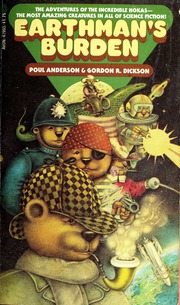
Quasit's Daily Book Recommendations: "Earthman's Burden" (1957) by
Gordon R. Dickson and Poul Anderson
Category: Adult, but good for ages 14 and up
Genre: Science Fiction, Humor
"Earthman's Burden" is collection of short stories about the Hoka, short teddy-bear-like aliens with incredibly wild imaginations who love human culture and stories - so much so that they •live• them. It's an incredibly funny collection.
The protagonist and straight man is Alexander Jones, a human space officer who crash lands on an alien planet—one that has only had one contact with humans, and that years before.
[He woke slowly with the sunrise and lay there for a while wishing he hadn’t. A long hike on an empty stomach followed by an uneasy attempt to sleep on the ground, plus the prospect of several thousand kilometers of the same, is not conducive to joy. And those animals, whatever they were, that had been yipping and howling all night sounded so damnably hungry.
“He looks human.”
“Yeah. But he ain’t dressed like no human.”
Alex opened his eyes with a wild surmise. The drawling voices spoke … English!
He closed his eyes again, immediately. “No,” he groaned.
“He’s awake, Tex.” The voices were high-pitched, slightly unreal. Alex curled up into the embryonic position and reflected on the peculiar horror of a squeaky drawl.
“Yeah. Git up, stranger. These hyar parts ain’t healthy right now, nohow.”
“No,” gibbered Alex. “Tell me it isn’t so. Tell me I’ve gone crazy, but deliver me from its being real!”
“I dunno.” The voice was uncertain. “He don’t talk like no human.”]
The Hokas, it turns out, were exposed to the legends of Earth's wild west by a member of the first expedition, who was a fan of the genre and played Western movies (the cowboy-and-Indian type) for them. Since then, the Hokas have gone head over heels for the genre—so much so that they've repatterned their whole existence on that basis, and have decided that the planet's other intelligent species, the reptilian Slissii, are "Injuns".
[The Childish Kid leered. “I know those gals,” he sighed. “Some fillies, hey? Stacked, don’t yo’ think?”
“Uh … yes,” agreed Alex. Hoka females had four mammaries apiece. “Quite.”
“Zunami an’ Goda an’ Torigi, that’s their names. If I warn’t so danged old—”
“How come they have, er, non-English names?” inquired Alex.
“We had to keep the old Hoka names for our wimmin,” said the Childish Kid. He scratched his balding head. “It’s bad enough with the men, havin’ a hundred Hopalongs in the same county … but how the hell can yo’ tell yore wimmin apart when they’re all named Jane?”]
In time the Hoka are introduced to other samples of Earth fiction, and take to them with the same wild enthusiasm. So there's an area based on 1880s England with a Hoka Sherlock Holmes, another based on Don Giovanni, a pirate area, and even a Space Patrol. They're all side-splittingly funny.
There's a second collection of Hoka stories entitled "Hoka!", as well as a novel that features the Hoka called "Star Prince Charlie". Oddly enough the end of the novel always brings me to tears.
You may be able to find some of the Hoka books in used bookshops or as ebooks from some of the major publishers. You can also borrow "Earthman's Burden" for free from the Internet Archive:
https://archive.org/details/zdanh_test_031_earthmansburden00poul
Happy reading! 🤓📖
#Books #Bookstodon #humor #ScienceFiction #ShortStories
#BookRecs #BookRecommendation #QuasitBookRecs
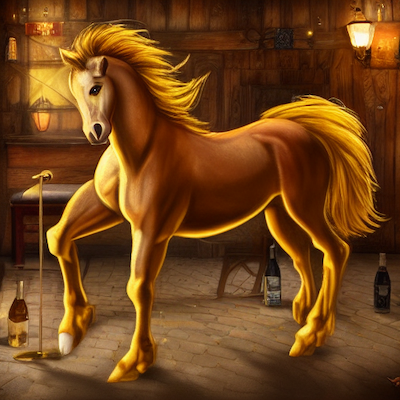 RS, Author, Novelist, Prosaist
#PennedPossibilities 1049 — Does your antagonist have everything they want? If not, how do they plan on accomplishing getting it?
No.
Humanity is going extinct, partially because of mistakes she's made, and partially because she thinks the universe has grown sick of people and wants them gone. [She's half right, surprisingly.]
Her full history on the face of it makes her seem evil, but there are means and there are the ends that justify those means (see above). She's always searching for help to solve the always worsening problem. To that end, she keeps finding students who often grow to regret their impulse to jump at the opportunity. Recently, she's practiced eugenics by moving around and concentrating populations with favorable characteristics together. Discovery of resources, inventions ranging from railroads to stargates, opportunities in a region that only favor certain types of individual, and occasional needful wars facilitate this. It's working. The quality of her students is rising. She's even found a student she hopes one day could replace her.
The devil-girl is sure Rainy Day's is evil and keeps running away.
Evil is relative.
[Author retains copyright (c)2026 R.S.]
#gender #fiction #writer #author
#sf #sff #sciencefiction
#writing #writingcommunity #writersOfMastodon #writers
#RSdiscussion
#RSstory #RSReluctanceStory