#PublierLaScience #OA "Diamond Open Access Needs Institutions, Not Heroes" : intéressant billet sur le blog #ScholarlyKitchen.
"Diamond open access is often described as “community-led,” and implicitly sustained by goodwill. While that may be viable on a small scale, it is not viable at the scale suggested by current policy ambitions.
This raises a specific and more practical question: what would it mean to support community-led publishing as infrastructure, rather than as a collection of heroic individual efforts?"
"Diamond OA as infrastructure, not a publishing model".
"From Ideals to Systems".
Remumérer le peerreviewing?
A lire
https://scholarlykitchen.sspnet.org/2026/02/18/guest-post-diamond-open-access-needs-institutions-not-heroes/
Guest Post — Diamond Open Access Needs Institutions, Not Heroes - The Scholarly Kitchen

Today's guest blogger asks: What would it mean to support community-led publishing as infrastructure, rather than as a collection of heroic individual efforts?

The Scholarly Kitchen

#scholarlykitchen #informationliteracy #AI

"The latest episode from Dr. Jenna Hartel (University of Toronto) spotlights an award-winning paper on exactly that. The author, Dr. Olof Sundin asks: “What happens when AI-infused information systems increasingly provide answers rather than directing people to sources?” In particular, what happens to our fundamental ability to discern the authority and accuracy of information, a cornerstone of information literacy?"

https://scholarlykitchen.sspnet.org/2025/08/15/infideo-friday-how-ai-is-changing-our-search-experiences/?informz=1&nbd=f734f69f-a43f-4a52-86a7-33b5b057daf8&nbd_source=informz

INFIDEO Friday: How AI is Changing Our Search Experiences - The Scholarly Kitchen

What happens when AI-infused information systems increasingly provide answers rather than directing people to sources?

The Scholarly Kitchen

"How the Growth of Chinese Research Is Bringing Western Publishing to Breaking Point"
by Christos Petrou

"By most accounts, the growth of Chinese research is a gift to the world. And to western publishers. ...

By other accounts, the growth of Chinese research has not been trouble-free. The retraction rate of China dwarfs the retraction rate of the OECD"

#scholarlykitchen #publishing #AcademicChatter #retraction #retractionWatch

https://scholarlykitchen.sspnet.org/2025/07/08/guest-post-how-the-growth-of-chinese-research-is-bringing-western-publishing-to-breaking-point/

Guest Post - How the Growth of Chinese Research Is Bringing Western Publishing to Breaking Point - The Scholarly Kitchen

Christos Petrou examines the rapid growth in publication volume coming from China, and how that is impacting the publishing industry.

The Scholarly Kitchen

Just turned down a review request from Frontiers Physiology

Manuscript was far from my area of expertize and the reputation of the publisher is not good

#AcademicChatter #science #PredatoryPublishing
#scholarlykitchen #predatoryjournals
https://scholarlykitchen.sspnet.org/2023/03/30/guest-post-of-special-issues-and-journal-purges/

Guest Post – Of Special Issues and Journal Purges - The Scholarly Kitchen

Christos Petrou takes a look at the Guest Editor model for publishing and its recent impact on Hindawi and MDPI, as Clarivate has delisted some of their journals.

The Scholarly Kitchen

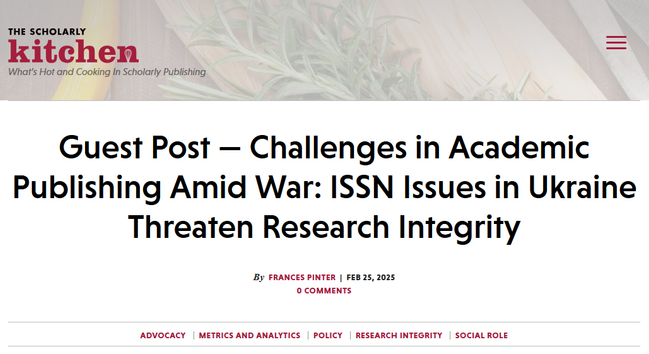
🌻 New #ScholarlyKitchen Blog Post: Challenges in Academic Publishing Amid War: ISSN Issues in Ukraine 🇺🇦 Threaten Research Integrity

The piece explores the ongoing violations of the rights of Ukrainian academic journals and authors since 2014, including violation of intellectual property rights and publication ethics.

🔗 https://scholarlykitchen.sspnet.org/2025/02/25/guest-post-challenges-in-academic-publishing-amid-war-issn-issues-in-ukraine-threaten-research-integrity/?informz=1&nbd=e6bcd134-b90f-4f13-a9fb-96a58438cb76&nbd_source=informz&fbclid=IwY2xjawIq3jxleHRuA2FlbQIxMQABHbtMi6JIlrvrS8JdxLN9xrhCQ0lTkzULNRDoK-OHCRrbIrVrj5LnYuc2GA_aem_Cto0IrvHal5hV2NSTt--eQ

#AcademicPublishing #PublishingEthics #PublishingIntegrity #IntelectualProperty

Guest Post - Challenges in Academic Publishing Amid War: ISSN Issues in Ukraine Threaten Research Integrity - The Scholarly Kitchen

Recently, a group of Ukrainian researchers uncovered serious violations in the use of ISSN identifiers by journals operating in temporarily occupied territories, revealing systematic misuse of academic infrastructure and promoting narratives hostile to Ukraine.

The Scholarly Kitchen

In den #USA machen sich die Kürzungen für #Wissenschaft bemerkbar:

"the cut is a critical threat to the US research infrastructure, puts medical progress at risk, and is a “disastrously bad idea.”

Was das fürs #Publizieren heißt, beschreibt @Lisalibrarian auf #ScholarlyKitchen: https://scholarlykitchen.sspnet.org/2025/02/10/nih-cuts-icr-implications-for-research-institutions-and-scholarly-publishing/

Die Gefahr gibt es auch in #Österreich und #Deutschland #FPÖ #noAFD

NIH Cuts ICR - Implications for Research Institutions and Scholarly Publishing - The Scholarly Kitchen

What are the implications of last Friday's NIH ICR budget cut? @lisalibrarian offers an early analysis.

The Scholarly Kitchen

💡 "Paywalls are Not the Only Barriers to Access: Accessibility is Critical to Equitable Access" #ScholarlyKitchen

By Todd Carpenter @tac_NISO, with comment from Israel Cefrin, PKP Digital Accessibility Specialist

In Israel's comment, check out PKP's work: Accessibility Audit, Inclusive Usability Testing, and Permanent Accessibility Project

"We’re committed to going beyond minimum compliance... how can we truly claim something is open if it isn’t accessible?"

https://scholarlykitchen.sspnet.org/2024/11/07/paywalls-are-not-the-only-barriers-to-access/#comment-131307

Paywalls are Not the Only Barriers to Access: Accessibility is Critical to Equitable Access - The Scholarly Kitchen

Digital accessibility to the scholarly communications process is core to providing equitable access to the literature

The Scholarly Kitchen

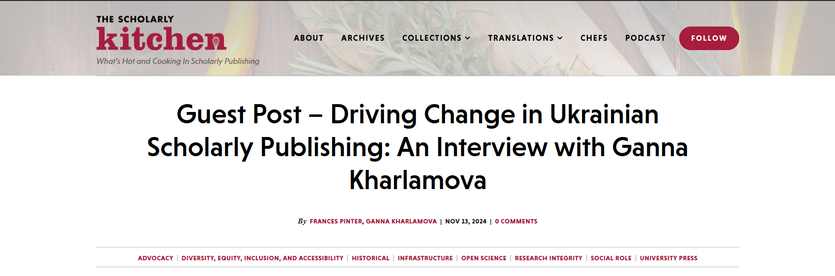
📌 New #ScholarlyKitchen blog post discussing the current state of scholarly publishing in Ukraine 🇺🇦 challenges researchers face, and the ongoing efforts to align editorial practices with global publishing standards.

🔗 https://scholarlykitchen.sspnet.org/2024/11/13/guest-post-driving-change-in-ukranian-scholarly-publishing-an-interview-with-ganna-kharlamova/

#AcademicPublishing #SciComm

Guest Post – Driving Change in Ukrainian Scholarly Publishing: An Interview with Ganna Kharlamova - The Scholarly Kitchen

An interview with Ganna Kharlamova, who is working to changing the way scholarly communications and publishing are conducted in Ukraine.

The Scholarly Kitchen
And now part II of the discussion about not citing chatbots as information sources has been posted to the #ScholarlyKitchen blog. https://scholarlykitchen.sspnet.org/2024/06/20/the-case-for-not-citing-chatbots-as-information-sources-part-ii/
Guest Post - The Case For Not Citing Chatbots As Information Sources (Part II) - The Scholarly Kitchen

Citing chatbots as information sources offer little in terms of promoting smart use of generative AI and could also be damaging.

The Scholarly Kitchen
There are already policies regarding whether to list #ArtificialIntelligence (#AI) like #chatbots as #coauthors in #academic #publishing. The #ScholarlyKitchen blog says there's something else to consider: Is it appropriate to cite chatbots as #information #sources? https://scholarlykitchen.sspnet.org/2024/06/19/chatbots-to-cite-or-not-to-cite-part-1/ #AmEditing
Guest Post - Chatbots: To Cite Or Not To Cite? (Part I) - The Scholarly Kitchen

If you use a chatbot in writing a text should you attribute the relevant passages to the tool via citation instead?

The Scholarly Kitchen