 j_bertolotti
#PhysicsFactlet
Scattering VS Extinction
In #Optics, the concepts of scattering and extinction are closely related. So closely related that many people tend to confuse them.
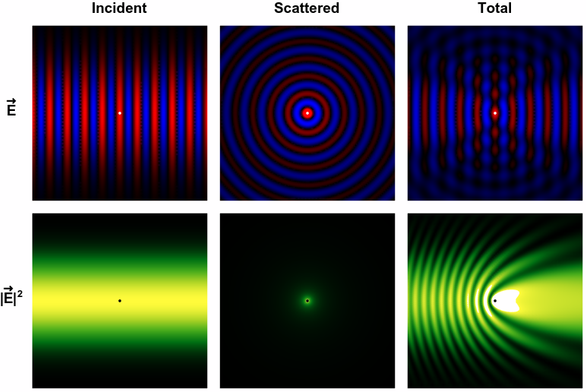
Imagine to illuminate a small object with a beam of light. If the object is small the scattered field will be essentially a spherical wave, and the total field will be the incident one plus the scattered field.
If we were able to measure directly the field (as we can do in the microwave regime) we could happily stop here, but in optics we can only measure intensities, and the intensity is defined as the time average of the modulus of the Pointing vector. In most cases of interest, the modulus of the Poynting vector is proportional to the modulus squared of the electric field (which explains why we often that a shortcut and just talk about |E|²).
So the quantity we measure is proportional to |Eᵢₙ +Eₛ|², which is the sum of the Poynting vector of the incident field, the Poynting vector of the scattered field, plus the cross terms. These cross terms are what we usually call "extinction" and are the result of the interference between the incident and scattering fields(and the reason why you get a "shadow" behind the scatterer).
 Dr. ir. Brian R. Pauw
 Markus Osterhoff
 Ricós
Ricós IL Photonics
 Scienza et Magia
 Daniel
 The Perpetually Curious!
 dbat
dbat 
 one can use geo-nodes to scatter stuff.