#PhysicsFactlet
The "stretch and fold" dynamics of the phase-space representation of a chaotic system (in this case a periodically driven simple pendulum) is always fun to see.

(Made for a lecture, so I am quickly putting it here. Maybe will write a thread about it in the near future.)

#Chaos

#PhysicsFactlet Scattering VS Extinction In #Optics, the concepts of scattering and extinction are closely related. So closely related that many people tend to confuse them. 1/ πŸ’‘ βš›οΈ πŸ§ͺ 🎒

#PhysicsFactlet
Scattering VS Extinction
In #Optics, the concepts of scattering and extinction are closely related. So closely related that many people tend to confuse them.
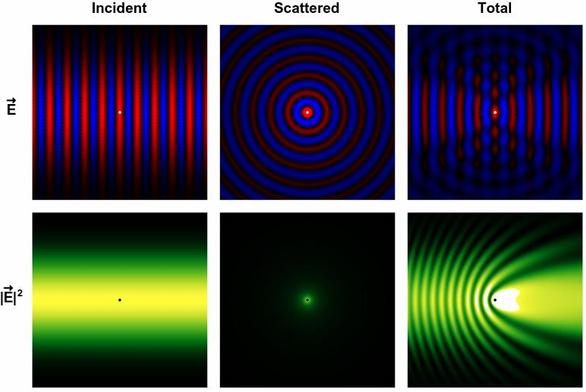
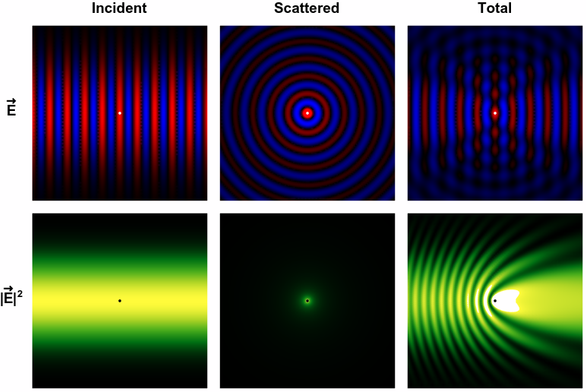
Imagine to illuminate a small object with a beam of light. If the object is small the scattered field will be essentially a spherical wave, and the total field will be the incident one plus the scattered field.
If we were able to measure directly the field (as we can do in the microwave regime) we could happily stop here, but in optics we can only measure intensities, and the intensity is defined as the time average of the modulus of the Pointing vector. In most cases of interest, the modulus of the Poynting vector is proportional to the modulus squared of the electric field (which explains why we often that a shortcut and just talk about |E|Β²).
So the quantity we measure is proportional to |Eα΅’β‚™ +Eβ‚›|Β², which is the sum of the Poynting vector of the incident field, the Poynting vector of the scattered field, plus the cross terms. These cross terms are what we usually call "extinction" and are the result of the interference between the incident and scattering fields(and the reason why you get a "shadow" behind the scatterer).

#Scattering #Electrodynamics

#PhysicsFactlet While electrodynamics is well understood, there aren't many scattering problems we can actually solve. A plane wave scattering from a uniform dielectric sphere is one of those few, and the solution was originally found by Gustav Mie in 1908. 1/ πŸ’‘ βš›οΈ πŸ§ͺ 🎒

#PhysicsFactlet
While electrodynamics is well understood, there aren't many scattering problems we can actually solve. A plane wave scattering from a uniform dielectric sphere is one of those few, and the solution was originally found by Gustav Mie in 1908. The solution is extremely elegant (albeit cumbersome), but not very practical for larger spheres, as it takes the form of a summation, and the number of terms we need to take into account grows fast with the radius.
Nevertheless it has become the prototype for all scattering solutions, and it has been extended to coated spheres, metallic spheres, birefringent spheres, ellipsoids etc etc.

In the animation: the scattered field from a uniform, dielectric disk (the 2D equivalent of the Mie solution). The source is from the bottom, and the (linear) polarization is assumed to be out of the plane.
The numerical solution has been obtained using a hand-coded finite-difference method to solve the Helmholtz equation.

#Optics #Physics #MieScattering
#PhysicsFactlet A simple finite element simulation of a pulse scattering on a small (but not point-like) dielectric obstacle. The scatterer behaves approximately as a re is a very faint halo of light going everywhere, but most light gets diffracted into something similar to a Airy Disk. 1/2 πŸ’‘ βš›οΈ 🎒

#PhysicsFactlet
I haven't made a single scientific animation in months. I just don't have the mental space right now.
But I am preparing a series of lectures on scattering for the Plasmonica 2026 School (https://www.plasmonica.it/2026school/), and it feels like a good excuse to make a few new ones.

This one shows a simple finite element simulation of a pulse scattering on a small dielectric obstacle.

#Physics #Optics #Scattering #Diffraction

#PhysicsFactlet In its simplest form Monte-Carlo integration allows to estimate a area/volume with complicated boundaries by taking a number of samples and looking at which fraction fall inside the object of interest. 🎒πŸ§ͺβš›οΈ #ComputationalPhysics

#PhysicsFactlet
In its simplest form Monte-Carlo integration allows to estimate a area/volume with complicated boundaries by taking a number of samples and looking at which fraction fall inside the object of interest.

#ComputationalPhysics #Integration

#PhysicsFactlet
Sometimes you need to forgo the intuitive way to define stuff for the sake of actually being able to do anything useful with those definitions.
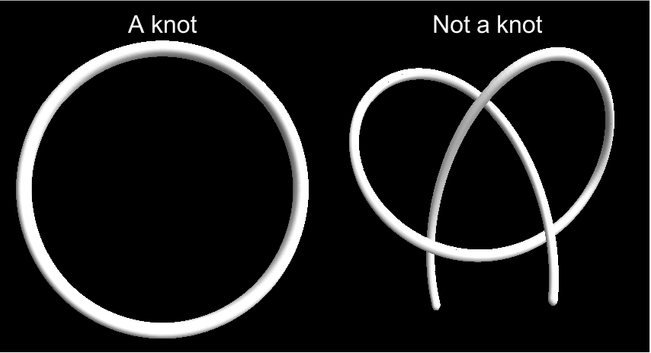
An example of this I always found funny is in knot theory, where a simple loop is considered to be a knot, while anything where the two extremes are dangling are not, including the common overhand knot.
This looks weird the first time you see it, but there is a very good reason to go with such a definition: you want to study what you can and can't do by manipulating the knot, and if you have the two extremes dangling, you can always untie any knot, making them all equivalent to a piece of string. In order to be able to say anything interesting about them you need to remove this trivial option, and thus accept the simple loop as a knot.
#knots