Roman Villa Uncovered in Wales Signals Major Historical Find

Largest Roman villa ever found in Wales discovered in Margam Country Park. Find out what this means for history and local tourism.

#RomanWales, #MargamPark, #PortTalbot, #Archaeology, #HistoryFind

https://newsletter.tf/largest-roman-villa-in-wales-found-margam/

The largest Roman villa in Wales, measuring 141 feet long, has been found. This is much bigger than other Roman sites found before.

#RomanWales, #MargamPark, #PortTalbot, #Archaeology, #HistoryFind
https://newsletter.tf/largest-roman-villa-in-wales-found-margam/

Largest Roman Villa in Wales Found Under Margam Park

Largest Roman villa ever found in Wales discovered in Margam Country Park. Find out what this means for history and local tourism.

NewsletterTF

PORT TALBOT STEEL GETS NEW ROLE IN GREEN ENERGY FUTURE: Welsh consortium launches research into wind turbine towers made with local steel

Researchers backed by Welsh Government funding have launched a project that could see the steel being made in Port Talbot’s new electric arc furnace used to build the next generation of wind turbine towers — creating a direct link between the town’s industrial future and Wales’s clean energy ambitions.

The consortium, led by the Offshore Renewable Energy Catapult, includes Tata Steel UK, energy companies RWE and Bute Energy, and engineering firms Hutchinson Engineering and Ledwood. It has been awarded £174,000 through the Welsh Government’s SMART Flexible Innovation Support scheme to research a new approach to turbine tower design using thin strip, coil-based steel produced in low-emission electric arc furnaces.

The significance for Port Talbot is immediate. Tata Steel is currently in the middle of a £1.25 billion transition from blast furnace steelmaking to electric arc furnace production — a transformation that has already cost thousands of jobs at the steelworks but which the company says will deliver a cleaner, more competitive future. As Swansea Bay News has reported extensively, construction of the new furnace is now under way, with commissioning expected by the end of 2027 or early 2028.

The type of steel at the heart of this new research project — thin strip, coil-based product made in an electric arc furnace — is precisely the kind of output that Port Talbot’s new operation will be able to produce. That steel is also the feedstock that flows downstream to operations including the Trostre tinplate works in Llanelli, which produces coated steel for food and drink packaging and which is directly dependent on the Port Talbot supply chain.

The turbine tower research aims to solve a specific problem in the UK’s renewable energy sector. Most wind turbine towers currently built in Britain rely on thick steel plate imported from overseas — creating a bottleneck in the supply chain and adding cost and carbon to projects. The consortium wants to develop a design that replaces imported thick plate with domestically produced thin strip coil steel, using engineering techniques borrowed from the marine and aerospace industries to create structures that are lighter, stronger and cheaper.

Crucially, the proposed design would also be dismantlable and recyclable — meaning that when turbines reach the end of their working life, the steel could be melted down and reused. Bute Energy’s Catryn Newton described it as a circular economy vision for Welsh steel: end-of-life turbines helping to power homes and industry for decades could eventually be recycled through the electric arc furnace and transformed into the towers of the next generation.

“If we get this right, we could see end of life turbines that have been helping to power homes and industry across Wales for the past 30 years, recycled and sent to the newer electric arc furnaces,” she said. “The work of this group is exploring whether that scrap metal can be transformed into a material that could be used in the next generation turbine towers, helping to power Wales’ clean power future.”

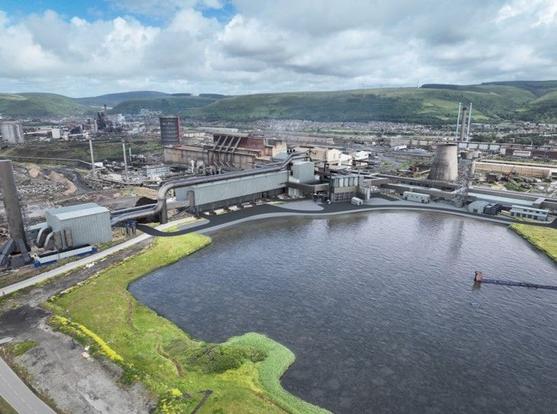
Computer-generated perspective of how Tata Steel at Port Talbot will look once the new EAF (electric arc furnace) is fully completed.
(Image: Tata Steel)

Tata Steel’s Sumitesh Das said the company was excited to be involved in research that could position Wales as a global hub for this kind of innovation. “As Tata Steel UK transitions to electric arc furnace steelmaking, our ambition is to ensure domestic supply chains capitalise on the growth of clean energy and help drive economic growth in the UK,” he said.

The project comes as Port Talbot’s industrial community continues to navigate the painful consequences of the blast furnace closures, which took around 2,800 jobs with them. The hope — articulated by politicians, unions and the company itself — has been that the new electric arc furnace would not only preserve steelmaking in the town but open doors to new markets and new applications for Welsh steel. This wind tower project is one of the first concrete examples of what that future might look like in practice.

Aberafan Maesteg MP Stephen Kinnock welcomed the research, saying it was essential that British and Welsh steel played a central role in the clean energy transition. “This research demonstrates how Wales and the UK can remain at the forefront of the transition to renewable energy,” he said. “By decreasing reliance on imported steel we can bolster energy security, create economic growth, secure regional jobs, and support offshore wind deployment in the Celtic Sea and beyond.”

Rebecca Evans MS, Cabinet Secretary for Economy, Energy and Planning, said the investment reflected the Welsh Government’s commitment to building a greener economy. She pointed to the potential for creating high-value jobs and strengthening supply chains as Welsh industry pivots towards clean energy.

The Celtic Sea, off the coast of Pembrokeshire and west Wales, is one of the most promising sites for floating offshore wind development in the UK. Port Talbot — with its established steel expertise, its port infrastructure and its proximity to that potential wind farm zone — has long been identified as a natural base for offshore wind supply chain activity. As Swansea Bay News has reported, a £64 million wind energy hub plan for Port Talbot has already been put forward with the promise of up to 5,000 jobs.

The first phase of the new research project will focus specifically on onshore turbine tower design and the commercial case for using locally produced coil steel. If the concept proves viable, the researchers say it could be extended to offshore and floating wind applications in later phases — potentially unlocking a significant new market for the steel being made in Port Talbot and processed downstream at Trostre.

Related stories from Swansea Bay News

Work begins on Port Talbot electric arc furnace as steelworks transition moves forward
The groundbreaking that marked the start of building the very furnace this wind tower research is designed to feed.

Inside the giant Port Talbot steelworks overhaul as Tata clears the way for new electric arc furnace
An inside look at the transformation under way at the steelworks — and what it means for the future of steel in South Wales.

Tata Steel begins new project at Port Talbot in £1.25bn green plan
The pickle line that supplies Trostre in Llanelli — a reminder of how closely linked Port Talbot and the downstream operations are.

PORT TALBOT POWER PLAY: £64m wind hub plan promises 5,000 jobs in major shake-up
The wider vision for Port Talbot as a centre for clean energy — and how today’s research fits into that bigger picture.

#electricArcFurnace #OffshoreRenewableEnergyCatapult #PortTalbot #PortTalbotSteelworks #steel #TataSteel #TataSteelworks #WelshSteel #windTurbine

PORT TALBOT JACKPOT: Steelworkers’ syndicate scoop £1M – and reunion to remember

A 15-strong syndicate of ex-colleagues from Port Talbot is celebrating after scooping a life-changing £1,000,000 in the EuroMillions draw.

The group – dubbed the “Tata Steel Syndicate” – first started playing together while working long shifts in the finance team at the town’s iconic steelworks.

What began as a bit of fun to lift spirits during 14-hour days turned into a seven-year tradition… and now a huge payday.

At the heart of it all is syndicate leader Paul Davy, 61, who kept the group going long after colleagues moved on – sending weekly emails and organising their £5 entries.

He said: “I couldn’t believe it – a message just popped up on the app.

“I thought it must be an error, but then I saw the winning code. I was in complete shock.”

Members of the Port Talbot syndicate celebrate their £1 million EuroMillions win on the seafront after scooping the jackpot.
(Image: Matthew Horwood/PA Media Assignments)

The win came via the Millionaire Maker code in the Friday February 27 draw – instantly making every member of the syndicate a winner.

But for Paul, the money is only part of the story.

“This win has given us the perfect excuse to celebrate together properly,” he said. “We haven’t all been in the same room for years.”

Despite going their separate ways professionally, the group remained close – staying in touch through emails, occasional meet-ups and the odd pint.

Now, they’re planning a full reunion to mark the moment their loyalty finally paid off.

Among those celebrating the windfall are Gill Furlong, Christine Davies, Sally Wise, Julie Lambert, Allan Evans, Ian Howells and Raja Prasad – all still living locally.

The group say the winnings will go towards a mix of practical plans and long-held dreams.

Top of the list? Paying off mortgages, dream kitchen renovations, new cars and long-awaited holidays.

For Paul, a return to cruising is firmly on the cards.

“Me and my partner went on a cruise a couple of years ago and loved it,” he said. “So another one – maybe the Mediterranean – is definitely on the list.”

The 15-strong syndicate pose together after their life-changing EuroMillions win.
(Image: Matthew Horwood/PA Media Assignments)

The syndicate had always treated their weekly ticket as “a bit like donating to charity with a chance of winning” – a mindset that made the shock even greater when their numbers finally came in.

And while the £1 million prize will be split between the 15 members, the real reward might just be the friendships it has rekindled.

After years of near-misses, hopeful emails and small stakes, their persistence has paid off in spectacular fashion – turning a simple workplace tradition into a story they’ll never forget.

Related stories from Swansea Bay News

UK ticket holder scoops massive £181M EuroMillions jackpot
One of the biggest wins in UK history as a lucky player lands a life-changing fortune.

Welsh couple scoop second £1M lottery win in Christmas miracle
Incredible double jackpot leaves couple celebrating twice.

Lottery winners help spread Christmas magic across Swansea Bay
Big winners give back to the community with festive generosity.

Neighbours celebrate £1M postcode lottery windfall
Joy as a local community shares in a huge prize.

Mount Pleasant mum bags £90k lottery win hours after surgery
A remarkable stroke of luck follows a tough day for Swansea mum.

Where are Wales’ luckiest places to live?
New figures reveal the hotspots for lottery wins across the country.

Welsh apprentices celebrate £1M lottery win
Young workers strike it lucky with a life-changing prize.

#Euromillions #EuromillionsWinner #featured #LotterWinners #Lottery #MillionaireMaker #PortTalbot #PortTalbotSteelworks #TataSteelSyndicate #TataSteelworks

PORT TALBOT POWER PLAY: £64m wind hub plan promises 5,000 jobs in major shake-up

A £64 million plan to turn Port Talbot into a floating offshore wind hub has been unveiled — with ministers promising thousands of jobs and a major boost for South Wales.

The UK Government says the funding will help develop the port into a base for a new generation of wind farms in the Celtic Sea, capable of powering millions of homes.

But while the announcement is being hailed as a breakthrough, the reality is that Port Talbot has been edging towards this role for some time.

Previous studies have already explored how floating wind turbines could be launched from the town’s docks, while earlier reports have highlighted how ports across South Wales — including Swansea and Milford Haven — are competing for a slice of the emerging industry.

This latest funding is aimed at pushing Port Talbot to the front of that race.

The money will go to Associated British Ports (ABP) to carry out detailed design and engineering work needed to handle floating turbines — huge structures assembled onshore before being towed out to sea.

Artist’s impression of ABP’s vision for Port Talbot Harbour and the construction of massive floating wind turbines.
(Image: ABP)

Energy Secretary Ed Miliband said the project puts Wales “at the heart” of the UK’s clean energy push.

He added:

“With its deep waters and strong winds, we are supporting Wales to storm ahead in floating offshore wind — a pioneering industry that will support thousands of good jobs and unlock the next generation of clean, homegrown power.”

The Celtic Sea is seen as one of the best locations in Europe for floating wind, with the potential to generate at least 4.5GW of electricity — enough to power around 6.5 million homes.

For Port Talbot, the headline figure will be jobs, with up to 5,000 roles linked to the development if projects progress as expected.

But that depends on future investment decisions, and for now the funding is focused on planning rather than construction.

Henrik Pedersen, chief executive of ABP, said the agreement marked “real progress” towards making the port a key part of the industry.

He said:

“This development would drive industrial regeneration, support thousands of skilled jobs and ensure Wales captures the full economic benefit of this emerging sector.”

Ministers have also linked the investment to wider global tensions and rising energy costs.

The UK Government said recent conflict in the Middle East had exposed how vulnerable households and businesses remain to volatile fossil fuel markets beyond the UK’s control.

They argue that projects like floating offshore wind in the Celtic Sea are key to “taking back control” of energy supply — while helping to bring down bills in the long term.

Funding for Port Talbot, they say, is part of a wider shift towards clean, homegrown power — while also bringing jobs and new industries to South Wales.

he Welsh Liberal Democrats have warned that Labour are missing a golden opportunity to create a local industrial supply chain. 

Welsh Liberal Democrat, David Chadwick MP sounded a note of caution however.

He said:

“Any job creation is a positive step for Port Talbot, but Labour need to be honest about what this actually contains.

“These turbines are set to be built using imported steel and only assembled locally, not manufactured. This means much of the real economic value will still go elsewhere.

“We should be using projects like this to back Welsh industry, strengthen our local supply chains, and create long-term skilled jobs here in Wales, not just host the final stage.”  

The announcement comes as Port Talbot continues to reshape its identity following major changes at the steelworks.

The UK Government has already backed a new electric arc furnace and committed funding to support workers and businesses through the transition.

Welsh Secretary Jo Stevens said the latest investment “heralds the next chapter” for the town.

She added:

“This is a significant moment for Port Talbot and a major step forward for the growing clean energy industry in Wales.”

There are also wider ambitions to turn the area into a clean energy hub, with the Celtic Freeport and offshore wind developments forming part of a bigger picture.

However, questions remain about how quickly those ambitions will translate into real-world change.

Despite the scale of the announcement, there is no confirmed timeline for construction, and final approvals are still needed before work can begin.

And while Port Talbot has been tipped before as a key player in offshore wind — including being linked to major Celtic Sea projects and infrastructure studies — large-scale developments have yet to materialise.

The project is also part of a wider and increasingly competitive race, with other ports in South Wales pushing hard to secure contracts linked to the booming offshore wind sector.

For now, ministers argue the investment is about more than just jobs — pointing to the need for greater energy security following global instability.

But for many locally, the key question will be simpler: when — and if — the promised benefits actually arrive.

After years of big regeneration pledges, there will be cautious optimism — but also a sense that the real test is still to come.

Related stories from Swansea Bay News

Port Talbot tipped for key role as third Celtic Sea wind farm confirmed
Earlier plans showed how the town could play a central role in major offshore wind projects off the Welsh coast.

Welsh Government highlights Port Talbot in offshore wind push
A national strategy identified Port Talbot as a key location for supporting the next generation of wind energy.

Ports battle for huge offshore wind contracts
Competition between South Wales ports has been heating up as firms eye lucrative construction deals.

Study launched into floating wind turbine deployment
Research into how turbines could be launched from Port Talbot highlights the scale of infrastructure needed.

#ABP #AssociatedBritishPorts #CelticSea #floatingWindFarm #industry #offshoreWind #PortTalbot #PortTalbotDocks #PortTalbotHarbour #windFarmConstruction

PORT TALBOT: Steel plan sparks cautious hope — but big questions remain for Welsh jobs

At the heart of the strategy is a push to rebuild domestic steelmaking, including new tariffs on imports, a target for half of UK steel demand to be met at home, and billions in funding to support the industry’s transition.

For communities built around steel, the announcement lands at a critical moment.

In Port Talbot, the shift away from traditional blast furnaces is already under way, while in Llanelli, the Trostre works continues to play a key role in Welsh production. Together, they form part of an industry now facing one of the biggest changes in its history.

Local Labour MP Dame Nia Griffith has backed the plan, arguing it signals a more serious commitment to the sector after years of uncertainty.

Dame Nia Griffith, MP for Llanelli, said:
“The steel industry is a vital core element of our economy here in Wales, generating growth and providing thousands of jobs, including hundreds in my own constituency.

“This is a clear, well thought-out, long-term strategy for our steel industry that will help deliver the high-quality steel our country needs for our key infrastructure, our national security and for the wider economy.”

Her support reflects the Government’s central message — that the strategy will not only protect jobs, but put the industry on a more stable footing for the future.

But that optimism is far from universal.

Opposition figures say the plan raises as many questions as it answers, particularly around how much of the promised investment will reach Wales and what role UK steel will play in major future projects.

Trostre Steel Works in Llanelli (Image: Tata Steel)

David Chadwick MP, Liberal Democrat spokesperson for Wales, said:
“It is welcome that the Government has finally acted, but this looks like a panicked move after months of delay.

“Since the blast furnaces were switched off, Welsh steel has been left on life support.”

There are also concerns about the UK’s trading position, with warnings that being outside key European arrangements could leave exporters at a disadvantage in one of their biggest markets.

Industry voices have struck a similarly measured tone — welcoming steps to tackle cheap imports while warning that deeper issues remain unresolved.

Unite, which represents many steelworkers across Wales, says the new tariff regime is a positive step, but argues the industry needs a clearer long-term direction.

Sharon Graham, General Secretary of Unite, said:
“Unite welcomes the strengthening of the UK’s tariff regime to prevent the dumping of cheap foreign steel onto the domestic market.

“But this last minute situation is just another reminder that the reactive approach to UK steel that sees it lurch from crisis to crisis needs to be overhauled.”

One of the biggest sticking points is the industry’s shift towards electric arc furnaces — a cleaner form of steelmaking that relies heavily on recycled materials.

While central to the Government’s net zero ambitions, unions have warned that relying too heavily on this approach could limit the UK’s ability to produce certain types of steel.

The hot mill at Tata Steel’s Port Talbot steelworks. (Image: Tata Steel)

Peter Hughes, Unite regional secretary, said:
“The government must also back the production of virgin green steel as we can’t simply rely on electric arc furnaces to produce all the steel we need.”

Alongside the strategy, ministers have also unveiled a new funding stream aimed at helping areas like Port Talbot adapt to the changes.

The Economic Growth & Investment Fund will offer grants of up to £1.5 million to businesses across Neath Port Talbot, Swansea and Bridgend, targeting sectors such as advanced manufacturing, green energy and digital industries.

Local leaders say it could help soften the economic impact of the transition — if it delivers.

Neath Port Talbot Council leader Cllr Steve Hunt looks out across Port Talbot Steelworks from a hillside vantage point, reflecting on the town’s industrial past and future.
(Image: Neath Port Talbot Council)

Cllr Steve Hunt, Leader of Neath Port Talbot Council, said:
“This fund provides an important opportunity to support businesses that are ready to invest, grow and create new jobs across the region.”

For now, the strategy marks a significant moment for Welsh steel — but not a settled one.

With major changes already under way and more still to come, the focus is quickly shifting from what has been promised to what will actually be delivered.

And for communities across South West Wales, that will ultimately be the measure that matters most.

Related stories from Swansea Bay News

One year on: resilience after blast furnace closure
Council leaders reflect on a turbulent year for the steel town.

Work begins on Port Talbot electric arc furnace
A major step in the steelworks’ transition to new technology.

Farage promises “reindustrialisation of Wales”
A headline‑grabbing pledge to revive coal and steel sparks debate.

Government criticised over treatment of steelworkers
Unions and politicians condemn support offered during the transition.

Dramatic video shows final push at Morfa coke plant
Striking footage captures the last days before shutdown.

#DavidChadwick #electricArcFurnace #industrialStrategy #JoStevens #Llanelli #NeathPortTalbotCouncil #NiaGriffith #PeterHughes #PortTalbot #SharonGraham #SouthWestWalesEconomy #steelJobsWales #TataSteel #Trostre #UKGovernment #UKSteelStrategy #UniteUnion #WelshEconomy #WelshSteel

PORT TALBOT: Government vows to “do whatever it takes” to protect steel jobs — but critics warn over end of traditional steelmaking

A major new Steel Strategy has been unveiled during a visit to Port Talbot, with ministers promising tougher trade rules, billions in investment and a push to increase the amount of steel made in Britain.

At the centre of the plan is a target for 50% of all steel used in the UK to be made domestically — up from around 30% — with the Government saying Welsh producers are expected to play a major role.

That includes Tata Steel operations in Port Talbot, Llanelli, Shotton and Newport, as well as 7Steel in Cardiff.

The UK Government says it will also crack down on cheap imports.

From July, steel import quotas would be cut by 60%, with anything above those limits facing a 50% tariff.

Ministers argue the move will stop British steel being undercut — a long-standing complaint from workers and industry leaders in South Wales.

But the strategy has already sparked debate about what kind of steel industry the UK is actually protecting.

Massive ladles and overhead cranes inside Port Talbot steelworks, as Tata prepares the site for Electric Arc Furnace installation. (Credit: Tata Steel)

While ministers are backing domestic production, the plans also confirm a continued shift away from traditional blast furnaces towards electric arc furnaces, like the one being built in Port Talbot.

These use recycled scrap metal rather than raw materials — a move the Government says is key to cutting emissions and modernising the industry.

However, critics warn that transition could come at a cost.

They argue electric arc furnaces cannot always produce the same specialist grades of steel needed for defence and major infrastructure, raising concerns about long-term capability.

There are also fears the UK could become more reliant on imported materials — even as ministers move to restrict finished steel imports.

Peter Kyle, Business and Trade Secretary, said steelmaking was “vital” to the UK’s future.

He said: “Making steel in the UK is vital for national security, critical infrastructure and the wider economy.

“With this strategy we are closing the decades-long chapter of destructive de-industrialisation and committing instead to strengthening and sustaining Britain as a steel-making nation.”

The Government says the strategy is backed by major investment, including £5.8 billion through the National Wealth Fund for priority industries such as steel.

That builds on more than £600 million already committed to Port Talbot, alongside plans to unlock up to £2.5 billion in further funding during this Parliament.

Jo Stevens, Secretary of State for Wales, said the plans showed ministers were standing firmly behind Welsh industry.

She said: “The UK Government is standing up for Welsh steelmaking and showing that we will do whatever it takes to boost domestic steel production and protect the thousands of steelmaking jobs in our communities.

“Welsh steel is expected to account for half of future UK steelmaking… Welsh steelmaking now has a secure and bright future.”

The strategy also includes measures to lower energy costs, prioritise UK-made steel in public projects and strengthen links with sectors like offshore wind, defence and infrastructure.

A new working group will also look at securing long-term supplies of scrap metal — a key part of the shift towards electric arc production.

The move comes after years of uncertainty for the industry, with global competition, rising costs and the transition to greener production putting pressure on steelmaking communities across South Wales.

Ministers insist imports will still play a role, but say the new rules are designed to strike a balance between protecting domestic producers and maintaining supply.

However, with the industry undergoing one of its biggest transformations in decades, questions remain over whether the strategy will truly secure the long-term future of steelmaking in Wales — or simply reshape it.

Related stories from Swansea Bay News

One year on: resilience after blast furnace closure
Council leaders reflect on a turbulent year for the steel town.

Work begins on Port Talbot electric arc furnace
A major step in the steelworks’ transition to new technology.

Farage promises “reindustrialisation of Wales”
A headline‑grabbing pledge to revive coal and steel sparks debate.

Government criticised over treatment of steelworkers
Unions and politicians condemn support offered during the transition.

Dramatic video shows final push at Morfa coke plant
Striking footage captures the last days before shutdown.

#BritishIndustry #Economy #electricArcFurnace #featured #industry #JoStevens #jobs #Llanelli #manufacturing #netZero #PeterKyle #PortTalbot #PortTalbotSteelworks #southWales #steel #steelIndustry #steelStrategy #steelworks #TataSteel #TataSteelworks #Trostre #TrostreSteelworks #UKGovernment #WelshSteel

PORT TALBOT: Football legends and social media stars tackle tradie mental health crisis

Former Swansea City star Lee Trundle will join social media sensations The Welsh Erection Boys and Benchin Bricky on the pitch this Sunday, March 22nd.

The event, organised by South Wales-based charity Tradie Events, aims to raise crucial awareness about the mental health epidemic gripping the industry.

New research from Trade Direct Insurance reveals a shocking statistic: nearly seven in ten (69%) tradespeople admit to experiencing mental health issues.

Over a third (34%) of those affected say their problems are at least partially caused by their demanding work.

Patricia Gardiner, sales and marketing director at Trade Direct Insurance, highlighted the immense pressure on tradies.

“Tradespeople often carry enormous responsibility managing customers, materials, cash flow and tight deadlines whilst also dealing with the physical demands of the work,” Ms Gardiner said.

She added: “When you layer financial uncertainty and tool theft risks on top, the pressure can become too much to bear.”

Trade Direct Insurance is now launching a new mental health and wellbeing service, offering free counselling and financial guidance to policyholders.

This vital support includes five confidential counselling sessions per year and 24/7 emotional support for issues like stress, anxiety, and depression.

Clair Evans, Executive Director at Tradie Events, emphasised the community spirit behind the match.

“This match is about more than just the game, it’s about celebrating the trades, bringing the community together, and shining a light on mental health in an industry where stress and pressure are often normalised,” Ms Evans stated.

The charity has already raised over £10,000, demonstrating the strong support for this critical cause.

Ms Evans hopes the event will inspire “even more conversation and support around wellbeing in the trades.”

The match is a powerful local initiative to address a national crisis, bringing together well-known figures to make a real difference in the community.

Related stories from Swansea Bay News

Welsh football clubs backed to reach mental health goals
A new programme helps clubs across Wales support players and fans struggling with their mental health.

Swansea man speaks out after years of mental health service failings
A local man shares his experience of being let down by the system — and why change is urgently needed.

Bake Off champion joins Scarlets to back new mental health scheme
A familiar face teams up with the Scarlets to push a new initiative aimed at supporting young people.

One in three GP mental health appointments in Wales ‘failed to meet needs’
A new survey from Mind Cymru reveals widespread concerns about access to mental health support.

#BenchinBricky #Charity #football #LeeTrundle #mentalHealth #PortTalbot #TheWelshErectionBoys #trades #tradesman #Tradespeople

Welsh star Michael Sheen to host BBC quiz show in surprise career move

Welsh actor Michael Sheen is swapping Hollywood scripts for quiz questions after landing a surprise new role hosting a popular BBC show.

The Port Talbot-born star has been announced as the new presenter of Richard Osman’s House of Games, taking over after creator and long-time host Richard Osman confirmed he was stepping down.

The hit programme, which airs on BBC channels BBC Two and BBC iPlayer, has become a staple of early evening television since launching in 2017.

Sheen will now take over hosting duties when new episodes are filmed and broadcast later this year.

The award-winning actor admitted he has “very large shoes to fill” but said he was thrilled to be joining the show.

“I’m a huge fan of the programme and incredibly excited to be able to move into the House,” he said.

Writing on Instagram, Richard promised to clean the place before the Michael arrived.

He said: “Beyond thrilled to be handing the House Of Games keys over to the one and only Michael Sheen. I promise to put the hoover round before he arrives.

“Best of luck Michael, you’re such a great choice, and I know you, and the viewers, will have an amazing time.”

The move marks Sheen’s first ever quiz show hosting role, in what many fans see as an unexpected turn in the star’s career.

Sheen has built an international reputation through acclaimed roles in film, television and theatre, including portraying former Prime Minister Tony Blair in multiple productions and appearing in films such as Tron: Legacy and Midnight in Paris.

But despite his Hollywood credentials, the actor has remained closely tied to Wales.

In recent years he has funded major cultural projects, including launching a new Welsh theatre company aimed at developing talent across the country.

Now he is set to become the new face of one of the BBC’s most popular quiz formats.

Each week on House of Games, four celebrities compete across five episodes in a series of quirky trivia and puzzle rounds, battling it out for daily prizes and the chance to be crowned the weekly champion.

Osman, who has hosted the show since it began nearly a decade ago, said it had been a “great pleasure” presenting the programme but that it was time for someone else to take over.

For fans of the show, that someone will now be a familiar Welsh face.

And for Sheen, it means stepping into the living rooms of millions of viewers every evening — not as a character, but as the man asking the questions.

Related stories from Swansea Bay News

Michael Sheen steps into Ospreys spotlight
The actor calls on the WRU to rethink the region’s future.

Sheen fronts explosive new BBC series
A hard‑hitting investigation into chemical contamination in South Wales.

Sheen’s Welsh National Theatre opens with powerful debut
A striking first production lands at Swansea Grand Theatre.

Welsh National Theatre sets up home in Swansea
Sheen’s new cultural venture establishes its base in the city.

New Port Talbot mural pays tribute to Meyrick Sheen
A vibrant artwork honours the actor’s father and local legacy.

#BBC #BBCEntertainment #BBCIPlayer #BBCTwo #HouseOfGames #MichaelSheen #PortTalbot #QuizShow #quizShows #RichardOsman #UKTelevision #WelshActors

AMMANFORD: Town named among Wales’ top spots for Mother’s Day celebrations

A study of Google search habits has revealed that residents in the two towns are among the most likely to be hunting for the perfect gift or celebration.

Ammanford ranked second in the whole of Wales, with a staggering 704 searches for every 1,000 people.

Carmarthen followed closely in third place, recording nearly 700 searches per 1,000 residents.

The research, conducted by Geraldo’s, analysed over 42 million searches across the UK to see which areas celebrate the day the most.

It estimated that around 60% of the UK public took part in Mother’s Day last year, spending a combined £1.4 billion on gifts and treats.

In Llanelli, more than half of the population — 510 per 1,000 people — were found to be searching for ways to mark the occasion.

Port Talbot also showed strong results, with 488 searches per 1,000 residents.

Toni Dawson, owner of Geraldo’s, said: “Family runs through the core of our business.”

She added: “We know how important days like Mother’s Day are to millions of others up and down the country.”

The data suggests that despite the rising cost of living, recognizing the “care, advice, guidance and love” of mothers remains a top priority for locals.

Ms Dawson noted that for those missing their mothers, the day can be difficult, but remains an important time for “recognising the memories you have.”

The study found that Wales as a whole saw nearly 1.6 million Mother’s Day searches, averaging around one search for every two people.

The findings highlight the deep-rooted family values held across Carmarthenshire and Neath Port Talbot.

The data was compiled by comparing search volumes against local population figures to find the true “Mother’s Day capitals” of the country.

LocationCombined SearchesPopulationSearches per 1,000 PeopleBangor15,66018,000870.00Ammanford8,45012,000704.17Carmarthen13,95020,000697.50Llanelli25,50050,000510.00Port Talbot18,08037,000488.65

With the big day arriving this Sunday, March 15, local businesses are bracing for a busy weekend as residents finalise their plans.

#Ammanford #Carmarthen #Carmarthenshire #Llanelli #MothersDay #PortTalbot