Interessante Studie zur #Lernforschung / #Lerntheorie
"Der Transfer von neurowissenschaftlichen Befunden in die schulische Praxis wurde begleitet von der Entstehung von Fehlkonzepten über das menschliche Gehirn, sogenannte #Neuromythen."
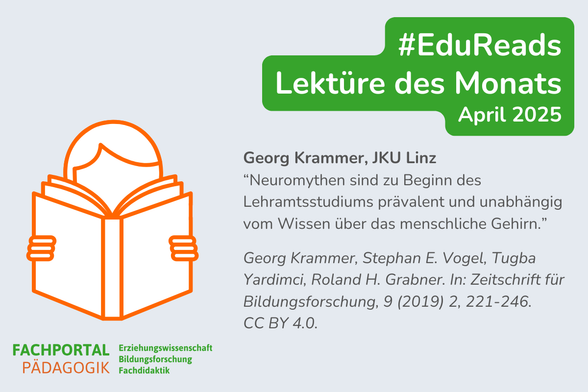
Neuromythen sind zu Beginn des Lehramtsstudiums prävalent und unabhängig vom Wissen über das menschliche Gehirn. Z f Bildungsforsch 9, 221–246 (2019). https://doi.org/10.1007/s35834-019-00238-2
#Lerntypen #Didaktik #neuroscience #Neurowissenschaft #Schule #Lehre #lernen

Neuromythen sind zu Beginn des Lehramtsstudiums prävalent und unabhängig vom Wissen über das menschliche Gehirn - Zeitschrift für Bildungsforschung
Transferring neuroscientific insights into education has created misconceptions of the human brain, i. e. neuromyths. Studies suggest that neuromyths are widely spread among teachers world-wide. However, it is unclear whether neuromyths already exist at the beginning of teacher education and whether they have a similar prevalence in Austria compared to other countries. The aim of the present study is to address these questions. In addition, this study aims to scrutinize the relationship between knowledge about the human brain and believing in neuromyths. 582 Austrian teacher education students responded to 40 statements of the human brain. Of these 40 statements, 20 were neuromyths and 20 were correct statements about the brain, i. e. neurofacts. Results showed that some neuromyths have a high prevalence already at the beginning of teacher education. Similar to previous findings in other countries, the most widely believed neuromyths were related to learning styles and to a disjoint functioning of the brain hemispheres. Furthermore, neuromyths did not form a unidimensional factor, as assumed—but not tested—by prior studies. Finally, results suggest that the knowledge about the human brain was not related to believing in neuromyths. To summarize, neuromyths are already prevalent at the beginning of teacher education. Teacher education should therefore take care to dispel these neuromyths by addressing neuromyths directly instead of only fostering general knowledge about the human brain. This holds particularly true for those neuromyths that could be potentially harmful when implemented in educational practices.
#edureads
Georg Krammer: „Schüler:innen lernen *nicht* besser, wenn ihr #Lerntyp berücksichtigt wird. Kurzzeitige Koordinationsübungen verbessern *keine* Integration der Gehirnhälften.
Glaubt man das Gegenteil, glaubt man an #Neuromythen.
Diese sind weltweit stark verbreitet unter Lehrer:innen. Die Ausbildung sollte daher gezielt Neuromythen auflösen, besonders jene, deren Umsetzung zu schädlichen #Schulpraktiken führen kann."
https://doi.org/10.1007/s35834-019-00238-2
#eduresearch #bildungsforschung #fediLZ
Neuromythen sind zu Beginn des Lehramtsstudiums prävalent und unabhängig vom Wissen über das menschliche Gehirn - Zeitschrift für Bildungsforschung
Transferring neuroscientific insights into education has created misconceptions of the human brain, i. e. neuromyths. Studies suggest that neuromyths are widely spread among teachers world-wide. However, it is unclear whether neuromyths already exist at the beginning of teacher education and whether they have a similar prevalence in Austria compared to other countries. The aim of the present study is to address these questions. In addition, this study aims to scrutinize the relationship between knowledge about the human brain and believing in neuromyths. 582 Austrian teacher education students responded to 40 statements of the human brain. Of these 40 statements, 20 were neuromyths and 20 were correct statements about the brain, i. e. neurofacts. Results showed that some neuromyths have a high prevalence already at the beginning of teacher education. Similar to previous findings in other countries, the most widely believed neuromyths were related to learning styles and to a disjoint functioning of the brain hemispheres. Furthermore, neuromyths did not form a unidimensional factor, as assumed—but not tested—by prior studies. Finally, results suggest that the knowledge about the human brain was not related to believing in neuromyths. To summarize, neuromyths are already prevalent at the beginning of teacher education. Teacher education should therefore take care to dispel these neuromyths by addressing neuromyths directly instead of only fostering general knowledge about the human brain. This holds particularly true for those neuromyths that could be potentially harmful when implemented in educational practices.
#Schule #Lernen #Neuromythen - Wie falsche Vorstellungen über das Gehirn den Unterricht noch immer prägen - "'Falsche Vorstellungen von den Funktionen des Gehirns können einen Einfluss auf die didaktischen Methoden haben und widersprechen der Forderung nach einem evidenzbasierten Unterricht', sagt Roland Grabner. 'Deshalb ist es wichtig, die Neuromythen zu hinterfragen, denn sonst werden sie von Generation zu Generation weitergegeben.'" - Interessanter Beitrag von Matthias Meili - Eventl. €
https://www.nzz.ch/wissenschaft/diese-neuromythen-ueber-das-lernen-sind-selbst-in-der-schule-weit-verbreitet-ld.1838727 
Lerntypen & Gehirnfunktion: Neuromythen unter Lehrpersonen
Lange dachte man, das Lernen in der Schule liesse sich gemäss der Funktionsweise des Gehirns gestalten. Mittlerweile ist der Neurohype in der Pädagogik vorbei. Geblieben sind erstaunlich viele Mythen.
Ein kurzweiliger und fundierter Essayband, der mit hartnäckigen Neuromythen aufräumt und nachhaltig zum Denken anregt. Eine Rezension (Rezension zu Siebeneinhalb Lektionen über das Gehirn von Lisa Feldman Barrett)
#Neuromythen #Evolution #Netzwerkstruktur #Menschsein #PsychologieHirnforschung»Siebeneinhalb Lektionen über das Gehirn«: Warum haben wir eigentlich ein Gehirn?
»Siebeneinhalb Lektionen über das Gehirn«: Warum haben wir eigentlich ein Gehirn?
Ein kurzweiliger und fundierter Essayband, der mit hartnäckigen Neuromythen aufräumt und nachhaltig zum Denken anregt. Eine Rezension (Rezension zu Siebeneinhalb Lektionen über das Gehirn von Lisa Feldman Barrett)
 Digidaktik
 Fachportal Pädagogik
 Michael Ditsch
 Spektrum (inoffiziell)