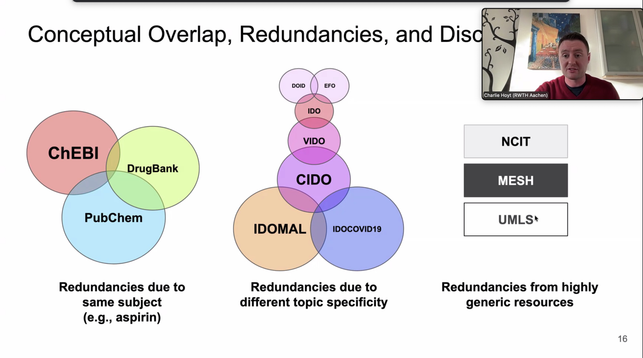
We are happy to welcome @cthoyt from RWTH in today's #nfdicore playground talking about "Bridging the Gap from Biomedical to Domain-Agnostic Semantics".

Besides others, he is demonstrating that our #nfdicore ontology is registered at Semantic Farm (= an open source, domain-agnostic, community curated semantic space registry, meta-registry, and compact identifier resolver.)

https://semantic.farm/nfdicore

#ontologies #knowledgegraphs #nfdirocks @joerg @heikef @enorouzi @sashabruns @MahsaVafaie @fizise

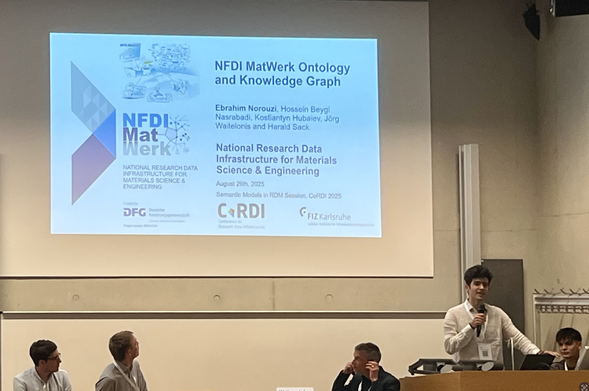
Our colleague @enorouzi is presenting his Lightning Talk about "NFDI MatWerk Ontology and Knowledge Graph", which is collaborative work of Ebrahim Norouzi, Hossein Beygi Nasrabadi, Kostiantyn Hubaiev, @joerg and @lysander07 at #CORDI2025

https://doi.org/10.5281/zenodo.16736115

@fiz_karlsruhe @NFDI @nfdi4culture @NFDI4Memory @NFDI4DS #NFDIMatWerk #NFDIrocks #NFDIcore #ontologies #knowledgegraphs

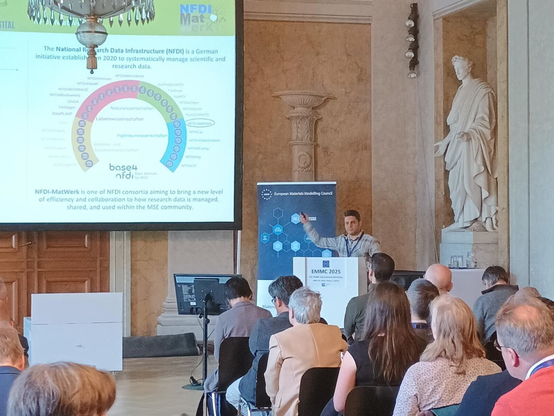
Last week, our team member Hossein Beygi Nasrabadi presented our work on BFO-based ontologies for materials science at the European Materials Modeling Council (EMMC) in Vienna. Joint work together with @joerg Kostya Hubaev @enorouzi @heikef and @lysander07

#ontologies #bfo #bfo2020 #materialsscience #NFDIMatWerk #NFDIrocks @KIT_Karlsruhe @fiz_karlsruhe #semanticweb #knowledgegraphs #pmdcore #mwo #nfdicore

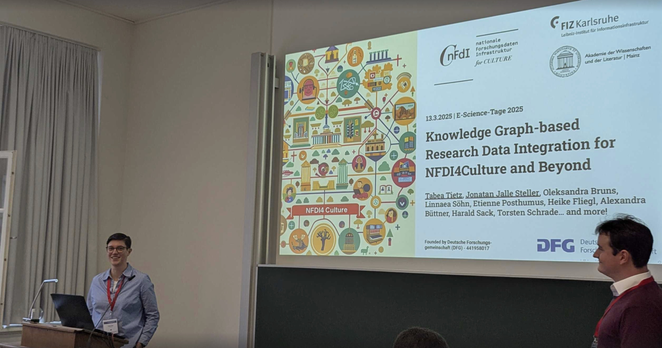
Presenting like a pro. @tabea at her talk on the NFDIcore ontology, the CTO Culture ontology, the Culture knowledge graph and further components of our KG-based research data integration framework together with @jonatan

https://zenodo.org/records/14989011

@fiz_karlsruhe @nfdi4culture @NFDI4DS #NFDIMatWerk #NFDIrocks #escitage2025 #escitage25 #escitage #rdm #knowledgegraphs #ontologies #nfdicore #heidelberg

Knowledge Graph-based Research Data Integration for NFDI4Culture and Beyond

Each NFDI consortium establishes research data infrastructures tailored to its specific domain. To facilitate interoperability across different domains and consortia, the NFDIcore ontology has been developed [1]. It serves as a mid-level ontology to represent metadata about NFDI resources, e.g. agents, projects, data portals, etc. NFDIcore establishes mappings to an array of standards across domains, including the Basic Formal Ontology, schema.org, DCTERMS, and DCAT. For domain-specific research questions, NFDIcore is extended following a modular approach, as e.g., with the NFDI-MatWerk ontology (MWO), the NFDI4DataScience ontology (NFDI4DSO), the NFDI4Memory ontology (MO), and the NFDI4Culture ontology (CTO).  CTO represents resources within the NFDI4Culture domains Architecture, Musicology, Art History, Media Science, and the Performing Arts. The ontology addresses domain-specific research questions, connects diverse cultural entities, and facilitates the efficient organization, retrieval, and analysis of cultural data. The interconnection of NFDI consortia by means of Linked Open Data (LOD) opens up new research horizons. Hence, a workflow, which includes data discovery, harvesting, preprocessing, mapping, and integration into a KG is required, which is described on the use case of the NFDI4Culture KG. The NFDI4Culture KG acts as a single point of access to various decentralized research data resources and aggregates diverse and isolated data from the research domain, enabling discoverability, interoperability and reusability of CH data. The KG consists of the Research Information Graph (RIG), describing metadata such as publishers, standards, and licenses, and the Research Data Graph (RDG), interconnecting the content metadata provided by data portals. Taking into account the challenges and objectives of NFDI4Culture to aggregate a diverse landscape of CH research data, we have designed a Python package of reusable LOD components, harvesters using these components, a SPARQL endpoint explorer (shmarql), and an ETL (Extract, Transform, Load) environment[2]. The latter consists of six modular workflow components, adaptable for independent use or within a comprehensive, automated ingest routine: 1: Run harvest routines. This uses RDF-based action files with schema.org step definitions to scrape data with external tools, link the feed to its RIG metadata, and generate persistent resource identifiers. To ensure harmonization, Python-based transformations convert resources in common cultural-heritage data formats into nfdicore/cto triples when needed. 2: Clean harvested data. To ensure harmonization between the harvested data feed and its associated action file, triples representing the harvesting state are added or deleted. 3: Commit harvest state. Changes made by a harvesting run are pushed to the pipeline’s own repository to ensure up-to-date action files. 4: Prepare and index data. If there are changes in a data feed, data directories are automatically updated or created and search indexes are produced. 5: Build a new endpoint. To prevent downtimes, a new SPARQL endpoint container is built while the previous version remains available. Once the new endpoint becomes operational, the old container is stopped and removed. 6: Publish statistics. Statistics about the integrated data feeds are published in a dashboard. It supports data analysis and visualizations based on provided SPARQL queries.   [1] https://ise-fizkarlsruhe.github.io/nfdicore/ [2] https://gitlab.rlp.net/adwmainz/nfdi4culture/knowledge-graph/culture-kg-kitchen   

Zenodo

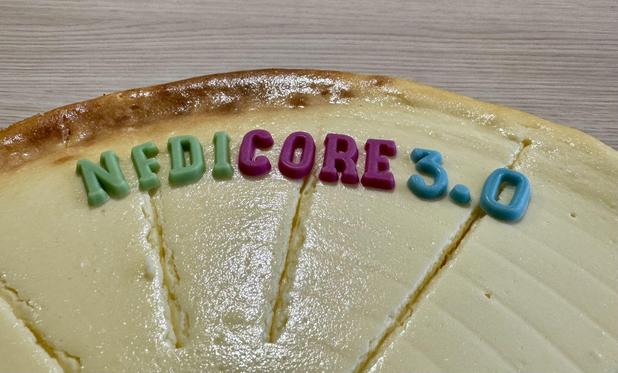
Introducing the new tradition of ontology release cake 🍰
The latest release of the NFDIcore ontology has been published as NFDIcore 3.0:
https://ise-fizkarlsruhe.github.io/nfdicore/docs/

@lysander07 @tabea @heikef @jonatan @sashabruns @joerg @enorouzi @nfdi4culture @NFDI @NFDI4DS #NFDIrocks #ontologies #semanticweb #nfdicore

NFDIcore Ontology

None

Service toot with a clickable DOI for @tabea's slides: https://doi.org/10.5281/zenodo.14185852

#UC4B2024 #NFDIcore ^kb

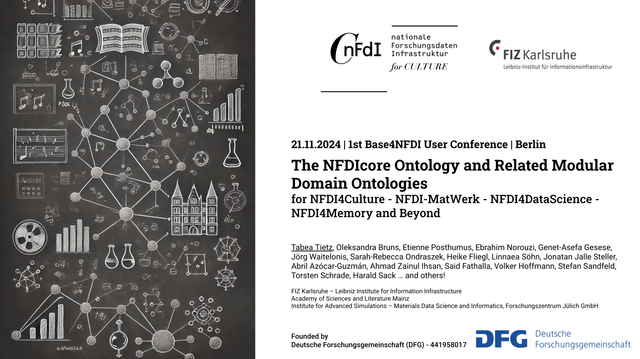
The NFDIcore Ontology and Related Modular Domain Ontologies for NFDI4Culture - NFDI-MatWerk - NFDI4DataScience - NFDI4Memory and Beyond

Presentation for the 1st Base4NFDI User Conference Each NFDI consortium works on establishing research data infrastructures tailored to its specific domain. To facilitate interoperability across different domains and consortia, the NFDIcore ontology was developed and serves as a mid-level ontology for representing metadata about NFDI resources such as individuals, organizations, projects, data portals, etc. Recognizing the diverse needs of consortia, NFDIcore establishes mappings to a wide array of standards across domains, including the Basic Formal Ontology (BFO), schema.org, DCTERMS, and DCAT, which is crucial for advancing knowledge representation, data exchange, and collaboration across diverse domains. Aligning with the Information Artifact Ontology (IAO) and Schema.org, NFDIcore focuses on describing three main concepts: Digital Information Artifacts, Independent Continuants, Planned processes and events. To answer domain-specific research questions, NFDIcore is extended following a modular approach, as with the NFDI4Culture ontology module (CTO), the NFDI-MatWerk ontology module (MWO), or the currently developed NFDI4DataScience ontology module (NFDI4DSO) and NFDI4Memory ontology module (MO). Current development is managed via GitHub. The NFDI4Culture Ontology (CTO) is designed to represent and categorize resources within the NFDI4Culture domain, which encompasses five academic disciplines: Architecture, Musicology, Art History, Media Science, and the Performing Arts. CTO defines classes and properties that address domain-specific research questions, connect diverse cultural entities, and facilitate the efficient organization, retrieval, and analysis of cultural data. The MatWerk ontology (MWO) serves as the backbone for the materials science and engineering knowledge graph (MSE-KG). The data represented focuses on (i) relevant community structure: researchers, research projects, universities, and institutions; (ii) infrastructure: software, workflows, controlled vocabularies, instruments, facilities, educational resources, and events; and (iii) data: repositories, databases, scientific publications, published datasets, and reference data. The NFDI4DS ontology (NFDI4DSO) describes all resources in the NFDI4DS data science domain and will serve as the basis for the NFDI4DS-KG, which will include the Research Information Graph (RIG) for metadata on resources and the Research Data Graph (RDG) for content-related index data, such as metadata for training datasets and machine learning models. The NFDI4Memory module is currently in development and in its first stage captures information about research structures within the consortium, including archives, libraries, museums, and other university institutions. The mid-level NFDIcore ontology represents metadata about NFDI resources with the goal of facilitating interoperability across different domains and consortia.

Zenodo

Today I'm in Berlin attending the 1st Base4NFDI User Conference. Happy to also present the #nfdicore ontology here! Come and see me in the break if you have any questions on how to participate in NFDIcore 🤩

slides: 10.5281/zenodo.14185852
#nfdirocks #UC4B2024 @lysander07 @fizise @fiz_karlsruhe @jonatan @sashabruns @joerg @epoz @sourisnumerique @enorouzi @nfdi4culture

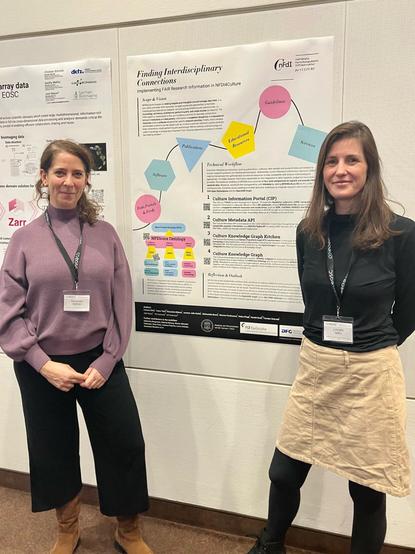
🤩 NFDI4Culture is currently represented at the EOSC Symposium 2024 (https://eosc.eu/symposium2024/) in Berlin with a joint poster by #adwmainz and #fizkarlsruhe on the topic
📄 ‘Finding interdisciplinary connections - Implementing FAIR research information in NFDI4Culture’.

#NFDIrocks #NFDIcore @NFDI #EOSC #EOSCSymposium2024 #NFDI #NFDI4Culture #fizkarlsruhe #adwmainz @fiz_karlsruhe #CultureInformationPortal @lysander07 @tabea @sourisnumerique @jonatan @epoz @fiz_karlsruhe @heikef

^gp (AB)

EOSC Symposium 2024: Berlin - EOSC Association

Online participation is still open, but in-person attendance is sold out and the waiting list is closed.

EOSC Association

Team KnowledgeGraph after a very successful and productive NFDI4Culture workshop at a very nice vegan dinner place. Always happy to have our colleagues from Akademie der Wissenschaften und Literatur Mainz visiting us in Karlsruhe!

#knowledgegraphs #ontologies #semanticweb #NFDIrocks #NFDIcore @NFDI @nfdi4culture @lysander07 @tabea @sourisnumerique @jonatan @epoz @fiz_karlsruhe @heikef @NFDI4Memory @NFDI4DS @GenAsefa @enorouzi

Erkältungsbedingt nehme ich heute nur virtuell am NFDI-Slot bei der #JahrestagungderAltertumsverbände teil. Gerade stellt @pvonrummel den #Helpdesk, die neue #Webseite/das Portal sowie den #Incubator vor, die auch schon Anschluss an den #nfdicore bieten. Wir freuen uns immer über Anfragen an den Helpdesk und den Austausch mit der #Community. :) @nfdi4objects #nfdirocks #fdm #n4OgoesVA24 #NFDI