 quackademic
Why has this not been fixed yet? Cruelty for profit shames us all.
#RoboDebt #welfare #MutualObligation #punishment #profit #politics #governance #AusPol
Why has this not been fixed yet? Cruelty for profit shames us all.
#RoboDebt #welfare #MutualObligation #punishment #profit #politics #governance #AusPol
These systems are gratuitously cruel. They generate political capital by positioning people who receive benefits as ‘not like us’ & have become a cash cow for providers administering these routines of fatuous make work.
These systems serve the interests of those who profit from them. Including those who seek to increase division & mistrust in our communities.
The role of the #police is protecting #capitalism
December 9, 2014
Excerpt [long]: "In England and the United States, the police were invented within the space of just a few decades—roughly from 1825 to 1855.
"The new institution was not a response to an increase in crime, and it really didn’t lead to new methods for dealing with crime. The most common way for authorities to solve a crime, before and since the invention of police, has been for someone to tell them who did it.
"Besides, crime has to do with the acts of individuals, and the ruling elites who invented the police were responding to challenges posed by collective action. To put it in a nutshell: The authorities created the police in response to large, defiant crowds. That’s
— strikes in England,
— riots in the Northern US,
— and the threat of slave insurrections in the South.
"So the police are a response to crowds, not to crime.
"I will be focusing a lot on who these crowds were, how they became such a challenge. We’ll see that one difficulty for the rulers, besides the growth of social polarization in the cities, was the breakdown of old methods of personal supervision of the working population. In these decades, the state stepped in to fill the social breach.
"We’ll see that, in the North, the invention of the police was just one part of a state effort to manage and shape the workforce on a day-to-day basis. Governments also expanded their systems of poor relief in order to regulate the labor market, and they developed the system of public education to regulate workers’ minds. I will connect those points to police work later on, but mostly I’ll be focusing on how the police developed in London, New York, Charleston (South Carolina), and Philadelphia.
* * * * *
"To get a sense of what’s special about modern police, it will help to talk about the situation when capitalism was just beginning. Specifically, let’s consider the market towns of the late medieval period, about 1,000 years ago.
"The dominant class of the time wasn’t in the towns. The feudal landholders were based in the countryside. They didn’t have cops. They could pull together armed forces to terrorize the serfs—who were semi-slaves—or they could fight against other nobles. But these forces were not professional or full-time.
"The population of the towns was mostly serfs who had bought their freedom, or simply escaped from their masters. They were known as bourgeois, which means town-dweller. The bourgeoisie pioneered economic relations that later became known as capitalism.
"For the purposes of our discussion, let’s say that a capitalist is somebody who uses money to make more money. At the beginning, the dominant capitalists were merchants. A merchant takes money to buy goods in order to sell them for more money. There are also capitalists who deal only with money—bankers—who lend out a certain amount in order to get more back.
"You could also be a craftsman who buys materials and makes something like shoes in order to sell them for more money. In the guild system, a master craftsman would work alongside and supervise journeymen and apprentices. The masters were profiting from their work, so there was exploitation going on, but the journeymen and apprentices had reasonable hopes of becoming masters themselves eventually. So class relations in the towns were quite fluid, especially in comparison to the relation between noble and serf. Besides, the guilds operated in ways that put some limits on exploitation, so it was the merchants who really accumulated capital at that time.
"In France, in the 11th and 12th centuries, these towns became known as communes. They incorporated into communes under various conditions, sometimes with the permission of a feudal lord, but in general they were seen as self-governing entities or even city-states.
"But they didn’t have cops. They had their own courts—and small armed forces made up of the townsmen themselves. These forces generally had nothing to do with bringing people up on charges. If you got robbed or assaulted, or were cheated in a business deal, then you, the citizen, would press the charges.
"One example of this do-it-yourself justice, a method that lasted for centuries, was known as the hue and cry. If you were in a marketplace and you saw somebody stealing, you were supposed to yell and scream, saying 'Stop, thief!' and chase after the thief. The rest of the deal was that anybody who saw you do this was supposed to add to the hue and cry and also run after the thief.
"The towns didn’t need cops because they had a high degree of #SocialEquality, which gave people a sense of mutual obligation. Over the years, class conflicts did intensify within the towns, but even so, the towns held together—through a common antagonism to the power of the nobles and through continued bonds of mutual obligation."
Read more:
https://socialistworker.org/blog/critical-reading/2014/12/09/main-role-police-protecting-ca
#Capitalism #WePoliceOurselves #ACAB #MutualObligation #MutualAid #Confederacy #SlaveOwners #WhiteSupremacy #WhiteSupremacists
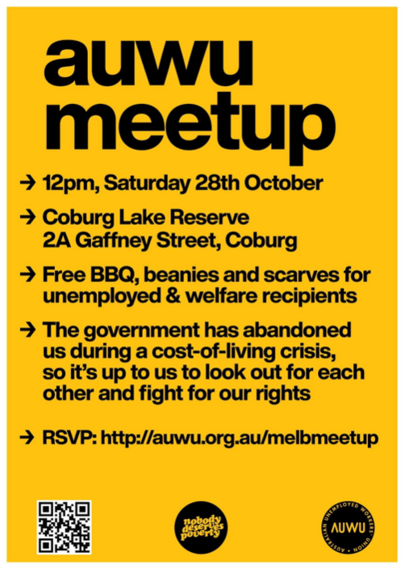
In late November 2023 a damning review of the #WorkforceAustralia system said the decades-long full #privatisation of Australia’s employment services system had failed. But the committee shied away from abolishing #mutualobligation
https://www.auwu.org.au/
#AUWU Australian Unemployed Workers Union #JobSeeker
#mutualobligation system enforced by privatised #jobagencies
#centrelink #centrestink #jobseeker #ServicesAustralia
Australian Unemployed Workers #Union #AUWU
"Coles staff to wear body cameras in supermarkets to combat theft and violence"
How about #raisetherate? The biggest drive of all this is poverty. Abolish #MutualObligation and other punitive suspensions of payments. Seriously, this means revamping the safety net from cradle to workforce and renationalising and reforming employment services.

 DoomsdaysCW
 Peter Riley
 Noel Kelly