T.A.E.’s (The Adaptable Educator) Book Review – Refuse to Choose: Use All of Your Interests, Passions, and Hobbies to Create the Life and Career of Your Dreams by Barbara Sher
Barbara Sher’s Refuse to Choose is less a self-help manual than a quiet rebellion against one of modern life’s most persistent moral fictions: that a meaningful person must become one thing, permanently, and then remain legible to everyone else. Her central argument is generous and radical. She refuses to treat curiosity as a flaw, breadth as indecision, or changing interests as failure. Instead, she offers a new identity for the wide-minded reader: the “scanner,” a person whose life is not diminished by many passions but enlarged by them.
What gives the book its force is the way it transforms what is often narrated as anxiety into vocation. The author writes for the reader who has been told, repeatedly, that too many interests mean too little discipline. Rather than pathologize this condition, she reinterprets it as a distinctive temperament with its own rhythms, needs, and forms of excellence. Her style is practical, but the underlying philosophical move is deeply humane: she asks us to stop shaming complexity. In this sense, Refuse to Choose is not only about career design; it is about self-recognition.
One of the book’s strongest achievements is its redefinition of productivity. It does not equate productivity with narrow specialization or relentless linear progress. It imagines a life organized around cycles, rotation, and creative abundance. The advice given often resembles an architecture of permission: make room for multiple “lives,” store interests without forcing immediate commitment, and treat unfinished fascinations not as debris but as a resource. The title itself is an argument. To “refuse to choose” is not merely to procrastinate; it is to reject a false binary between depth and diversity.
A particularly memorable aspect of the book is Sher’s use of reassuring, almost manifesto-like language. She repeatedly invites the reader to see themselves as legitimate rather than defective. Phrases such as “scanner” and “multiple interests” become acts of reclamation. The book’s tone is often that of a patient ally leaning across the table and saying, in effect, that your pattern is real, and it has a shape. That rhetorical kindness is one reason the book has endured. It does not merely advise; it dignifies.
At the same time, Sher is at her best when she pairs affirmation with structure. The book avoids becoming a celebration of scatter by offering practical strategies: lists, systems for idea-keeping, project rotation, and ways to create a “control room” for one’s interests. These frameworks matter because they keep the book from collapsing into sentiment. The author understands that freedom without design can become chaos. Her insight is that multi-passionate people do not need fewer interests; they need better containers.
Literarily, the book has a conversational clarity that suits its purpose. It is not ornate, and it does not need to be. Its plainspoken voice is part of its ethical appeal. Sher is writing against cultural contempt, so she chooses accessibility over prestige. The result is a text that feels invitational rather than performative. Its power comes from recognition, not display.
Still, the book is not without limitations. At times, its optimism can feel a little too seamless, as though the mere acceptance of one’s interests will solve the material constraints of time, money, labor, and care. Some readers may also wish for a more rigorous discussion of structural conditions: class, disability, family obligations, and the unequal freedom to experiment. Sher is strongest on identity and motivation; she is less attentive to the social systems that shape who gets to “refuse to choose” safely. Even so, this is a limitation of emphasis rather than of value.
Ultimately, Refuse to Choose is persuasive because it articulates a moral permission many readers have been waiting for all their lives. Its deepest claim is not simply that you can have many interests, but that your many interests may themselves be the pattern. That insight can feel liberating, even restorative. Sher offers not a grand theory of mastery, but a more tender and perhaps more realistic vision: a life composed of recurring enthusiasms, unfinished questions, and the courage to belong to one’s own complexity.
In the end, the book’s most memorable gift is its refusal of shame. It tells the restless, the multi-obsessed, the beautifully distracted: you are not unfinished. You are plural.
#BarbaraSher #BookReviews #interests #LiteraryCriticism #Mindset #Multidisciplinary #multipotentialite #Sher José - Luis Gutiérrez Villanue

 🐦🔥nemo™🐦⬛ 🇺🇦🍉
 Matteo Cesari
 offbeat amsterdam
 The New Renaissance Mindset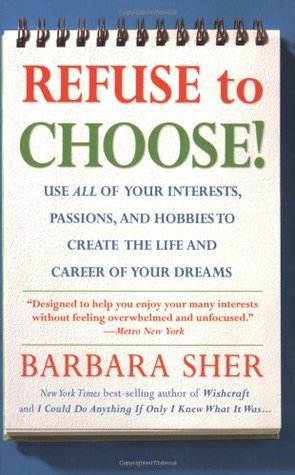
 Korawich Kavee
 Ecology & Evolution of Health
 Reel Tubes
 💧🌏 Greg Cocks



 ICalzada