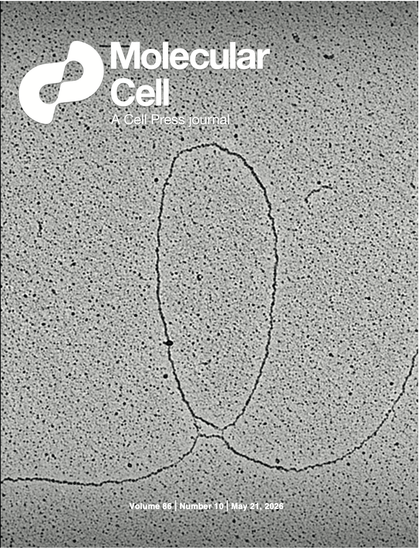
Bacteria possess unique traits with great potential for benefiting society. However, current genetic engineering methods to harness them are limited to a small fraction of bacteria. A team led by #HIRI has introduced an approach that can make more bacteria amenable to genetic engineering. The method, called IMPRINT, uses cell-free systems to enhance #DNA transformation across various bacterial strains. 🦠🧬 The findings were published in #MolecularCell: https://www.helmholtz-hiri.de/en/newsroom/news/detail/news/unlocking-the-world-of-bacteria/
Unlocking the world of bacteria

HIRI researchers introduce novel approach to DNA transformation and genetic mutation of bacteria

Helmholtz Institute for RNA-based Infection Research
Listen up, #CRISPR Fan(zor)atics! ✂️🧬 In a new #MolecularCell spotlight, Costas Patinios, a postdoc in #HIRI’s Beisel lab, recaps Feng Zhang's recent remarkable discovery describing eukaryotic #RNA-guided DNA endonucleases, called Fanzors. Read more here: https://authors.elsevier.com/a/1hjJC_OylrlCTl
bioRxiv cell biology (@[email protected])

📰 "A special envelope separates extra-chromosomal from chromosomal DNA in the cytoplasm of mammalian cells" by 🔬 Schenkel, L., Wang, X., Le, N., Burger, M., Kroschewski, R. #bioRxiv #cellbiology http://biorxiv.org/cgi/content/short/2023.03.02.530628v1?rss=1

botsin.space
Beautiful work.
---
RT @BeckmannLab
Check our most recent work in collaboration with the amazing @inada_lab. The study unveils the molecular basis of eIF5A-dependent CAT tailing in eukaryotic ribosome-associated quality control. #ribosome #cryoEM #MolecularCell Here's a thread with the most exciting findings🧵...
https://twitter.com/BeckmannLab/status/1626536169642110976
Beckmann Lab on Twitter

“Check our most recent work in collaboration with the amazing @inada_lab. The study unveils the molecular basis of eIF5A-dependent CAT tailing in eukaryotic ribosome-associated quality control. #ribosome #cryoEM #MolecularCell Here's a thread with the most exciting findings🧵...”

Twitter

Reading about nonsense-mediated altered splicing. The original papers describing this phenomenon were published in #Science and #MolecularCell in 2002. Evidence that this phenomenon was probably not real was published in 2005 in #RNA.

This pattern is not exceptional. Who still remembers the claims published in #Science that #translation was nuclear ?